
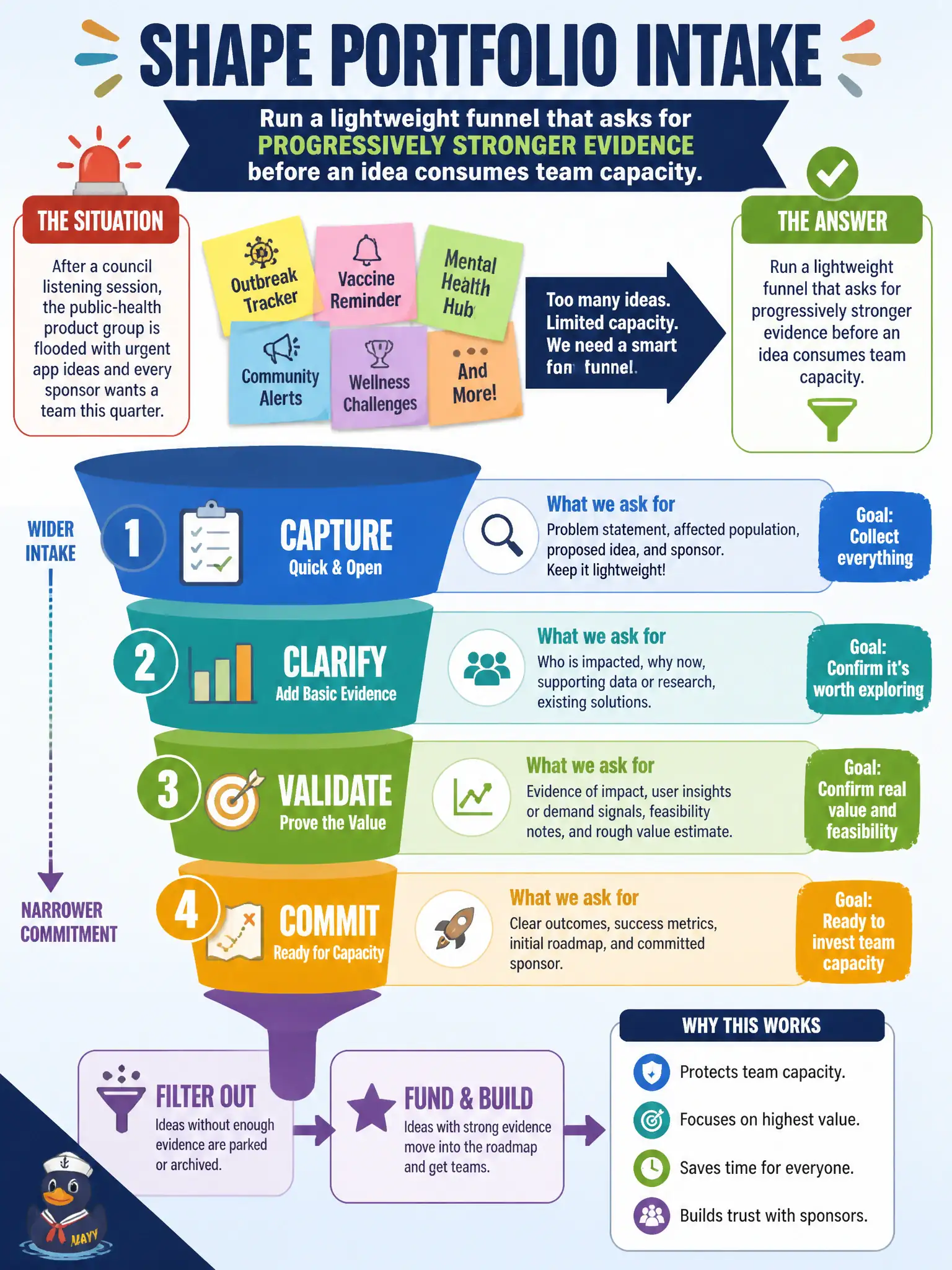
After a council listening session, the public-health product group is flooded with urgent app ideas and every sponsor wants a team this quarter. How should the Product Owner shape portfolio intake?
Select an answer to reveal the explanation.
Short Explanation
Think of a nightclub with a rope, not a warehouse with an open loading dock. Health-app ideas are cheap; staffed Sprints are not. A funnel that asks for a little more proof at each gate keeps the portfolio from drowning in untested work.
Full Explanation
Portfolio intake should not treat every request as committed work after a council listening session floods public health with urgent app ideas. Evidence gates—problem evidence, then a cheap experiment, then a funded product bet—raise the bar as the cost of capacity rises. The Product Owner should run a lightweight funnel that asks for progressively stronger evidence before an idea consumes team capacity. Dumping every idea onto one backlog hides opportunity cost; freezing intake until next budget year ignores real Unrealized Value; last-speaker ranking substitutes politics for empiricism.
Accepting every idea onto a citywide Product Backlog fails by pretending nothing can be politically dropped and drowning capacity. Freezing intake until next year’s budget fails by blocking legitimate new evidence of unmet health needs. Ranking ideas by which department director spoke last fails because speaking order is not value evidence.
Exam caveat: Intake funnels raise the evidence bar as capacity cost rises; they do not auto-commit every idea. Operational check: Publish a three-gate health-portfolio funnel (problem evidence → experiment → funded bet) and require sponsors to clear the first gate before any Scrum Team capacity is reserved.