
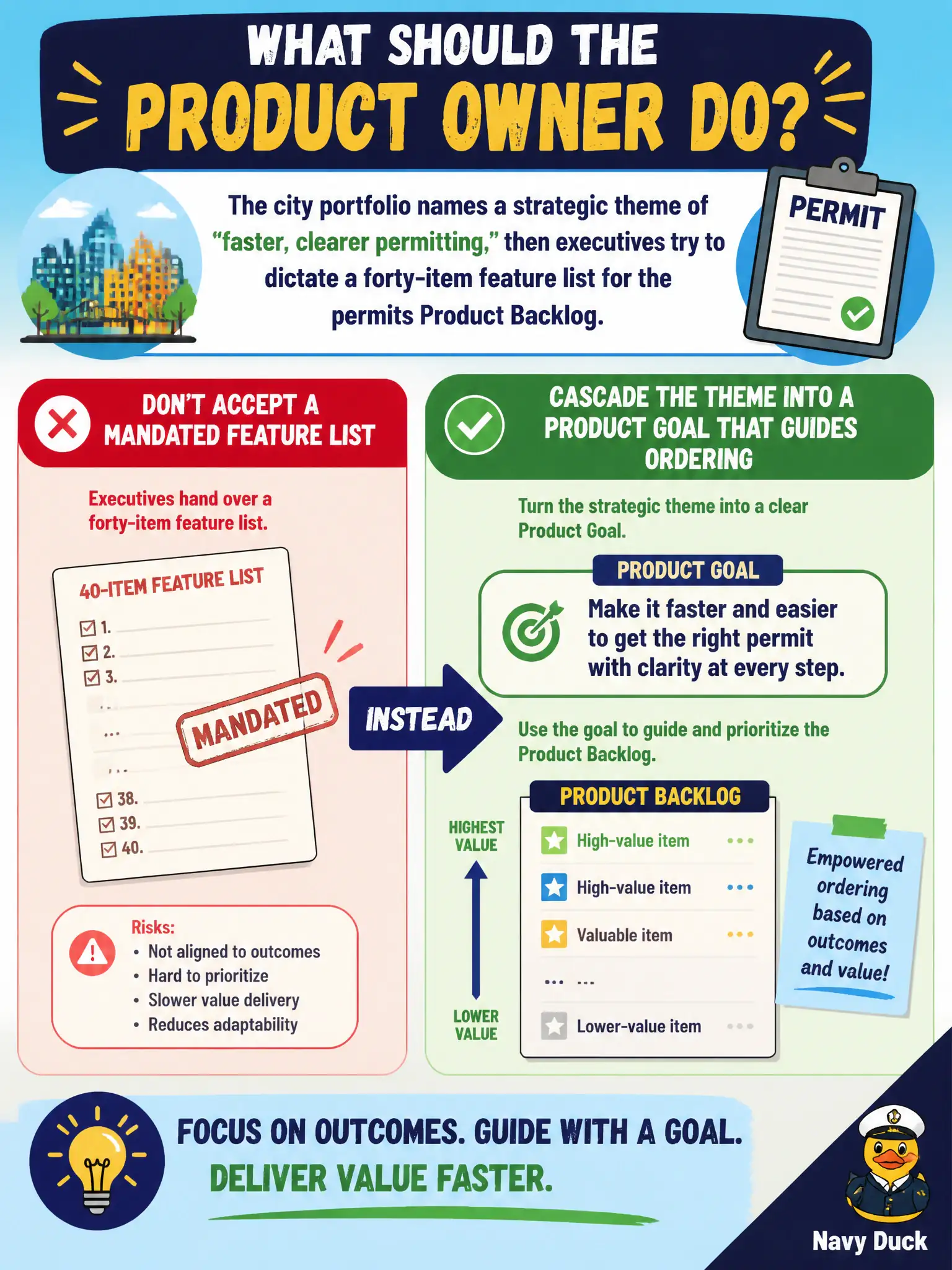
The city portfolio names a strategic theme of faster, clearer permitting, then executives try to dictate a forty-item feature list for the permits Product Backlog. What should the Product Owner do?
Select an answer to reveal the explanation.
Short Explanation
A theme like faster, clearer permitting is a north star, not a shopping list of forty widgets. Turn it into a Product Goal that can steer the backlog, and keep the feature catalog off the mandate pile. Strategy should aim the product, not micromanage every permit screen.
Full Explanation
Portfolio strategic themes should cascade into Product Goals that give the Product Owner a clear aim while preserving backlog-ordering accountability. When the city names faster, clearer permitting as a strategic theme, then executives try to dictate a forty-item feature list, a mandated feature catalog pretends discovery is finished and turns empiricism into compliance. The Product Owner should cascade the theme into a Product Goal that guides ordering without accepting a mandated feature list. Ignoring strategy entirely is the opposite error: products still need to connect to city outcomes.
Replacing the Product Goal with the forty-item list as the new commitment fails by converting strategy into a feature mandate. Ignoring the strategic theme because Product Goals must be invented only inside the Scrum Team with no portfolio input fails by disconnecting the product from city outcomes. Asking a PMO to write a year of Sprint Goals from the feature list fails by removing empirical Sprint planning.
Exam caveat: Strategy becomes a Product Goal that steers ordering; it is not a mandated feature shopping list. Operational check: Rewrite the permits Product Goal from the “faster, clearer permitting” theme, publish how near-term backlog order serves that goal, and reject the forty-item list as a binding commitment.