
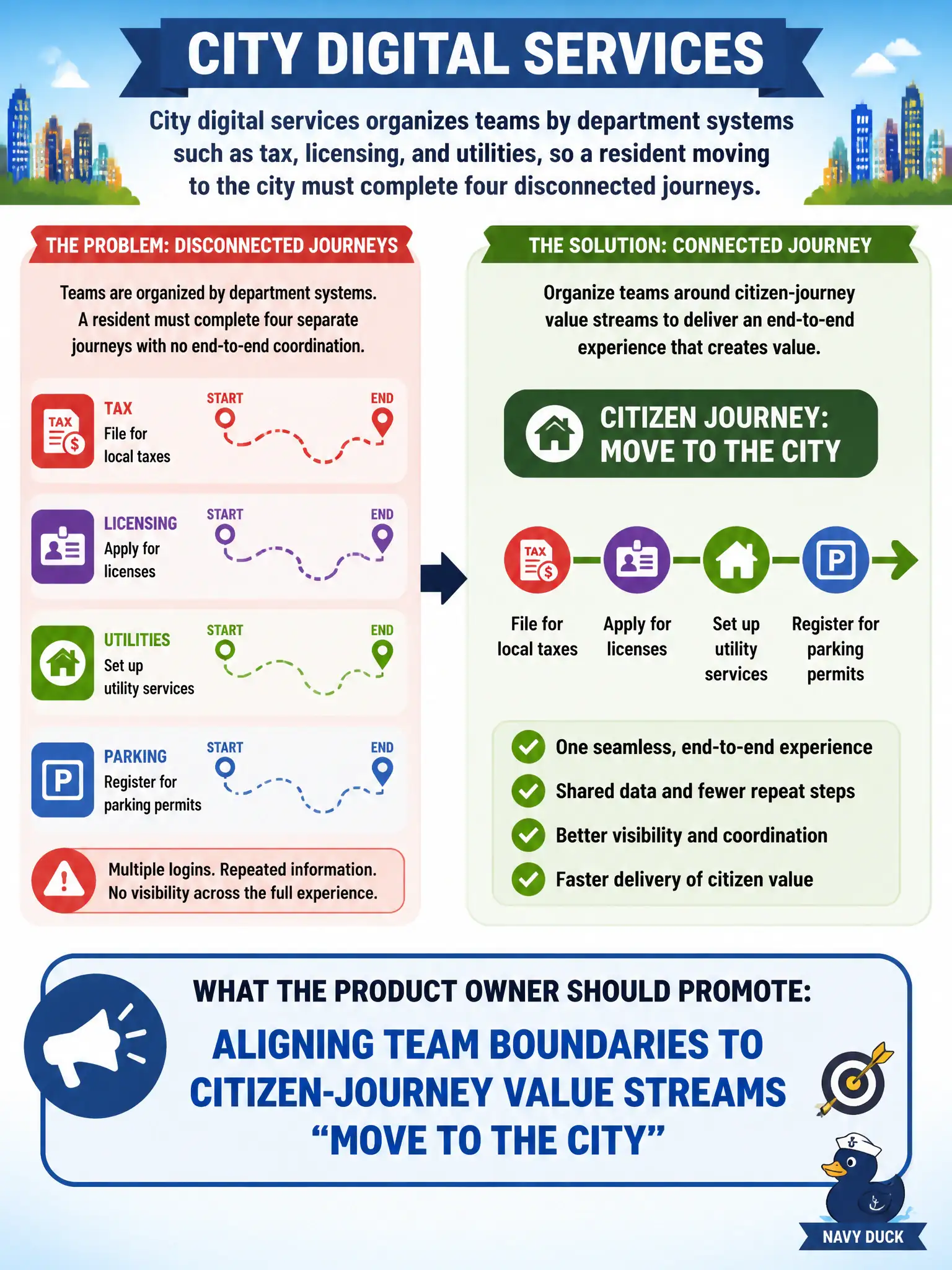
City digital services organizes teams by department systems such as tax, licensing, and utilities, so a resident moving to the city must complete four disconnected journeys. What should the Product Owner promote?
Select an answer to reveal the explanation.
Short Explanation
Residents do not experience “the tax system” and “the licensing system.” They experience moving to the city, and the org chart currently chops that journey into four queues. Align teams to the citizen value stream so one product effort can finish the move, not the department’s database.
Full Explanation
Team boundaries that mirror internal department systems force Product Owners to coordinate handoffs across a citizen journey. When city digital services organizes teams by tax, licensing, and utilities systems, a resident moving to the city must complete four disconnected journeys. Value-stream alignment—such as a “move to the city” journey—lets a cross-functional team deliver a coherent Increment of resident value. Organizational design should follow how citizens experience outcomes, not how departments store records or draw budget lines on an org chart.
Keeping department-system teams and adding a liaison committee fails by coordinating fragmentation instead of finishing the journey. A component-team model keyed to each legacy database fails by encoding systems over outcomes. Outsourcing each department system to a different vendor fails by increasing specialization walls around the same broken resident journey and multiplying handoffs.
Exam caveat: Align teams to citizen-journey value streams, not to internal system ownership charts. Operational check: Pilot a “move to the city” value-stream team spanning the handoffs a new resident faces, and measure end-to-end completion time versus the four-queue baseline.