
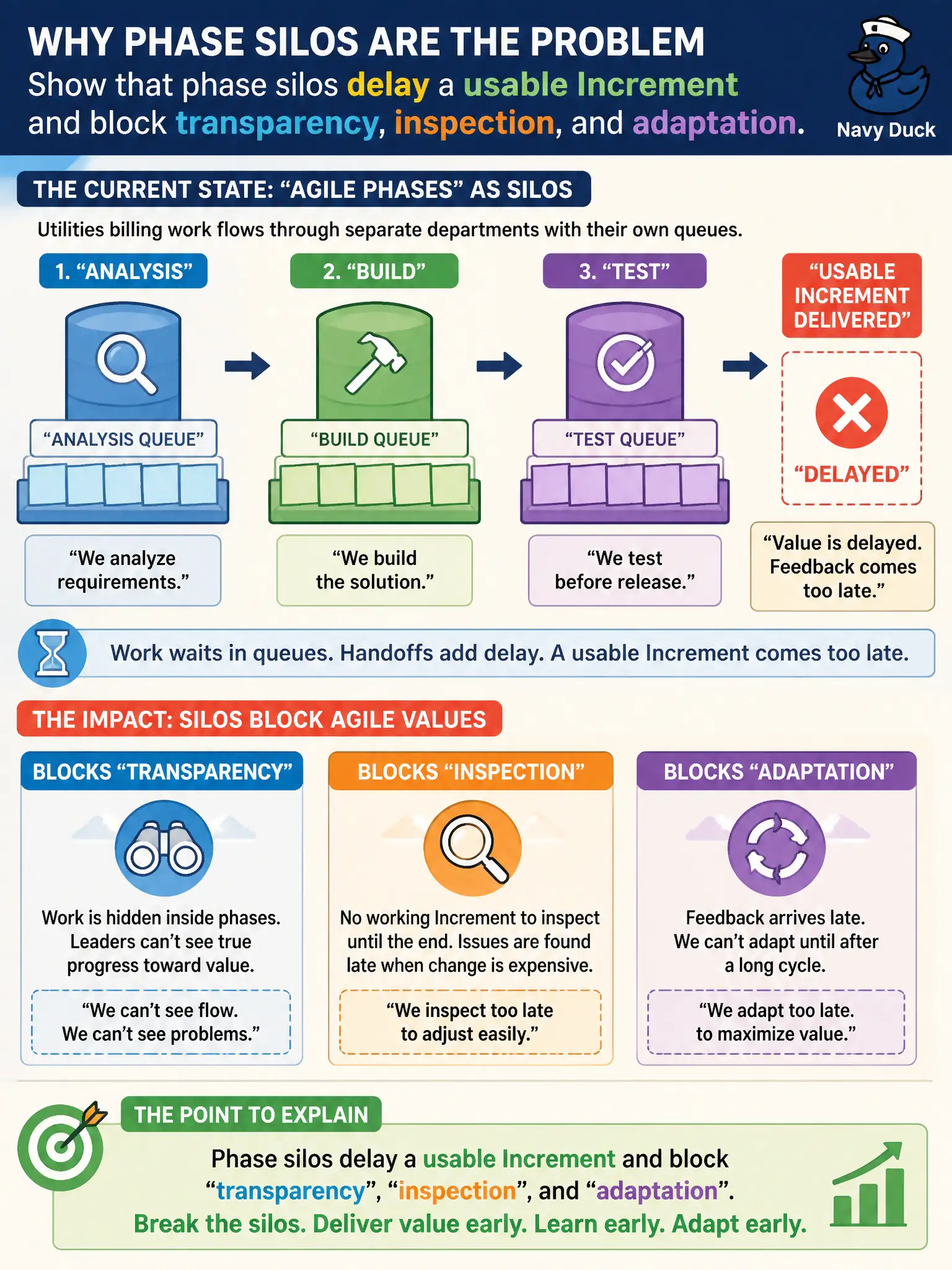
Utilities billing work still flows through separate analysis, build, and test departments, each with its own queue. Leaders call the stages “Agile phases.” How should the Product Owner explain the problem?
Select an answer to reveal the explanation.
Short Explanation
If analysis, build, and test still live in three buildings, you just painted a waterfall blue. Empiricism needs a Done slice you can poke this Sprint, not a relay that finishes next winter. Phases with story points are still phases.
Full Explanation
Empiricism depends on producing a transparent, Done Increment frequently enough to inspect and adapt. When utilities billing still flows through separate analysis, build, and test departments—each with its own queue—leaders may call the stages “Agile phases,” but the structure recreates waterfall delays. Sequential silos hide incomplete work, postpone learning about value, and block transparency, inspection, and adaptation. The Product Owner should explain that phase silos delay a usable Increment and harm product value and forecast quality.
Agreeing that named phases are fine if each department estimates in story points fails because points on a waterfall do not restore a Done Increment. Inserting a quarterly program increment event fails by adding commitment ceremony without removing departmental queues. Moving all testing to a year-end audit fails by making Sprint “complete” counts dishonest and delaying quality feedback.
Exam caveat: Relabeled analysis-build-test departments are still phase gates; Scrum needs a Done Increment each Sprint. Operational check: Show leadership the cycle time from analysis start to production-usable billing Increment, then propose a cross-functional team that can finish a vertical slice without three departmental queues.