
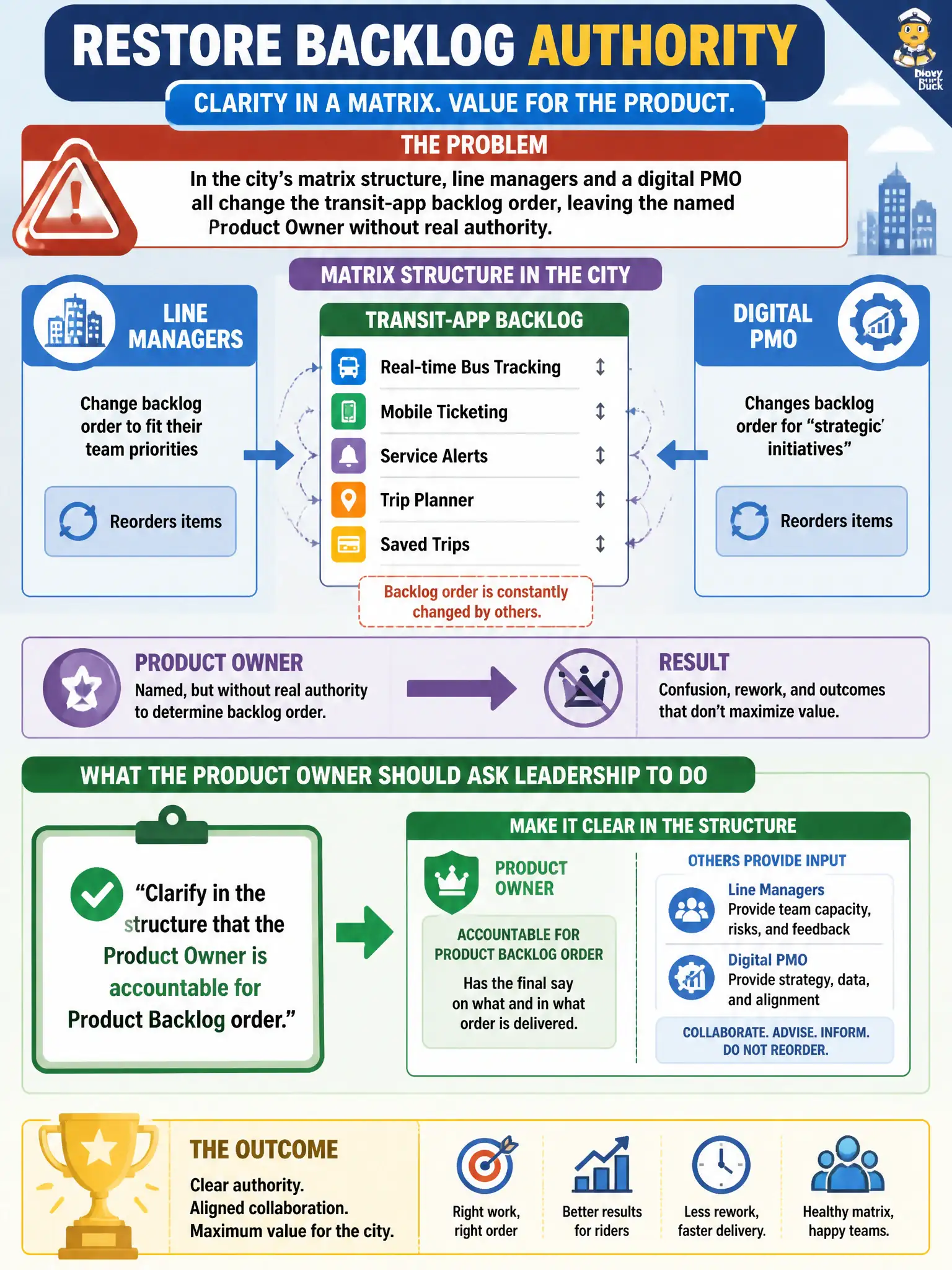
In the city’s matrix structure, line managers and a digital PMO all change the transit-app backlog order, leaving the named Product Owner without real authority. What should the Product Owner ask leadership to do?
Select an answer to reveal the explanation.
Short Explanation
A Product Owner with no ordering rights is a tour guide holding a blank map. Titles on a slide do not count; the structure has to actually let that person say what comes next. Ask leadership to fix the wiring, not to add more co-pilots.
Full Explanation
Organizational design must enable Product Owner accountability for a transit app, not merely print the title on a slide. In a city matrix where line managers and a digital PMO all change backlog order, empiricism and value maximization become political. The Product Owner should ask leadership to clarify in the structure that the Product Owner is accountable for Product Backlog order, with real authority in the operating model. Voting, PMO ownership, or multiplying Product Owners encodes the confusion rather than removing it.
Keeping the matrix as-is and facilitating a weekly manager vote fails because committee ranking is not single Product Owner accountability. Moving backlog ownership to the PMO fails by matching the org chart’s politics instead of fixing product accountability. Creating three Product Owners—one per matrix dimension—fails by guaranteeing conflicting orders.
Exam caveat: A Product Owner without real ordering authority is a label, not an accountability. Operational check: Obtain a written leadership decision that only the named Product Owner may order the transit Product Backlog, and that matrix managers submit requests through intake rather than direct reordering.