
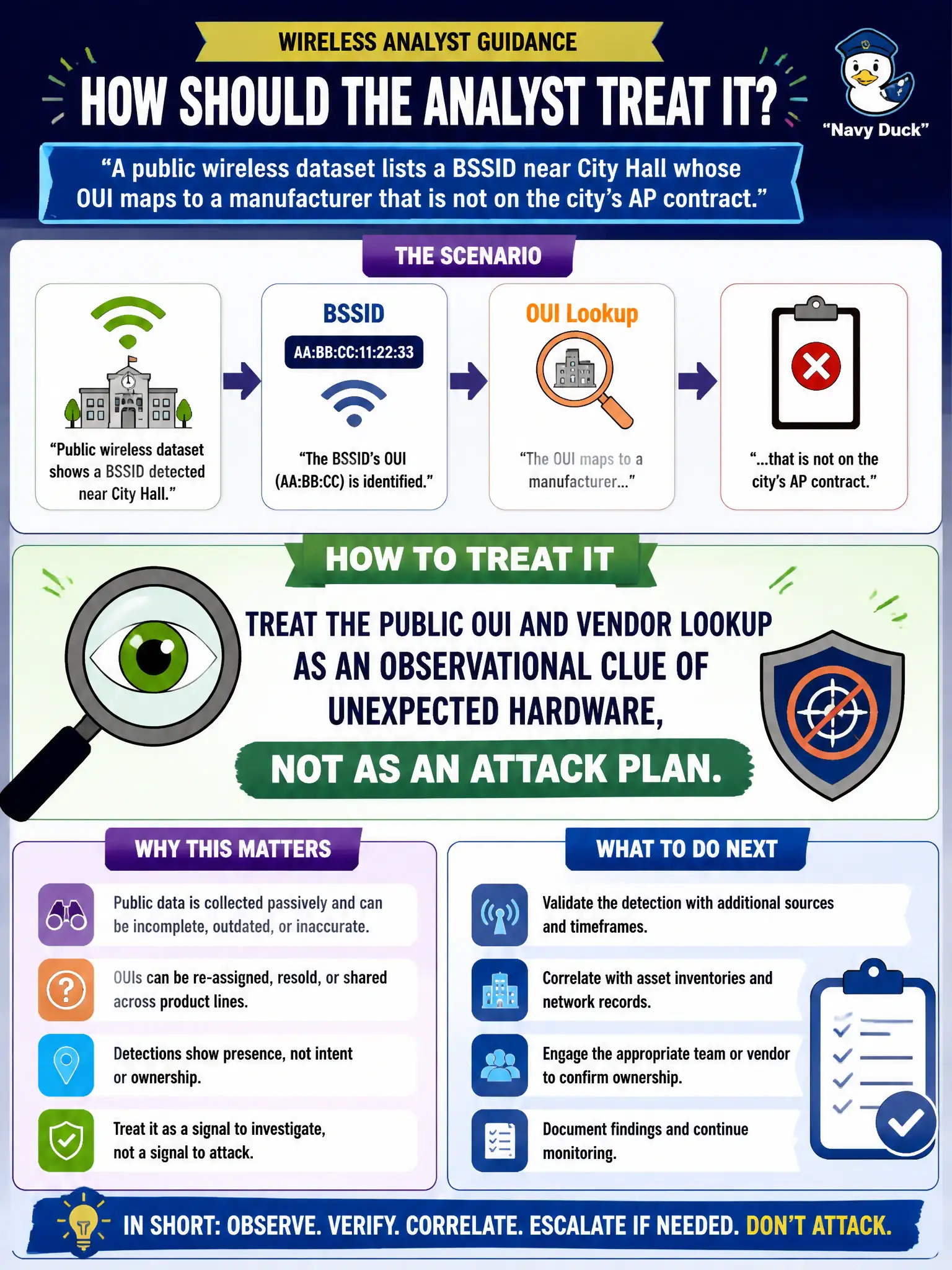
A public wireless dataset lists a BSSID near City Hall whose OUI maps to a manufacturer that is not on the city’s AP contract. How should the analyst treat that?
Select an answer to reveal the explanation.
Short Explanation
The first six of a BSSID are a maker’s badge in public datasets. If that badge is not the city’s contracted brand, flag unexpected hardware—do not declare fraud or push firmware at the AP. It is a clue, not a courtroom.
Full Explanation
Organizationally unique identifiers derived from public BSSID values can indicate manufacturer. When a public wireless dataset lists a BSSID near City Hall whose OUI maps to a manufacturer absent from the city's AP contract, the analyst should treat the OUI and vendor lookup as an observational clue of unexpected hardware—not as proof of fraud and not as a plan to modify the device. That clue helps IT ask inventory questions while staying in public-data methods.
Concluding the contract is void and the vendor committed fraud leaps from a maker badge to a legal finding. Flashing new firmware onto the access point over the air is unauthorized device modification. Ignoring OUIs because BSSID prefixes are never published is factually wrong; OUI registries are standard public references used in wireless observation.
Exam caveat: stale maps, cloned or spoofed BSSIDs, and visitor or contractor APs near City Hall can explain unexpected OUIs; leave those alternatives open unless inventory confirms otherwise.
Operational check: record BSSID, OUI lookup result, contract vendor list, map vintage, and location; label it unexpected-hardware clue; and route to IT—without fraud declarations or firmware flashes.