
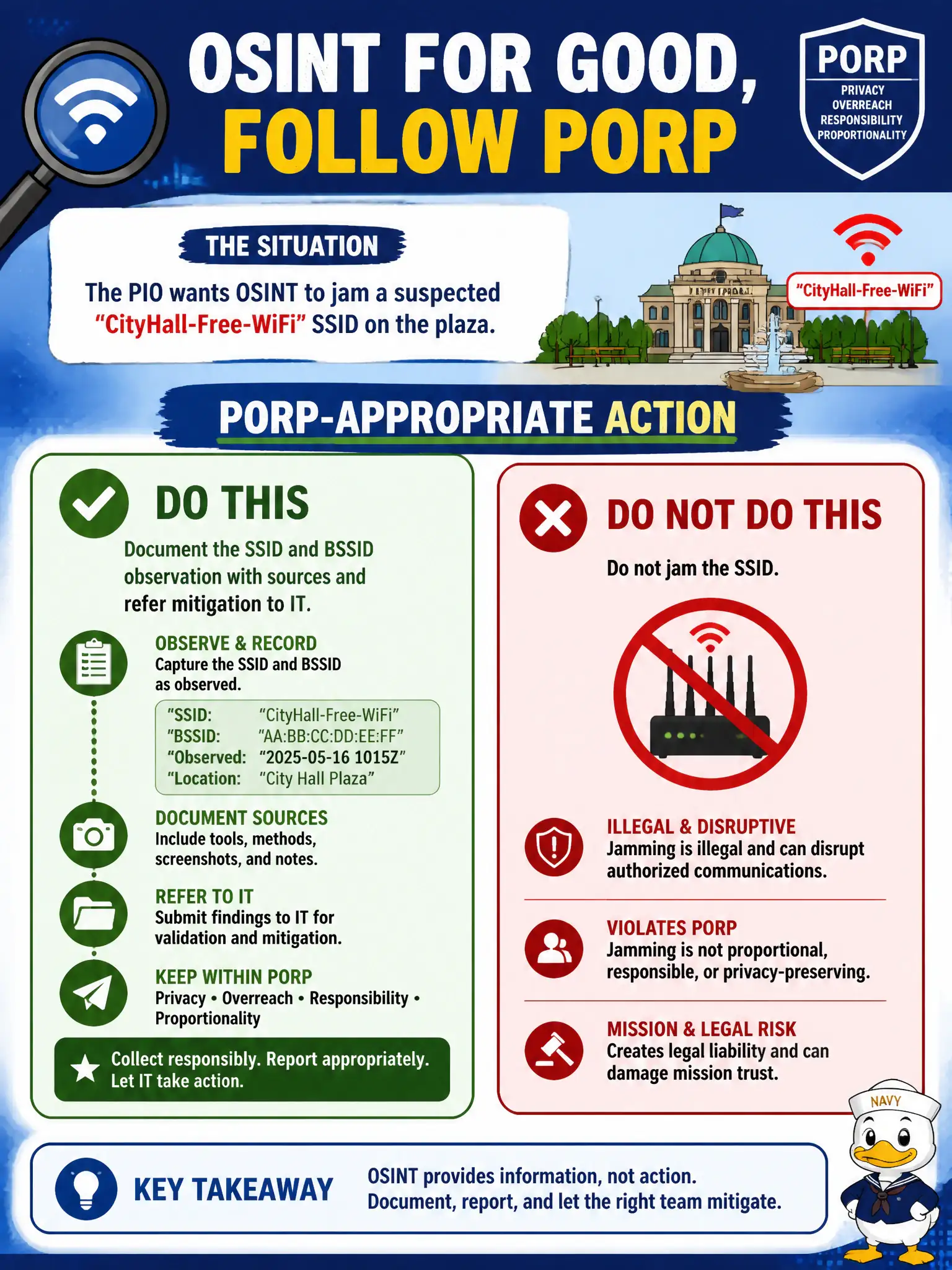
The PIO wants OSINT to jam a suspected fake “CityHall-Free-WiFi” SSID on the plaza. What is the PORP-appropriate action?
Select an answer to reveal the explanation.
Short Explanation
OSINT writes the field notes; it does not run a radio war on the plaza. Capture the SSID and BSSID, point IT at the observation, and leave the jamming gear in the closet. The research desk also does not write tickets or fines.
Full Explanation
PORP wireless work documents public observations and refers mitigation to the responsible civic IT or security function. When the PIO wants OSINT to jam a suspected fake 'CityHall-Free-WiFi' SSID on the plaza, the appropriate action is to document the SSID and BSSID observation with sources and time, then refer mitigation to IT—not to jam. Research remains observational even when the political urgency is high.
Transmitting interference until the fake SSID drops is RF jamming, typically unlawful without separate authority and outside PORP. Deploying a more powerful official access point to drown the fake one without IT still engages in RF competition and bypasses change control. Fining the suspected operator on the spot invents enforcement power the OSINT desk does not hold.
Exam caveat: documenting a look-alike SSID is not the same as proving malicious impersonation; IT may need additional confirmation before disruptive response. Urgency from communications staff does not convert OSINT into an attack team.
Operational check: capture SSID/BSSID, plaza location, and observation time with sources; send the packet to IT/security for authorized mitigation; and refuse jamming, drowning, or on-the-spot fines from the research role.