
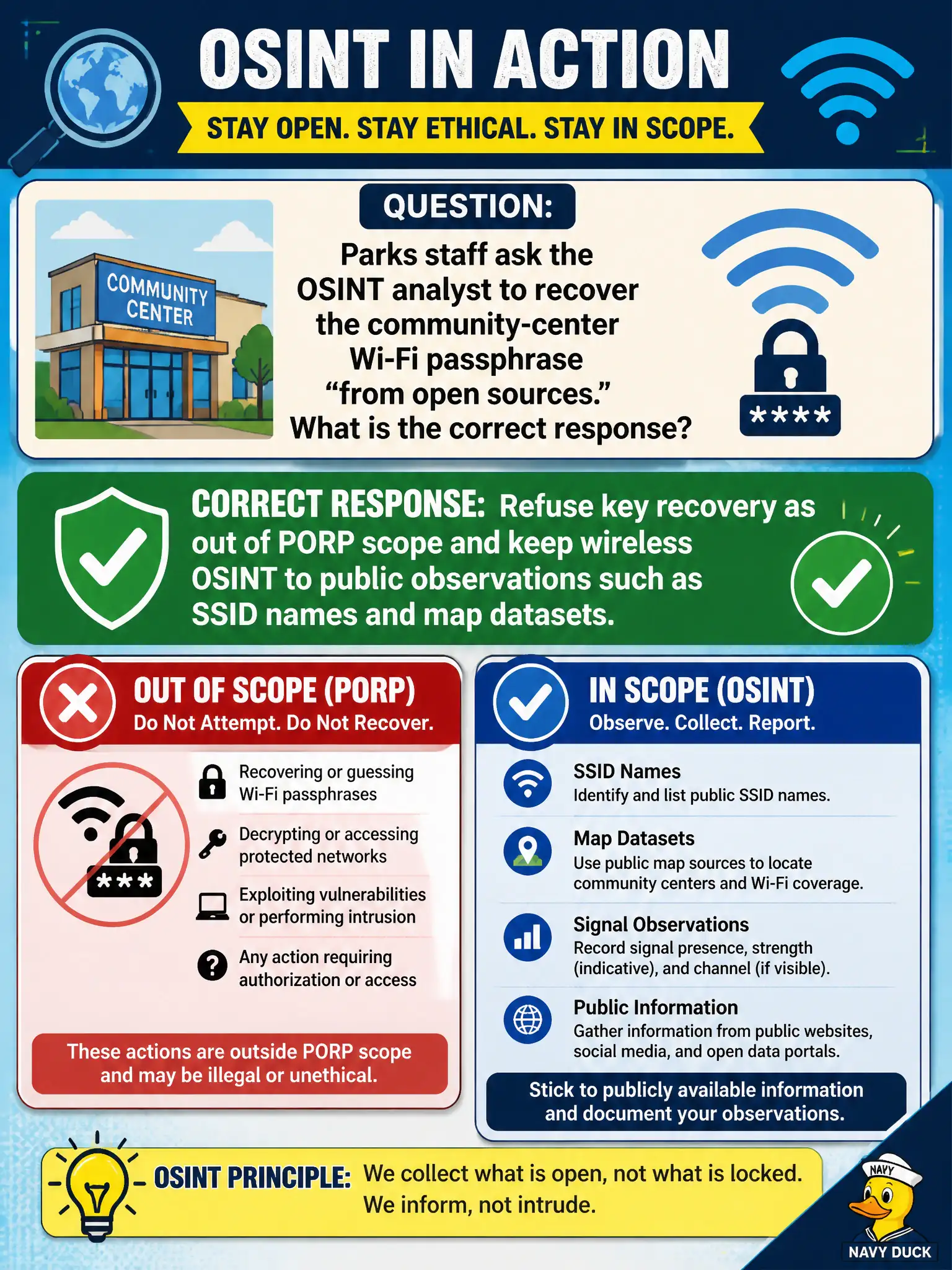
Parks staff ask the OSINT analyst to recover the community-center Wi-Fi passphrase “from open sources.” What is the correct response?
Select an answer to reveal the explanation.
Short Explanation
OSINT does not pick Wi-Fi locks, even at a rec center. If parks wants the passphrase, they ask IT—not the research desk. Stick to public names and map pins, and never toss a guessed key into Slack.
Full Explanation
PORP wireless OSINT is observation of public artifacts: SSID names, BSSID/OUI clues, and wardriving-class maps. When parks staff ask the analyst to recover the community-center Wi-Fi passphrase 'from open sources,' the correct response is to refuse key recovery as out of scope and keep work on public observations. Passphrases are credentials; cracking or guessing them is attack tradecraft even when the building is municipal and the network is labeled guest.
Running a dictionary attack because community centers are public buildings confuses public-facility status with authorization to attack cryptography. Looking up default vendor passwords and trying them on the live access point is credential spraying against a live system, not OSINT. Posting a guessed passphrase to parks Slack so staff can verify it spreads potential credentials and creates additional exposure.
Exam caveat: some default passwords appear in public manuals, but attempting them on a live civic AP crosses from reading documentation into interactive attack; obtain credentials through IT inventory and change-control instead.
Operational check: decline the key-recovery request in writing, offer SSID/map observation products if useful, and direct parks to IT for the passphrase from asset management—never Slack a guessed key.