
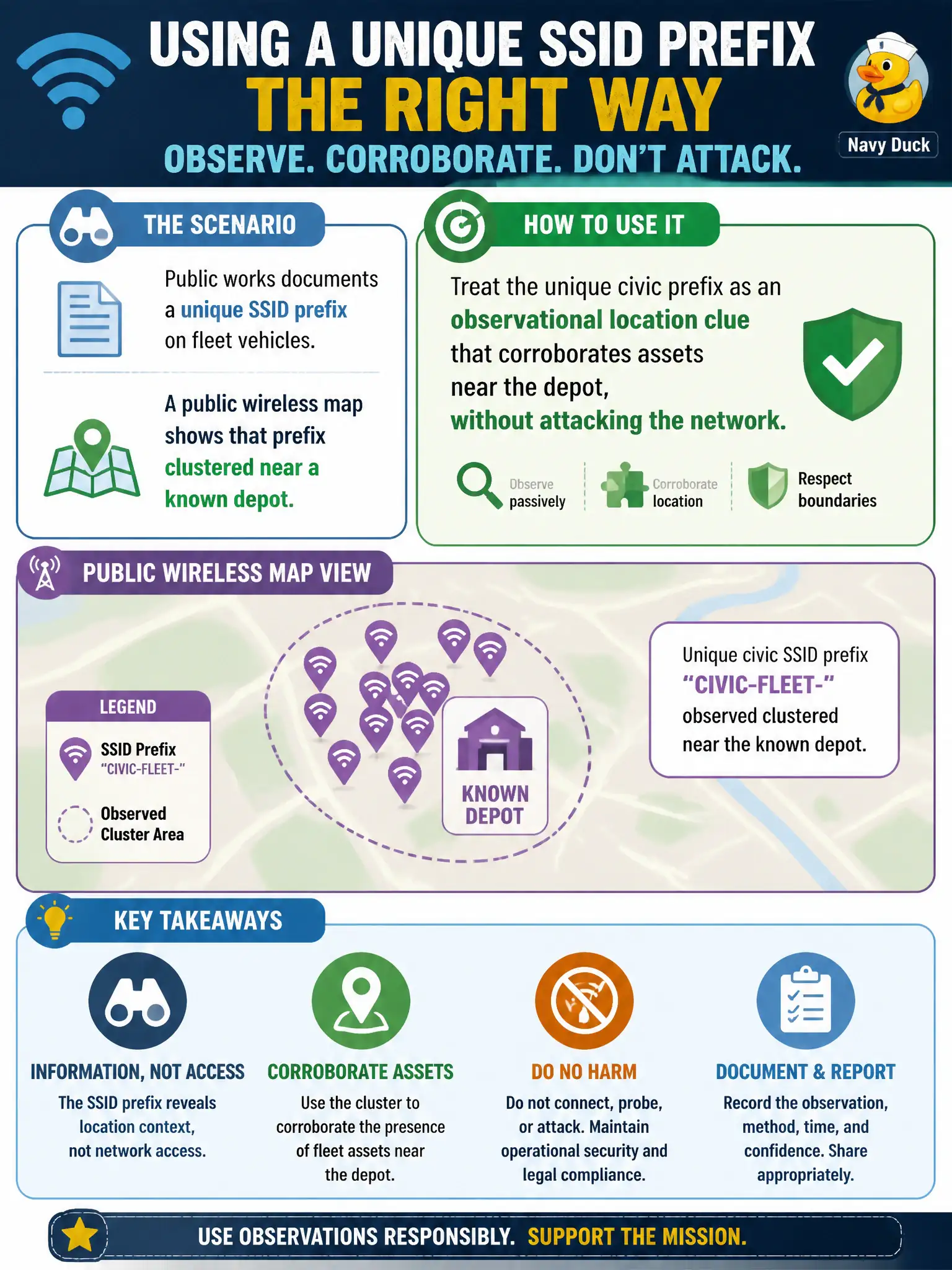
Public works documents a unique SSID prefix on fleet vehicles. A public wireless map shows that prefix clustered near a known depot. How should the analyst use it?
Select an answer to reveal the explanation.
Short Explanation
A one-of-a-kind truck SSID near the yard is like seeing the city paint job in the parking lot. It helps corroborate where assets show up on a public map. It is not a VPN door, a deauth test, or a time clock for a named driver.
Full Explanation
Documented unique SSID prefixes on fleet vehicles can serve as observational location clues when they appear in public wireless datasets. Clustering of that civic prefix near a known public-works depot corroborates that fleet-related names have been observed there. The analyst should cite the prefix, map vintage, and depot as public geographic context without attacking the network or turning the cluster into a personnel time clock.
Using the prefix as a pentest foothold to pivot into the fleet VPN converts observation into unauthorized network intrusion. Broadcasting deauthentication frames to confirm which trucks are online is an active RF attack. Treating the cluster as proof a specific named employee is at the depot right now over-attributes coarse, possibly stale map data to a person.
Exam caveat: wireless maps are coarse and dated; presence of a prefix near a depot is corroborative context for assets, not real-time proof of a named driver's location or authorization to touch the WLAN.
Operational check: export the prefix cluster with timestamps and distance to the known depot, state observational limits, and deliver to public works as a location clue—without VPN pivoting, deauth, or employee presence claims.