
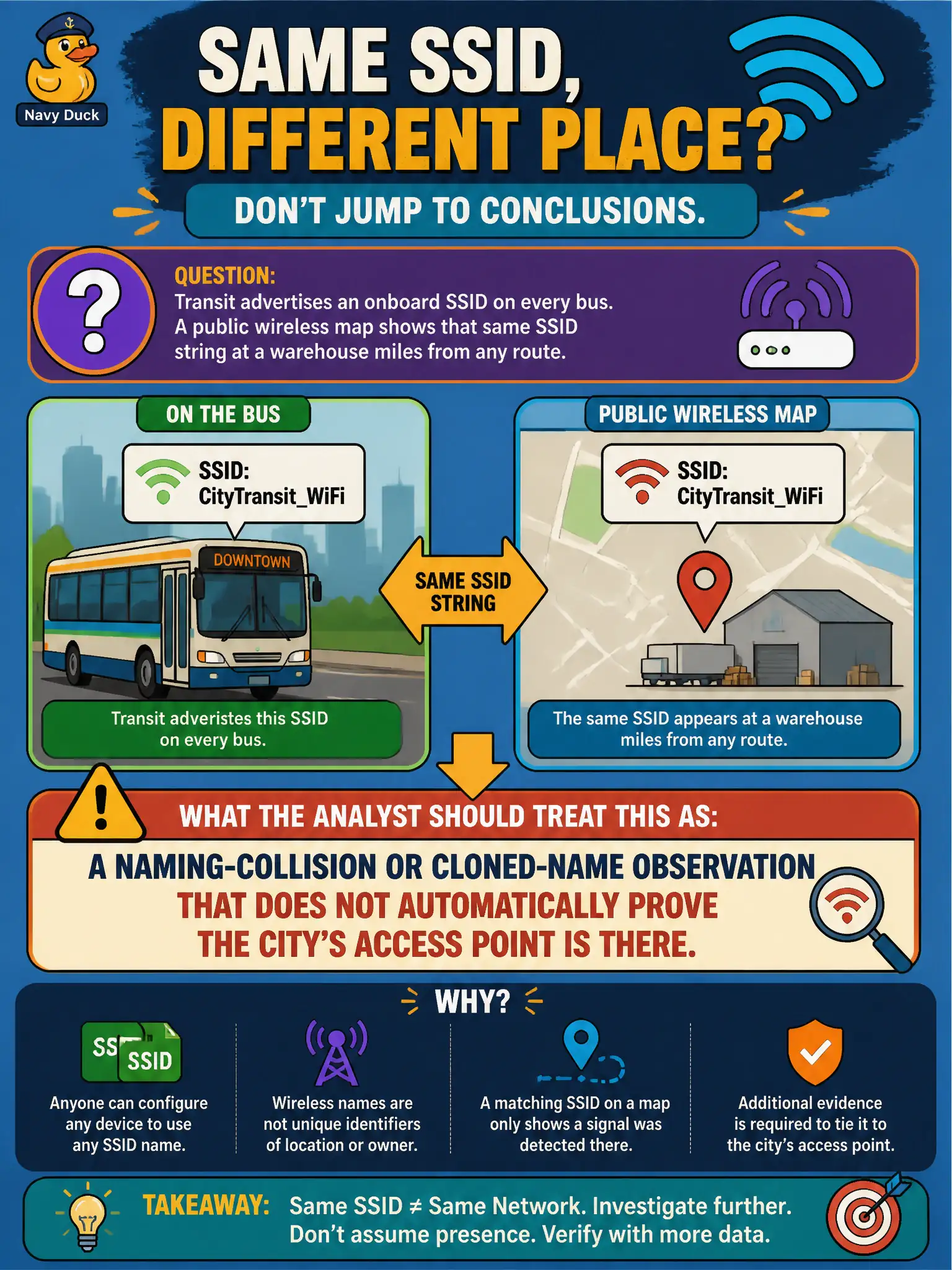
Transit advertises an onboard SSID on every bus. A public wireless map shows that same SSID string at a warehouse miles from any route. What should the analyst treat that as?
Select an answer to reveal the explanation.
Short Explanation
SSID names are like “Joe’s Coffee”—lots of shops can hang the same sign. A pin far off the bus route is a collision or clone note, not a new depot and not a remote-admin ticket. Say the string appeared there; do not crown it city property.
Full Explanation
SSID strings are not unique identifiers. When transit advertises an onboard SSID and a public wireless map shows that same string at a warehouse miles from any route, the analyst should treat the hit as a naming-collision or cloned-name observation that does not automatically prove the city's access point is there. Report the string, location, and map vintage so transit can investigate without leaping to ownership or remote administration.
Calling the warehouse an unofficial bus depot owned by transit over-claims from a name string alone. Remotely reconfiguring the warehouse access point as a transit asset is unauthorized access and attack behavior. Claiming public wireless maps never mislabel SSIDs and can be used without caveats ignores known staleness, cloning, and geolocation error in wardriving-class corpora.
Exam caveat: identical civic-looking SSIDs commonly appear from coincidence, cloning, or stale pins; further corroboration uses other public sources and IT asset lists, not RF takeover.
Operational check: cite the map pin, SSID string, distance from routes, and dataset date; label it collision/clone candidate; and ask transit IT for inventory correlation—without remote reconfiguration or depot declarations.