
A 311 photo shows a sandwich board advertising “free public Wi-Fi” with an SSID that does not match the city’s published guest network name. What is the correct first OSINT step?
Select an answer to reveal the explanation.
Short Explanation
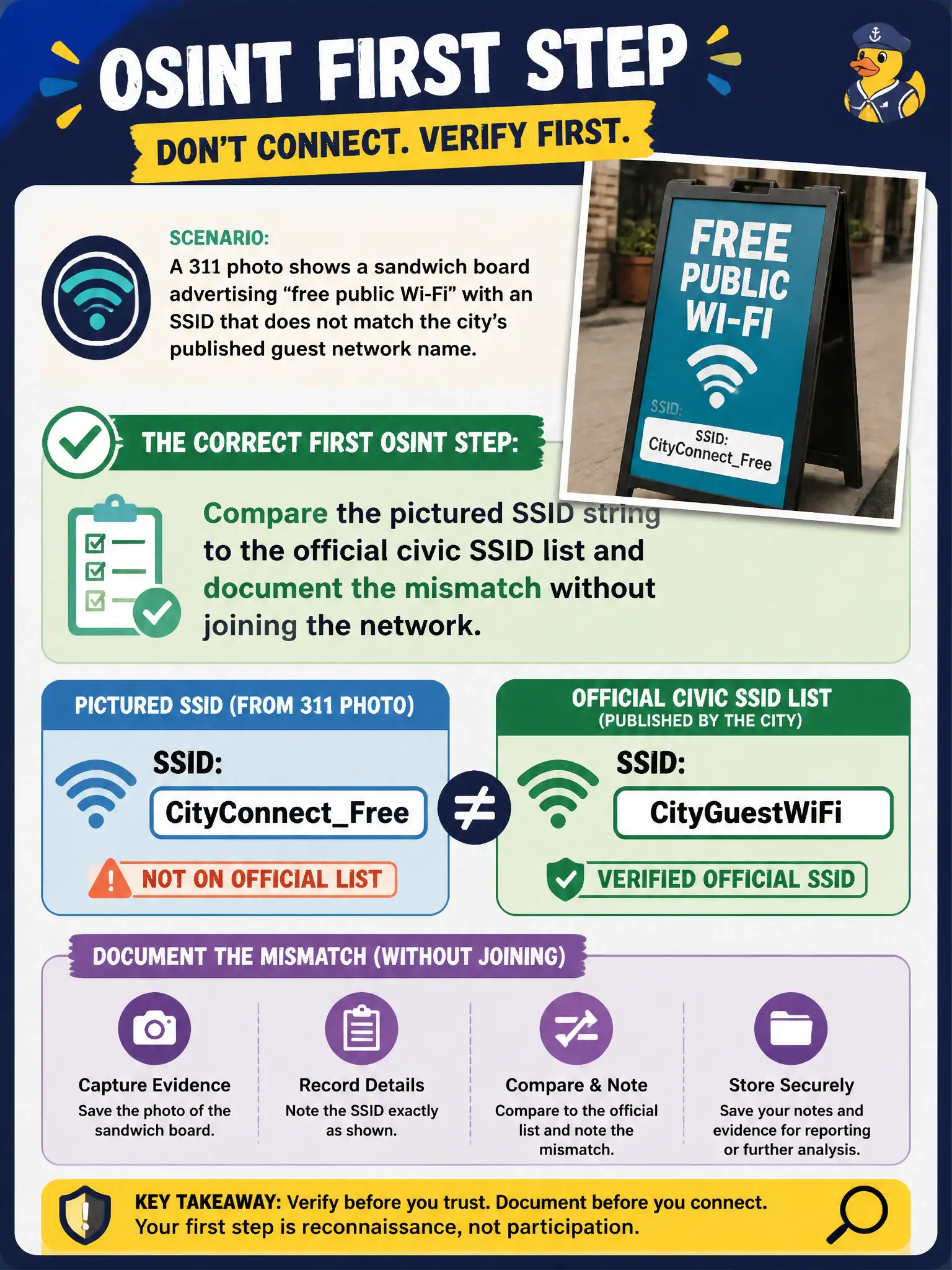
The photo already handed over the network name. Line it up next to the city’s published guest SSID and write down whether they match. No need to join, jam, or treat a sidewalk sign like a city seal.
Full Explanation
Wireless OSINT can begin from a public 311 image. When a sandwich board advertises 'free public Wi-Fi' with an SSID that does not match the city's published guest network name, the correct first step is to compare the pictured string to the official civic SSID list and document the mismatch without joining the network. That sourced observation—311 photo citation, official list citation, and retrieval dates—gives IT or the PIO a clean lead about an unofficial or look-alike name on city sidewalks.
Connecting to the advertised SSID and running an exploit against the access point is offensive testing, not PORP. Assuming the sandwich board is official because it sits on a public sidewalk confuses physical placement with network authenticity. Jamming the unknown SSID from a rooftop is RF interference and typically unlawful without separate authority.
Exam caveat: a name mismatch is an observation, not proof of malicious impersonation; vendors and events may advertise temporary SSIDs. Escalate characterization only with additional sourced context.
Operational check: save the 311 photo URL or ticket ID, quote the pictured SSID, pull the official guest-SSID list with date, write the mismatch, and refer to IT/PIO—without associating, exploiting, or jamming.