
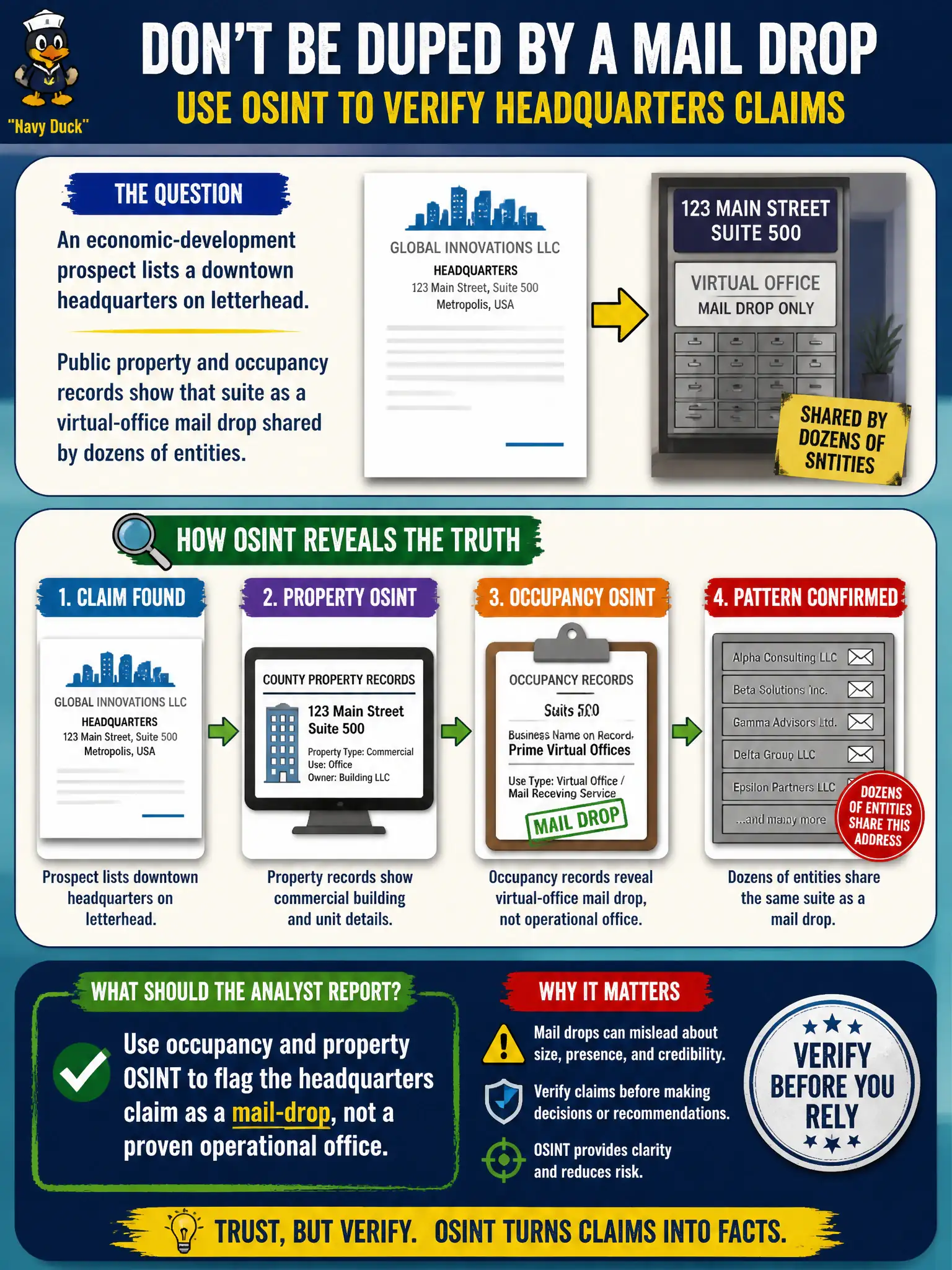
An economic-development prospect lists a downtown headquarters on letterhead. Public property and occupancy records show that suite as a virtual-office mail drop shared by dozens of entities. What should the analyst report?
Select an answer to reveal the explanation.
Short Explanation
A fancy street on the stationery can still be a mailbox farm. Property and occupancy records are how you test the headquarters story. If the suite is a shared drop, say so—do not sneak into the mailroom or send a subpoena from the OSINT chair.
Full Explanation
Business OSINT tests claimed headquarters against public property, occupancy, and suite-use records rather than trusting letterhead alone. When an economic-development prospect lists a downtown headquarters but public records show the suite as a virtual-office mail drop shared by dozens of entities, the analyst should flag the HQ claim as an address of convenience—not a proven operational office—and source the occupancy and property evidence with dates so development staff can demand real occupancy proof.
Treating printed letterhead as conclusive legal headquarters confuses stationery with occupancy evidence. Visiting after hours to photograph mailboxes without a public-records basis drifts into intrusive physical collection that PORP does not require when occupancy indexes already speak. Subpoenaing the virtual-office operator's private client list is compulsory process, not open-source research, and exceeds the analyst's civic OSINT role.
Exam caveat: some legitimate firms use mail drops for registered-agent purposes; the finding is that public occupancy does not support an exclusive operational HQ claim, not that the entity is fictitious.
Operational check: cite property and occupancy records for the suite, note multi-entity mail-drop use, quote the letterhead address, timestamp the pulls, and ask economic development to seek operational-address evidence—without after-hours mailroom photography or subpoenas from the research desk.