
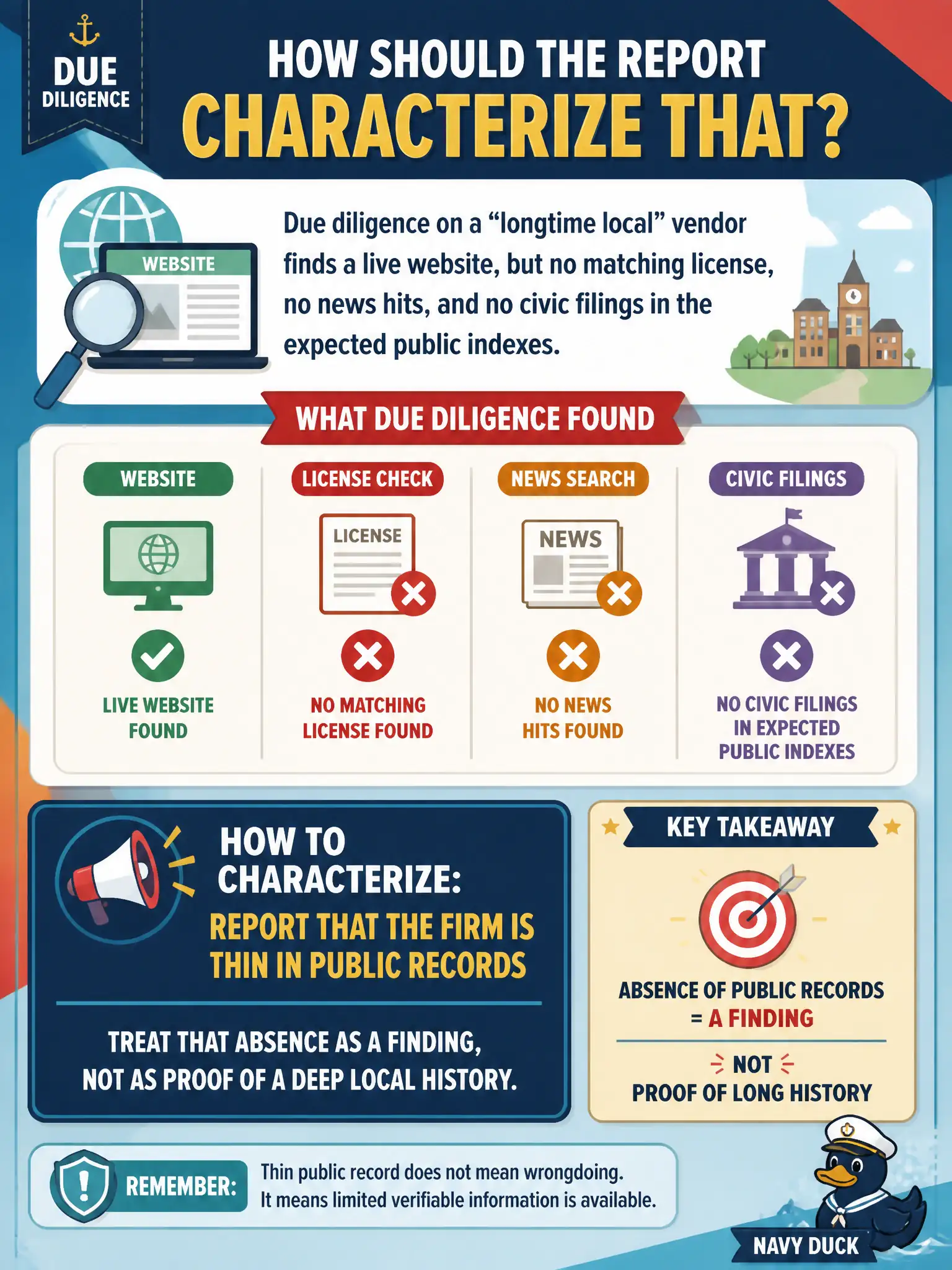
Due diligence on a “longtime local” vendor finds a live website, but no matching license, no news hits, and no civic filings in the expected public indexes. How should the report characterize that?
Select an answer to reveal the explanation.
Short Explanation
A shiny homepage with no licenses, no news, and no filings is a skinny paper trail, not a hometown legend. Say the public footprint is thin. Do not write the vendor a biography or jump to spy-movie endings.
Full Explanation
Negative results are reportable in civic business OSINT. After checking expected public surfaces—licenses, news, filings, and the live website—a 'longtime local' vendor that shows only a website and no matching license, news hits, or civic filings should be characterized as thin in public records. That absence is itself a finding for due diligence, not proof of a deep local history and not a license to invent biography or leap to covert-affiliation theories.
Inventing a robust local history to avoid embarrassing the vendor falsifies the civic record. Concluding the vendor is a state intelligence front because thin records always mean covert work is speculative over-attribution unsupported by the checked indexes. Ignoring missing records because only the website counts discards the multi-surface method that makes business OSINT useful to procurement.
Exam caveat: thin footprints can reflect new firms, informal operators, or incomplete indexes; list what was checked and when so readers can judge coverage rather than treating silence as mystery or malice.
Operational check: document each index searched (licenses, news, filings, website), record 'not found' with dates, retain the live-site URL, and deliver the thin-footprint finding to procurement as sourced absence—without invented history or spy-novel conclusions.