
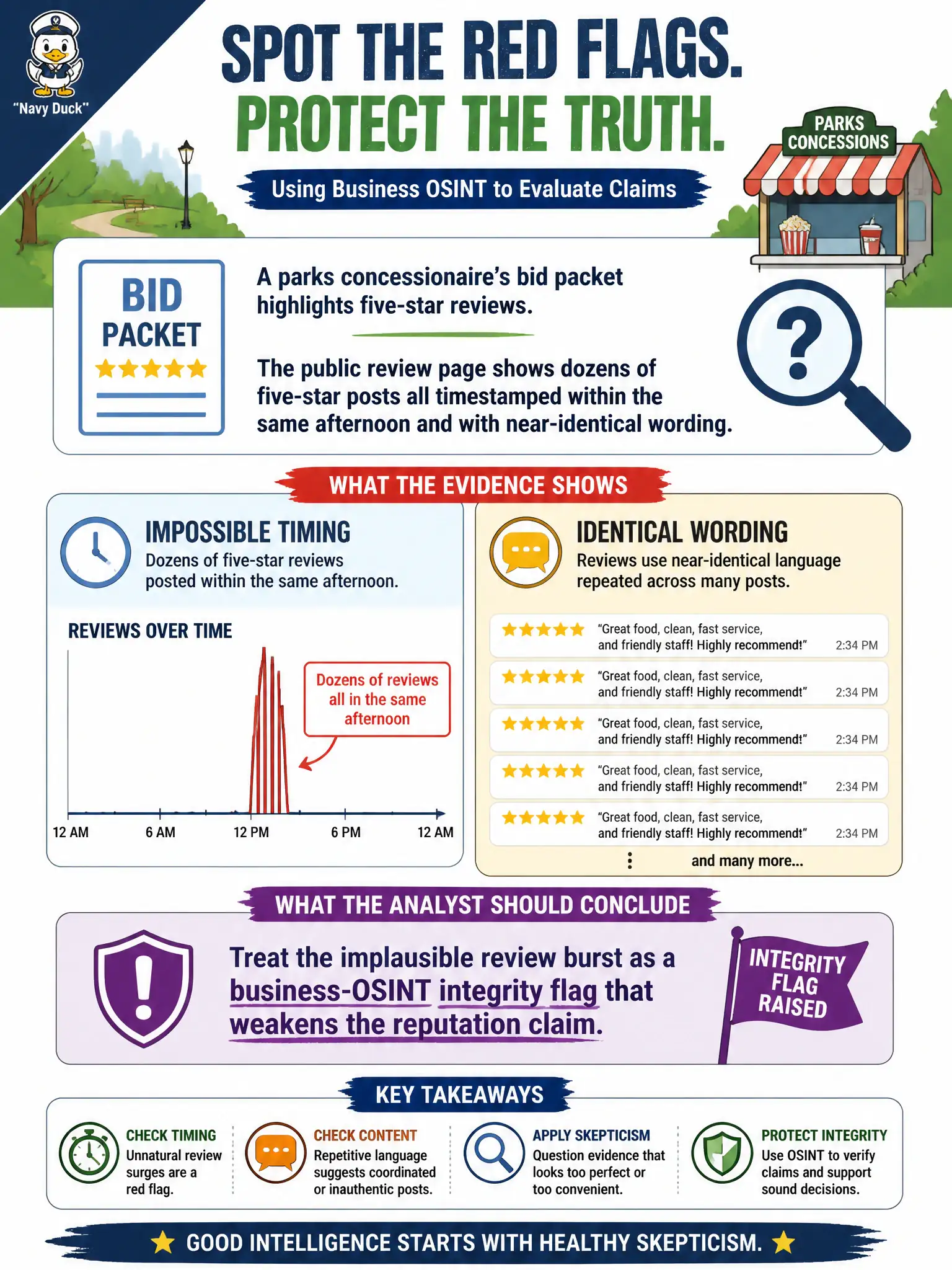
A parks concessionaire’s bid packet highlights five-star reviews. The public review page shows dozens of five-star posts all timestamped within the same afternoon and with near-identical wording. What should the analyst conclude?
Select an answer to reveal the explanation.
Short Explanation
Twenty five-star notes that landed in one lunch hour look more like a copy machine than a crowd. That pattern is a skepticism flag, not a Michelin star. Do not DM reviewers from a real account or play website janitor.
Full Explanation
Review-integrity analysis in civic business OSINT examines public patterns—timing clusters, duplicated wording, and burst volume—that can weaken reputation claims in a bid packet. When a parks concessionaire highlights five-star reviews but the public page shows dozens of near-identical five-star posts timestamped in the same afternoon, the analyst should treat that implausible burst as a sourced integrity flag, capture the page with timestamps, and note how it undercuts the reputation claim rather than treating the stars as proven food quality.
Copying the same-day burst into an award memo as fact confuses a suspicious public pattern with verified excellence. Messaging reviewers from a personal account to ask whether they were paid is interactive contact that leaves passive OSINT and harms OPSEC. Deleting reviews by acting as a platform moderator on the city's behalf is impersonation and content manipulation, not research.
Exam caveat: coordinated reviews are an integrity signal, not automatic proof of paid fraud; platforms may also display sorting artifacts. Keep language at 'implausible public pattern' unless additional sourced evidence supports a stronger claim.
Operational check: screenshot the review page showing timestamps and duplicated wording, cite URL and retrieval time, contrast with the bid's five-star claim, and deliver the integrity flag to parks procurement without DMing reviewers or moderating the platform.