
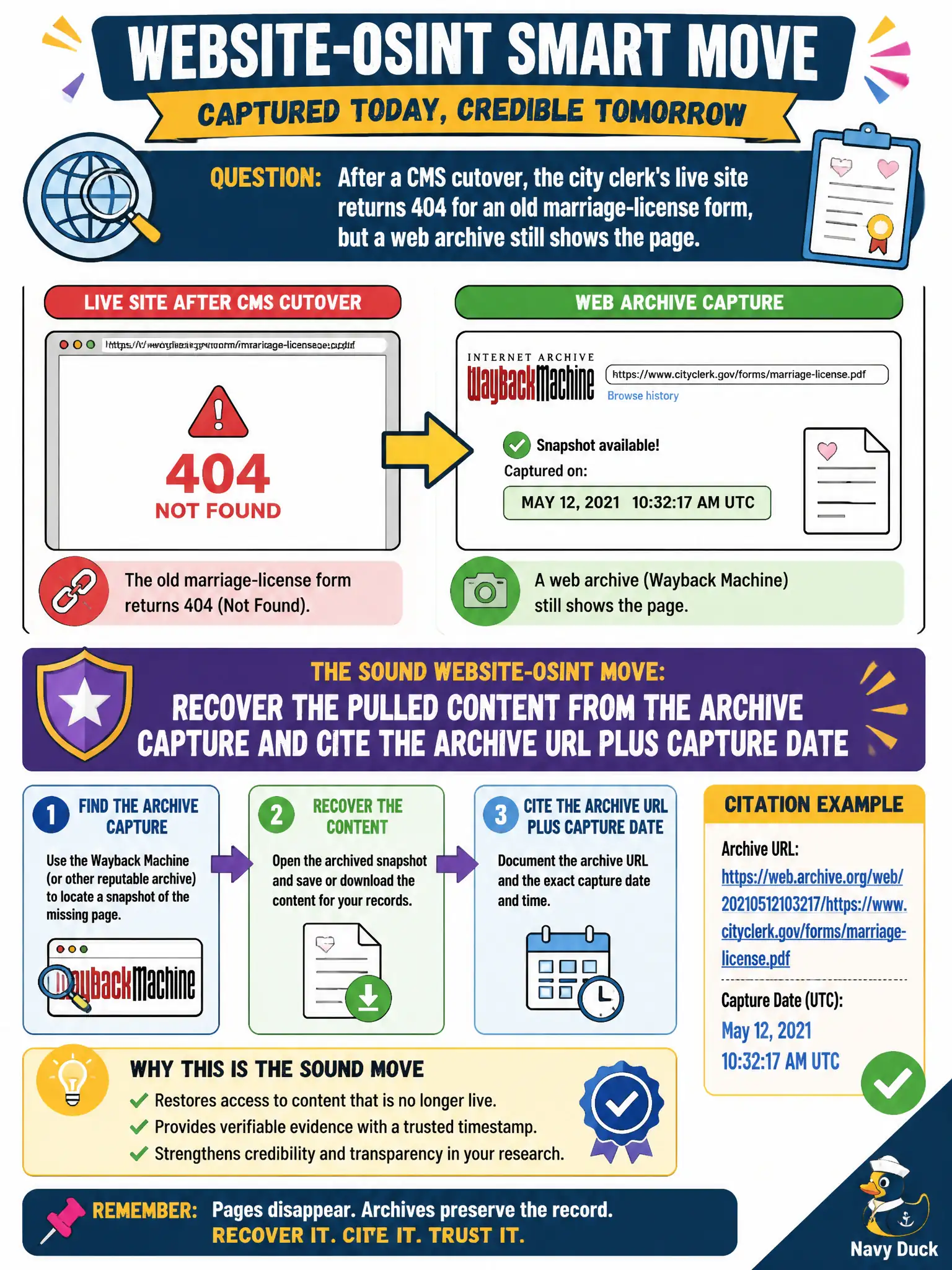
After a CMS cutover, the city clerk's live site returns 404 for an old marriage-license form, but a web archive still shows the page. What is the sound website-OSINT move?
Select an answer to reveal the explanation.
Short Explanation
A 404 is like an empty shelf, not a time machine — the old form may still live in the archive aisle. Web archives are website OSINT when the live civic page is gone. Grab the capture, write the date, and keep the citation with the notes.
Full Explanation
After a CMS cutover, if the city clerk’s live site returns 404 for an old marriage-license form but a web archive still shows the page, the sound website-OSINT move is to recover the pulled content from the archive capture and cite the archive URL plus capture date. Archives preserve civic process history when live pages vanish after redesigns. Treating the 404 as proof the form never existed and stopping collection fails by confusing current availability with historical existence. Restoring the form to the live civic site by replaying archived form submissions fails as an unauthorized operational change and possible privacy incident, not OSINT. Mirroring every historical civic URL from the archive onto a personal public blog fails as uncontrolled republication outside the clerk’s records program. Exam caveat: archive captures can be incomplete or poorly timed—cite what you have and note gaps. Operational check: locate the archive snapshot; save archive URL and capture date; extract the form content needed for the clerk’s question; keep the product labeled as archive-sourced rather than live-site content. In municipal practice, record the rationale in the case file so future staff know which control was chosen and which failure modes the rejected options would create for city services.