
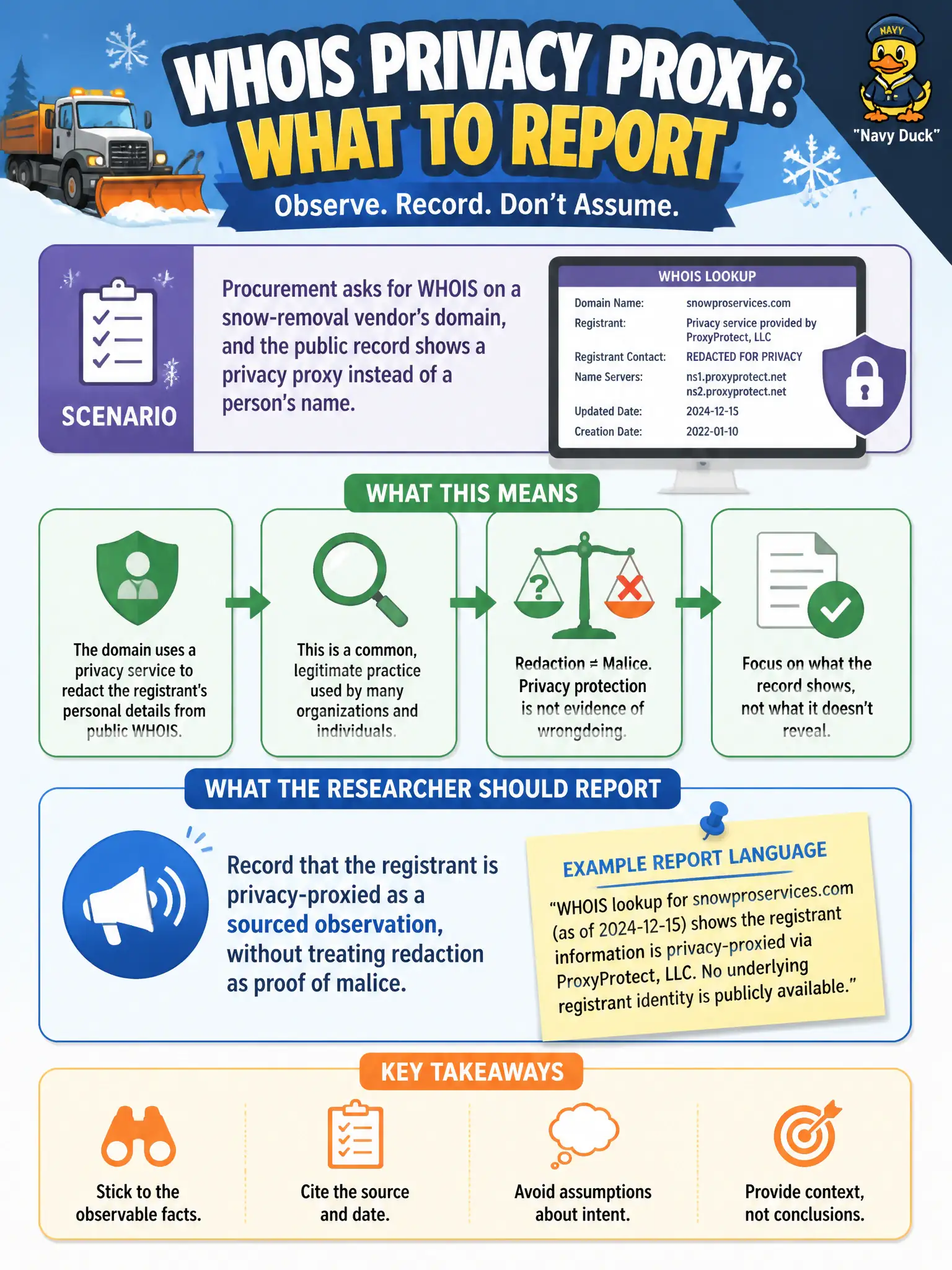
Procurement asks for WHOIS on a snow-removal vendor's domain, and the public record shows a privacy proxy instead of a person's name. What should the researcher report?
Select an answer to reveal the explanation.
Short Explanation
A privacy proxy on WHOIS is like a PO box on a storefront — common, not a confession. The observation still belongs in the notes: the record is redacted. Do not invent a crime story, and do not social-engineer the registrar to peek behind the curtain.
Full Explanation
When procurement asks for WHOIS on a snow-removal vendor’s domain and the public record shows a privacy proxy instead of a person’s name, the researcher should record that the registrant is privacy-proxied as a sourced observation, without treating redaction as proof of malice. Privacy proxies are common and are not confessions. Concluding the vendor is malicious because privacy protection always hides crime fails as an attribution leap unsupported by the public record. Marking the WHOIS task failed because a usable registrant person name was not returned fails; the proxied state itself is a reportable observation. Bypassing the proxy by pretexting the registrar help desk for the hidden registrant record fails as social engineering outside open-source ethics. Exam caveat: some jurisdictions or contract clauses may later justify legal process for registrant data—that is not the first OSINT finding. Operational check: capture the WHOIS or registration output showing the privacy service; date the retrieval; report “privacy-proxied registrant” to procurement without malice language; pursue other public business-entity sources for responsible parties. In municipal practice, record the rationale in the case file so future staff know which control was chosen and which failure modes the rejected options would create for city services.