
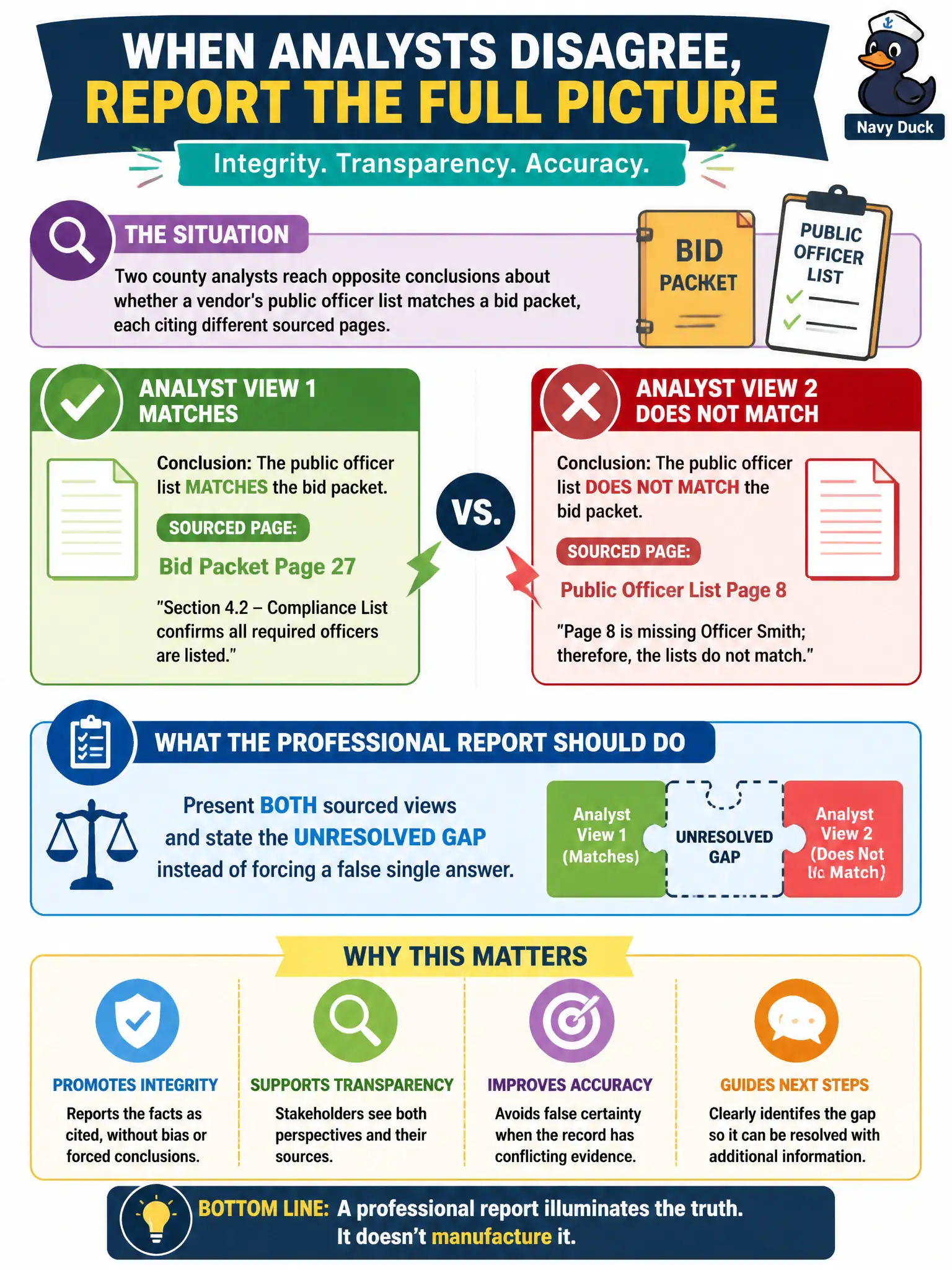
Two county analysts reach opposite conclusions about whether a vendor's public officer list matches a bid packet, each citing different sourced pages. What should the professional report do?
Select an answer to reveal the explanation.
Short Explanation
When two good maps disagree, you do not throw one in a drawer and pretend the road is settled. Show both sourced views and label the leftover hole. Honest uncertainty is a valid OSINT conclusion—not a failure.
Full Explanation
Unresolved gaps are reportable. When two county analysts reach opposite conclusions about whether a vendor's public officer list matches a bid packet, each citing different sourced pages, the professional report should present both sourced views and state the unresolved gap instead of forcing a false single answer. Honest uncertainty is a valid OSINT conclusion.
Picking the conclusion procurement prefers and hiding the conflicting page misrepresents evidence. Averaging the two write-ups into an unsourced maybe erases citations. Discarding both public source sets and waiting for a closed-source credit report abandons public OSINT without documenting why the conflict remains.
Exam caveat: leadership may later ask the vendor or seek another filing; the OSINT product's job is to surface the conflict clearly, not to paper it over.
Operational check: quote both pages with URLs and dates, state how each supports a different conclusion, label the officer-list question as an open gap, and avoid preference-hiding or closed-source substitution as the only path. Keep municipal wording calibrated to what public sources actually show, and record retrieval dates so peers can re-perform the work.