
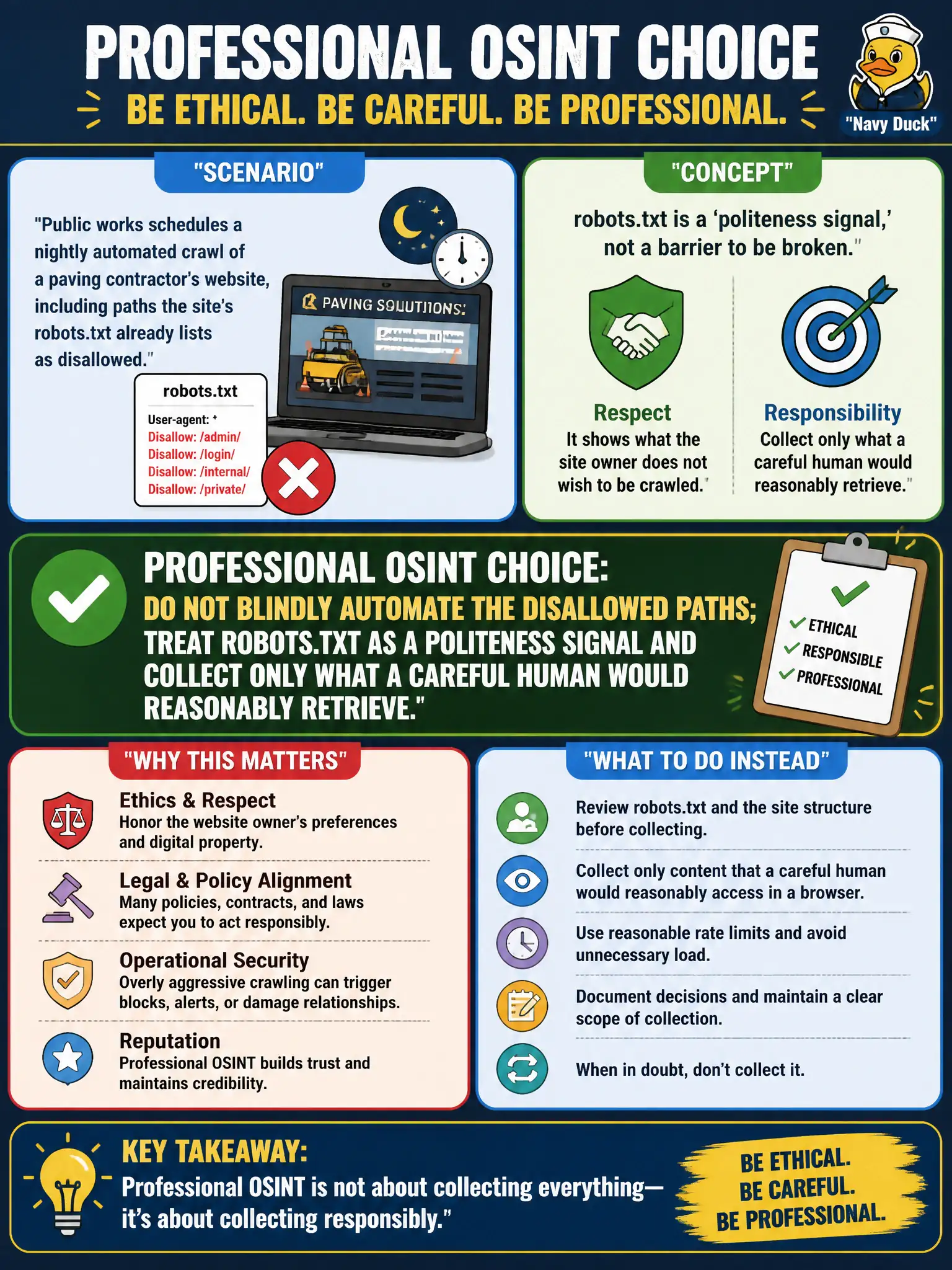
Public works schedules a nightly automated crawl of a paving contractor's website, including paths the site's robots.txt already lists as disallowed. What is the professional OSINT choice?
Select an answer to reveal the explanation.
Short Explanation
Robots.txt is more like a 'please use the front door' sign than a vault lock—but a city still does not kick in the side door on a nightly timer. Professional website OSINT stays polite: skip automated grabs of paths the site asked crawlers not to hit. If a page matters, retrieve it the way a careful human would, not as a bulk job that ignores the sign.
Full Explanation
robots.txt is not a cryptographic control, yet civic researchers still treat it as a professionalism and rate-limit cue. When public works schedules a nightly automated crawl of a paving contractor's website including paths the site's robots.txt lists as disallowed, the professional choice is not to blindly automate those disallowed paths; treat robots.txt as a politeness signal and collect only what a careful human would reasonably retrieve for the engagement.
Ignoring robots.txt on every civic job because those files exist only for search-engine marketing dismisses a standard courtesy signal and invites abuse optics. Mirroring the entire disallowed tree once and relabeling it a public archive still performs bulk collection the site asked crawlers to avoid. Increasing crawl threads until disallowed folders return successful pages treats blocks as a puzzle to defeat rather than a boundary to respect.
Exam caveat: a human analyst may still open an ordinary public URL in a browser when needed; the issue is indiscriminate nightly automation of disallowed paths, not reading a single public page with attribution.
Operational check: read robots.txt, exclude disallowed paths from the nightly job, bound remaining crawl to needed URLs at human-comparable rates, and document the politeness choice in the method notes.