
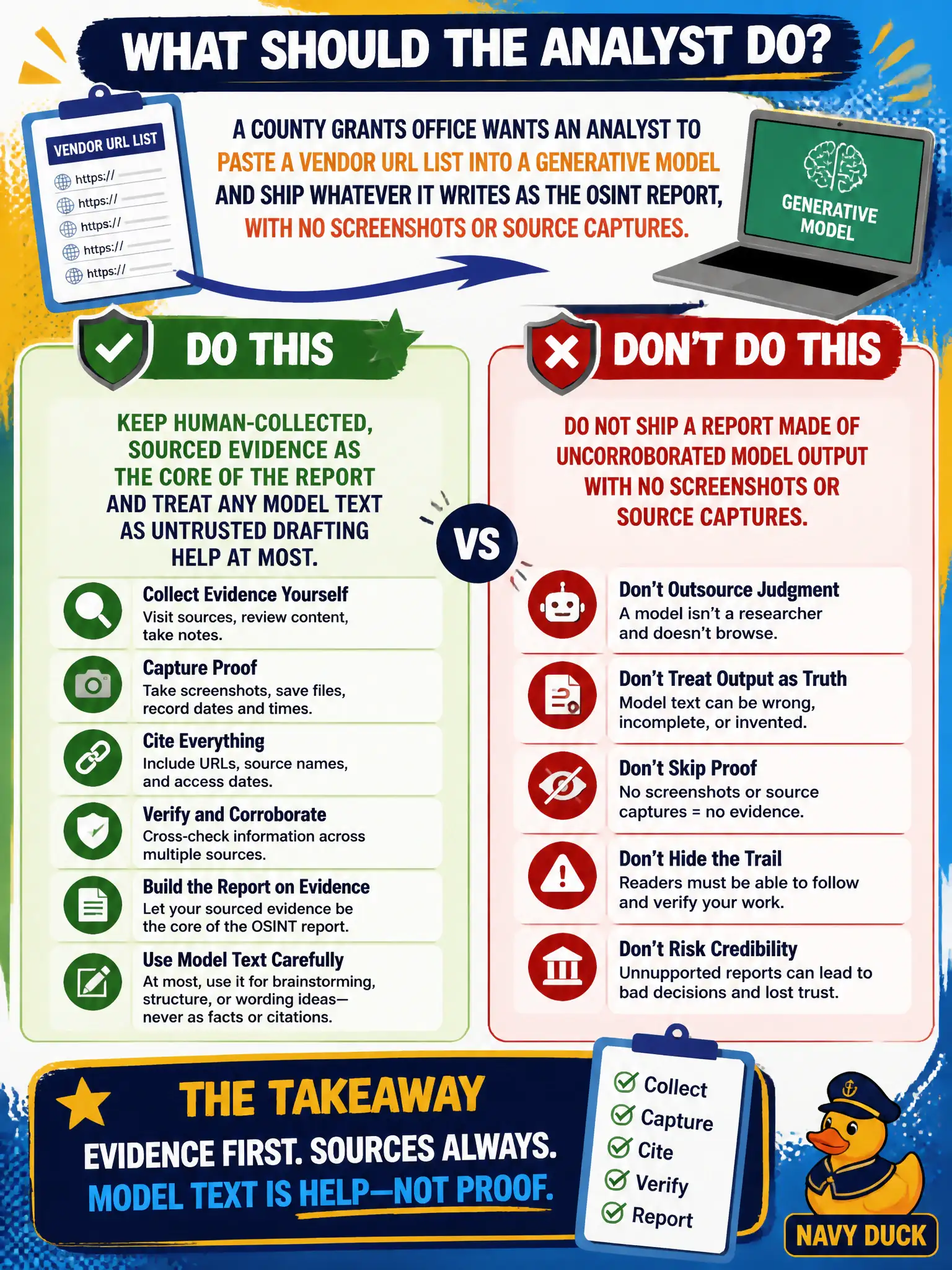
A county grants office wants an analyst to paste a vendor URL list into a generative model and ship whatever it writes as the OSINT report, with no screenshots or source captures. What should the analyst do?
Select an answer to reveal the explanation.
Short Explanation
Asking a model to write the report from a naked URL list is like reviewing restaurants from addresses nobody visited. The captures and checked sources are the meal; the model is at best a notepad. Civic OSINT still has to show what was actually retrieved.
Full Explanation
A professional OSINT report is built from collected, cited public artifacts, not from unsourced generative paraphrase. When a county grants office wants an analyst to paste a vendor URL list into a generative model and ship whatever it writes as the OSINT report with no screenshots or source captures, the analyst should keep human-collected, sourced evidence as the core and treat any model text as untrusted drafting help at most.
Submitting model output as the official report because generative summaries of unsourced URLs already meet civic evidence rules is false; models can hallucinate titles, quotes, and conclusions. Skipping collection and asking the model to invent plausible vendor findings fabricates the grant packet. Replacing the URL list with the model's citations even when those pages were never retrieved launders fake sources.
Exam caveat: drafting help after captures exist may be acceptable if every factual claim still traces to a retrieved artifact; the model never becomes the evidence layer.
Operational check: retrieve and capture each vendor URL, write findings from those captures, optionally use a model only to polish prose already grounded in exhibits, and refuse to ship unsourced model text as the OSINT product.