
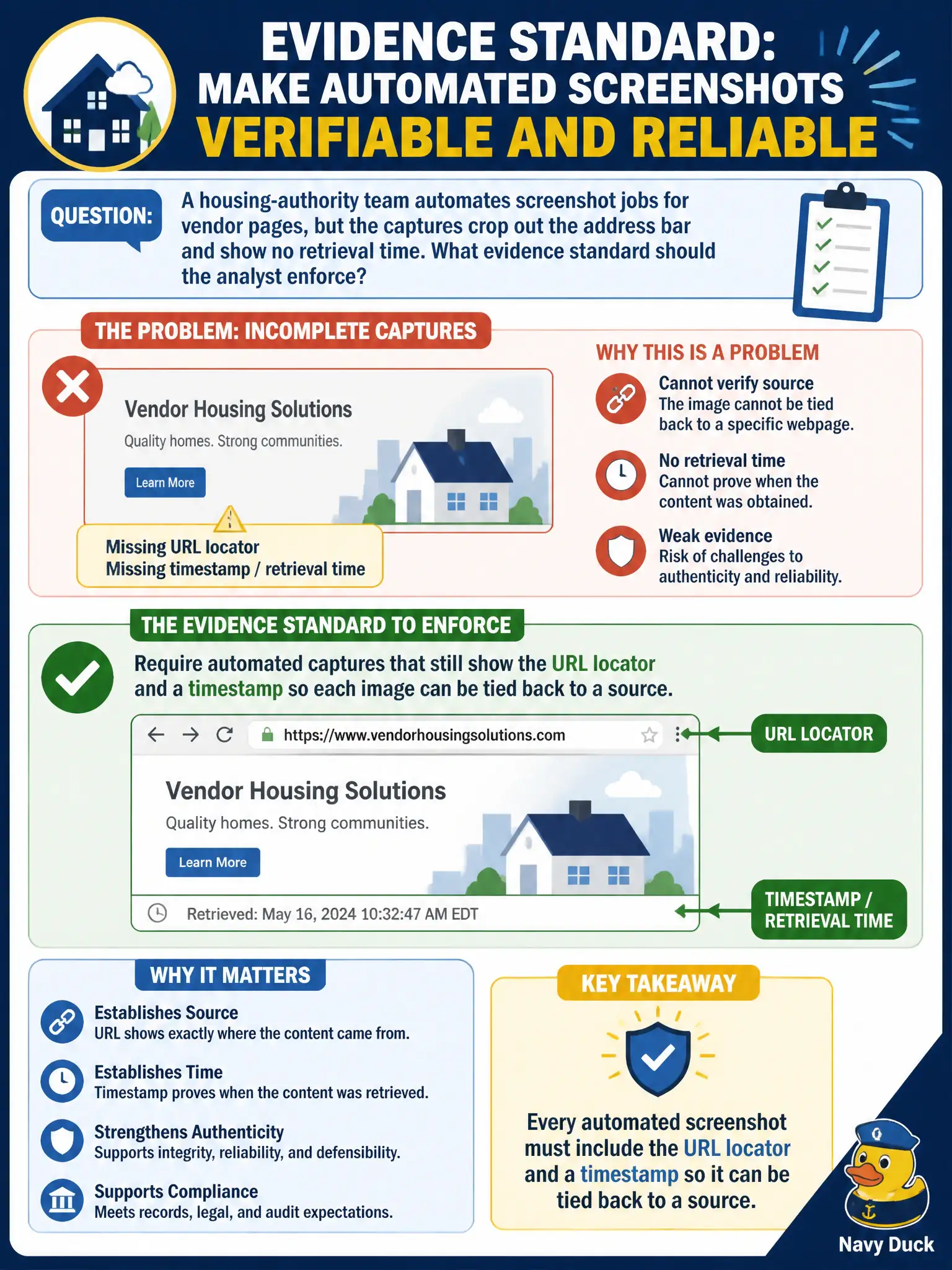
A housing-authority team automates screenshot jobs for vendor pages, but the captures crop out the address bar and show no retrieval time. What evidence standard should the analyst enforce?
Select an answer to reveal the explanation.
Short Explanation
A screenshot without the URL and time is like a photo of a street with the signs cropped off—you cannot prove which corner it was. Automation does not lower the evidence bar from Domain 1 notes. If the job takes the picture, it still has to keep the locator and the clock.
Full Explanation
Automated collection is still evidence collection. Civic reviewers need to see which URL was captured and when, because pages change and similar layouts repeat across vendors. When a housing-authority team automates screenshot jobs that crop out the address bar and show no retrieval time, the analyst should require automated captures that still show the URL locator and a timestamp so each image can be tied back to a source.
Cropped page-only images are not enough because filenames can be invented later during the briefing. Dropping screenshots entirely and keeping only the automation log fails to show what appeared on the page. Watermarking every screenshot with an intern's personal email adds personal OPSEC leakage without fixing locator/time gaps.
Exam caveat: if the capture tool cannot show an address bar, embed equivalent metadata (URL + ISO timestamp) in the filename or sidecar and reference it in captions—but do not omit locators.
Operational check: reconfigure screenshot jobs to retain URL and time, recapture deficient images, caption exhibits with those locators, and ban personal-email watermarks as a substitute for evidence hygiene. Keep municipal wording calibrated to what public sources actually show, and record retrieval dates so peers can re-perform the work.