
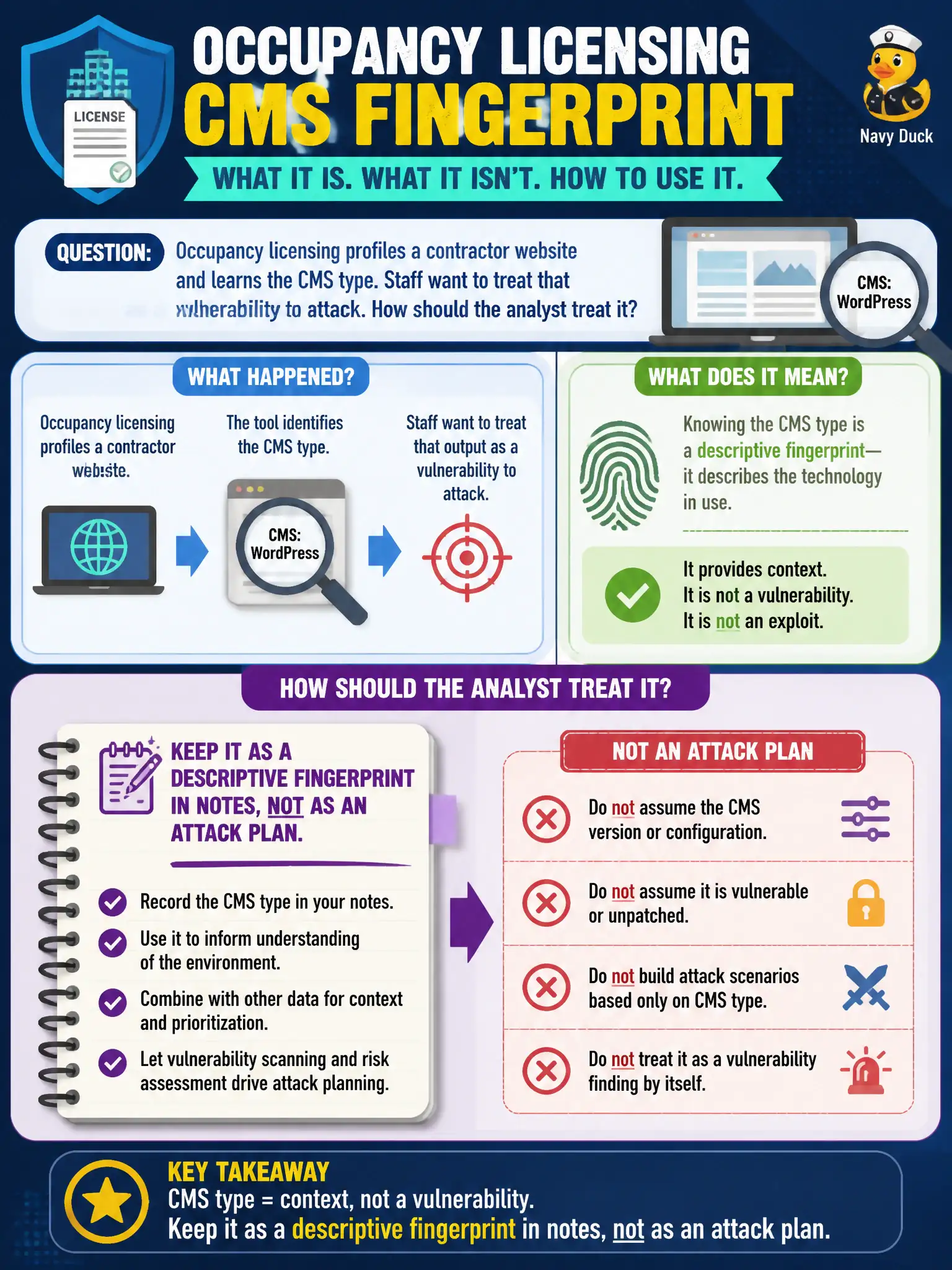
Occupancy licensing profiles a contractor website and learns the CMS type. Staff want to treat that output as a vulnerability to attack. How should the analyst treat it?
Select an answer to reveal the explanation.
Short Explanation
Seeing the shop sign is not kicking in the door. A CMS fingerprint is a description for the notes, not a pentest plan. PORP records the stack; it does not exploit it.
Full Explanation
Website-tech profilers support OSINT by describing public stack clues such as CMS family. When occupancy licensing profiles a contractor website and learns the CMS type, the analyst should keep that output as a descriptive fingerprint in notes for due diligence and correlation—not as an attack plan. PORP records what the public site reveals; it does not exploit it.
Treating the CMS name as an invitation to attempt unauthorized access on the contractor host converts fingerprinting into intrusion. Publishing guessed CMS credentials in the licensing packet as OSINT spreads speculative secrets and attack material. Discarding the stack observation because website OSINT forbids technology clues wrongly excludes a standard descriptive technique.
Exam caveat: CMS family alone rarely implies a specific CVE exploitation path the city is authorized to test; keep language descriptive unless a separate authorized assessment exists.
Operational check: note CMS/family with profiler source and date in the licensing file, use it only for correlation/vendor context, and refuse access attempts or credential guesses under the OSINT label. In municipal practice, keep the wording tied to public artifacts, retrieval dates, and the authorized civic question so peers can re-perform the work without guessing intent.