
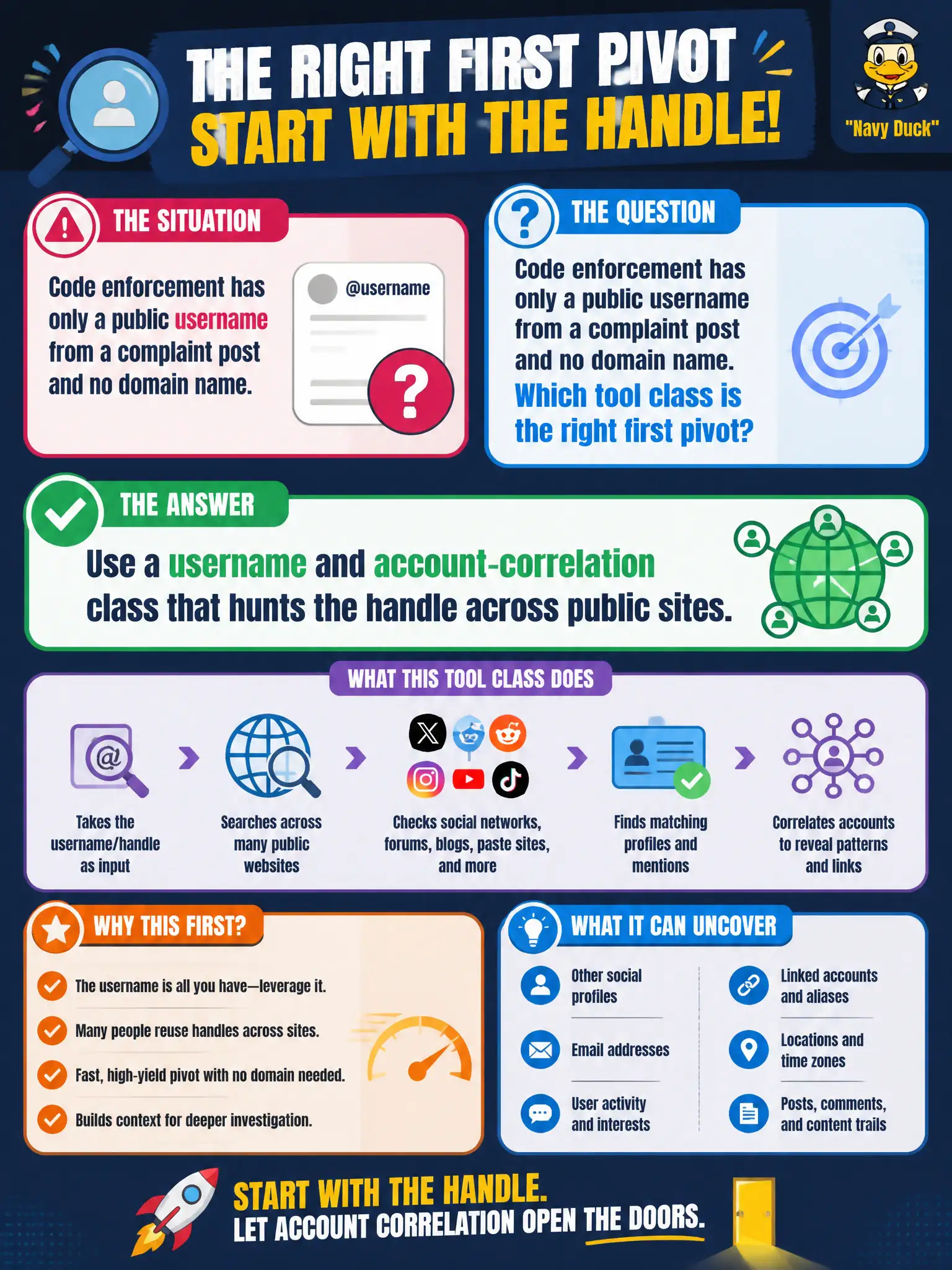
Code enforcement has only a public username from a complaint post and no domain name. Which tool class is the right first pivot?
Select an answer to reveal the explanation.
Short Explanation
A handle is a name tag, not a domain or a radio. Account-correlation tools look for the same username on public sites. WHOIS waits until you actually have a domain to look up.
Full Explanation
Username OSINT tool classes exist to correlate a handle across public platforms and sites. When code enforcement has only a public username from a complaint post and no domain name, the right first pivot is a username and account-correlation class that hunts that handle across public sites, then records hits with URLs and dates before pivoting further.
Running WHOIS on a domain that has not been identified answers a registrar question with no input. Opening a wireless map of the neighborhood named in the complaint before touching the username skips the only concrete identifier. Fingerprinting the CMS of the city's own homepage substitutes an unrelated website-tech task for account research.
Exam caveat: identical handles can belong to different people; treat matches as leads until additional public context corroborates the same entity.
Operational check: run account-correlation on the exact complaint username, cite platforms and retrieval times, and only open WHOIS, wireless, or CMS tools if a domain, RF clue, or site identifier appears. In municipal practice, keep the wording tied to public artifacts, retrieval dates, and the authorized civic question so peers can re-perform the work without guessing intent.