
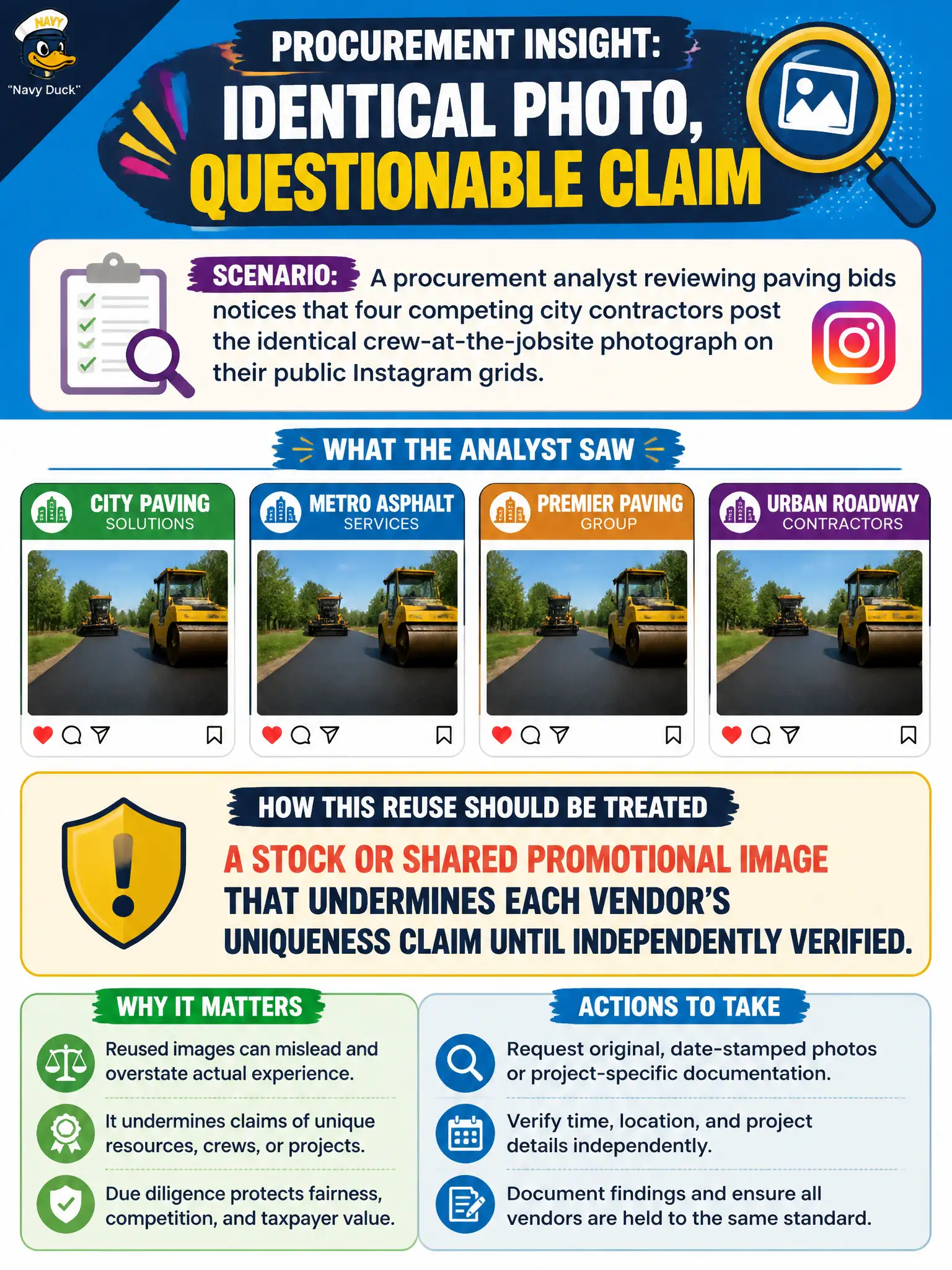
A procurement analyst reviewing paving bids notices that four competing city contractors post the identical crew-at-the-jobsite photograph on their public Instagram grids. What should that reuse be treated as?
Select an answer to reveal the explanation.
Short Explanation
Think of four storefronts hanging the same catalog poster and calling it their own crew. A repeated Instagram grid photo is usually stock or borrowed art, not proof each firm has a unique team on site. Flag the reuse and verify people and jobs with other public sources.
Full Explanation
When procurement reviewing paving bids finds four competing city contractors posting the identical crew-at-the-jobsite photograph on their public Instagram grids, that reuse should be treated as a stock or shared promotional image that undermines each vendor’s uniqueness claim until independently verified. In municipal bid integrity work, repeated marketing art is a signal to test claims about distinct crews and capacity, not a finished legal conclusion. Treating the reuse as proof the four firms legally operate as one joint venture fails because shared stock imagery does not establish corporate structure, joint-venture filings, or bid collusion by itself. Sending Instagram follow requests from a real city staff profile to recover original EXIF fails as OPSEC-poor engagement and as a misunderstanding of what public social OSINT can obtain; EXIF is often stripped anyway. Treating Instagram geotags on the photo as official GPS of each contractor’s yard fails because geotags are user-selected labels and a shared image cannot place four yards at once. Exam caveat: image reuse is a due-diligence flag, not automatic proof of fraud or a single legal entity. Operational check: capture all four grid URLs and the shared image; reverse-search for stock sources; ask for distinct site photos or public project references in the bid file; document the uniqueness claim as unverified until independent evidence appears.