
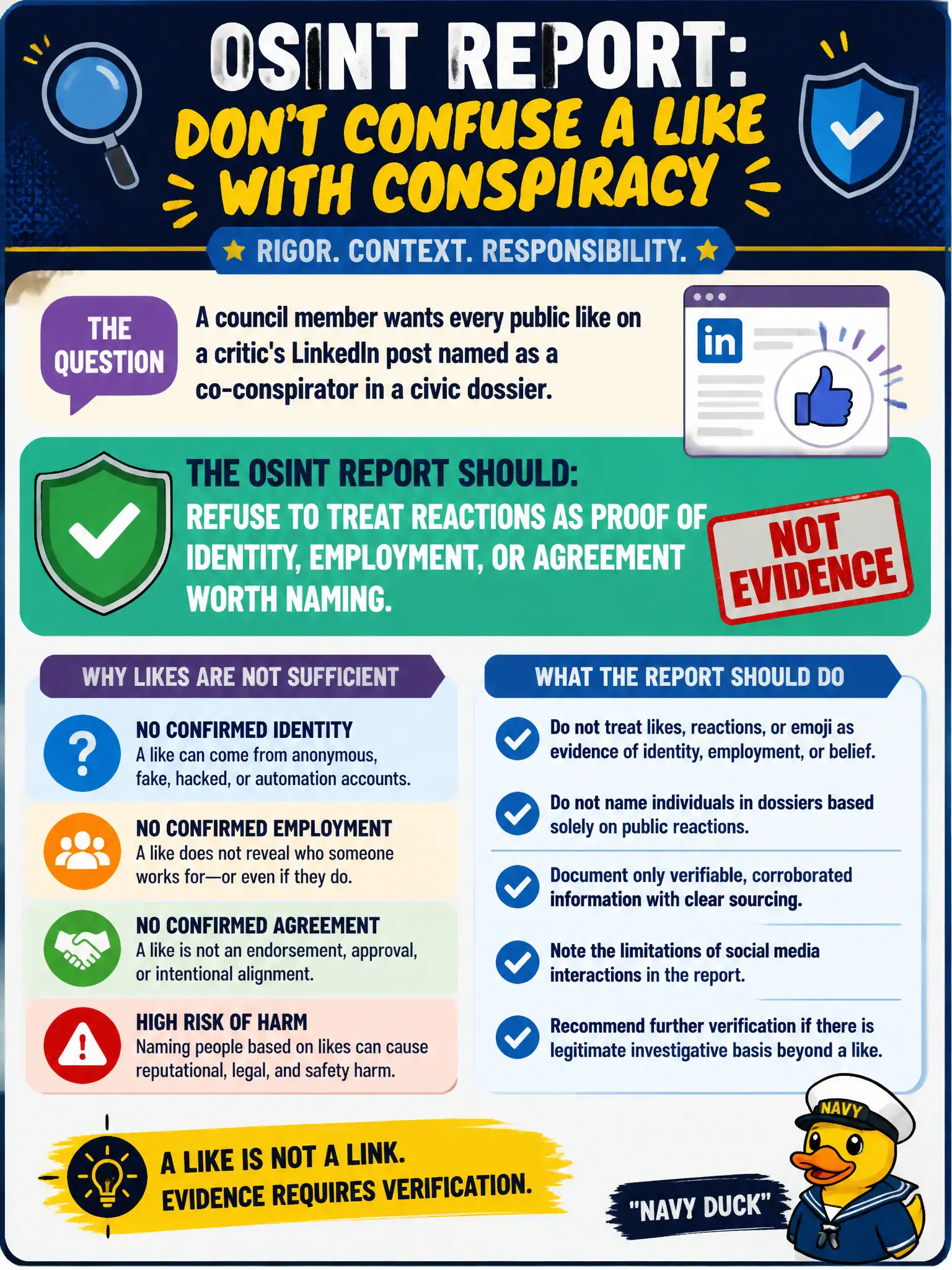
A council member wants every public like on a critic's LinkedIn post named as a co-conspirator in a civic dossier. What should the OSINT report do?
Select an answer to reveal the explanation.
Short Explanation
A like is a nod in a crowded room, not a signed affidavit. Do not turn reactors into a co-conspirator roster. Weak engagement is not identity, employment, or agreement.
Full Explanation
If a council member wants every public like on a critic’s LinkedIn post named as a co-conspirator in a civic dossier, the OSINT report should refuse to treat reactions as proof of identity, employment, or agreement worth naming. Likes are weak, low-cost engagement signals and are not signed statements suitable for adversarial naming in a municipal file. Listing every liker as an identified co-conspirator fails by converting casual reactions into identity claims the evidence cannot support and by creating political and legal risk for the city. Scraping private reaction lists by logging in as a friend fails because private reactions are outside public OSINT and require bypassing privacy settings. Treating likes as equivalent to signed public comments at a hearing fails; hearings create attributable speech with formal process, while likes do not establish agreement content or identity assurance. Exam caveat: strong, attributable public comments may be citable as speech; undifferentiated likes still should not populate a conspirator roster. Operational check: if engagement context is needed, summarize reaction volume without naming private citizens as conspirators; escalate only attributable public statements with URLs to counsel or council staff for advice.