
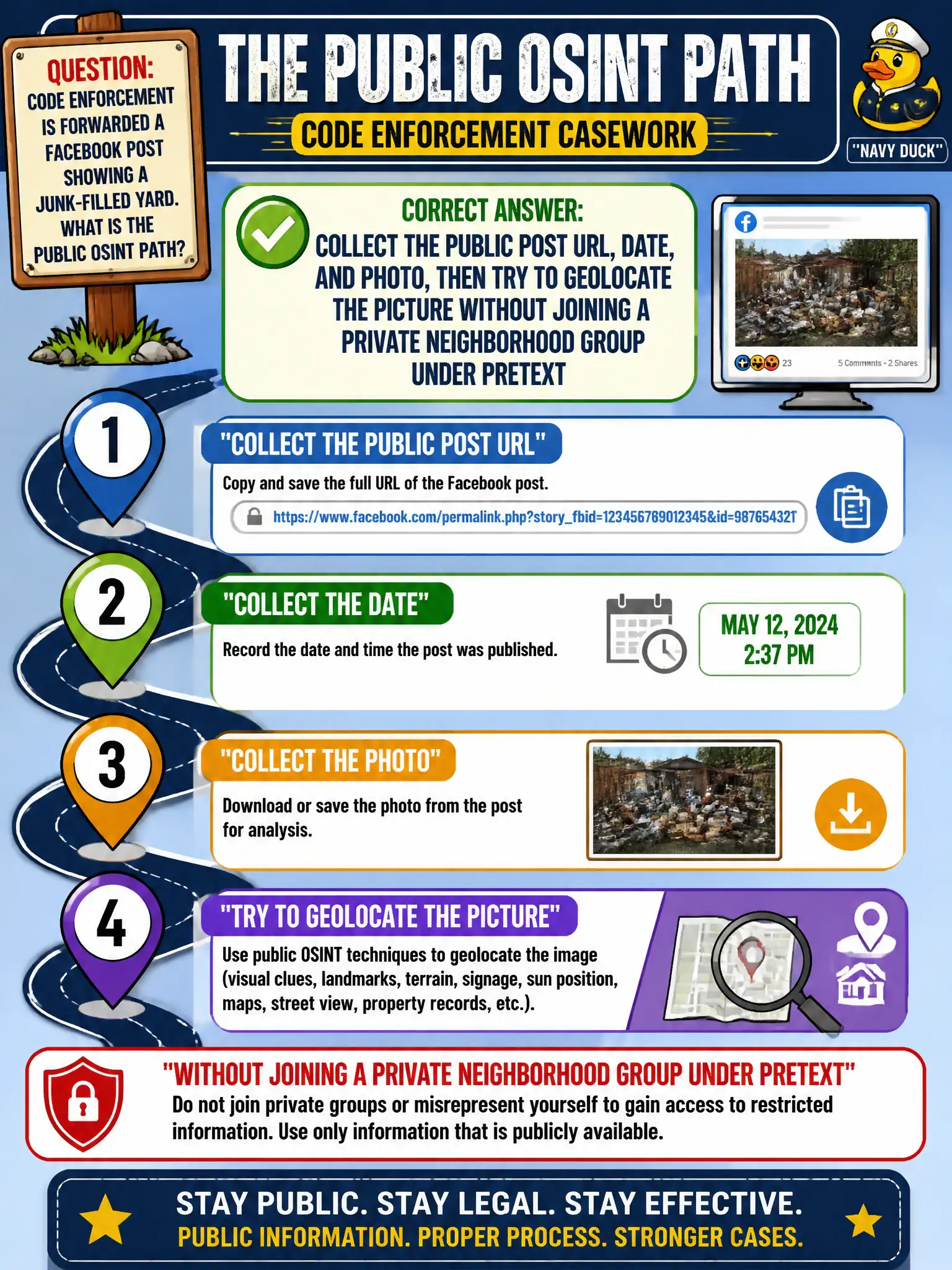
Code enforcement is forwarded a Facebook post showing a junk-filled yard. What is the public OSINT path?
Select an answer to reveal the explanation.
Short Explanation
If the yard photo is sitting on the public sidewalk of Facebook, save the URL, the date, and the picture, then work the pixels for place. Do not sneak into a private neighborhood club under a fake name.
Full Explanation
When code enforcement is forwarded a Facebook post showing a junk-filled yard, the public OSINT path is to collect the public post URL, date, and photo, then attempt to geolocate the picture without joining a private neighborhood group under pretext. Public sidewalk content is in scope for civic code-enforcement support; private groups are not a free expansion of collection merely because the subject is a yard. Joining the private neighborhood group with a fake neighbor story fails as pretexting into a closed community beyond open-source ethics and beyond typical municipal authorization. Friending the poster from a real inspector account to unlock friends-only albums fails by using authentic civic identity to bypass privacy and by contaminating the investigation’s OPSEC. Skipping URL capture because a forwarded screenshot is enough fails because unsourced screenshots lack durable citation, may omit UI chrome, and are harder to defend if challenged. Exam caveat: if only a screenshot exists and the post is gone, label it second-hand and still try reverse image and geolocation on visible pixels. Operational check: save URL and retrieval time when live; capture image; work landmarks and reverse search; document that private-group collection was not used in the code-enforcement OSINT note.