
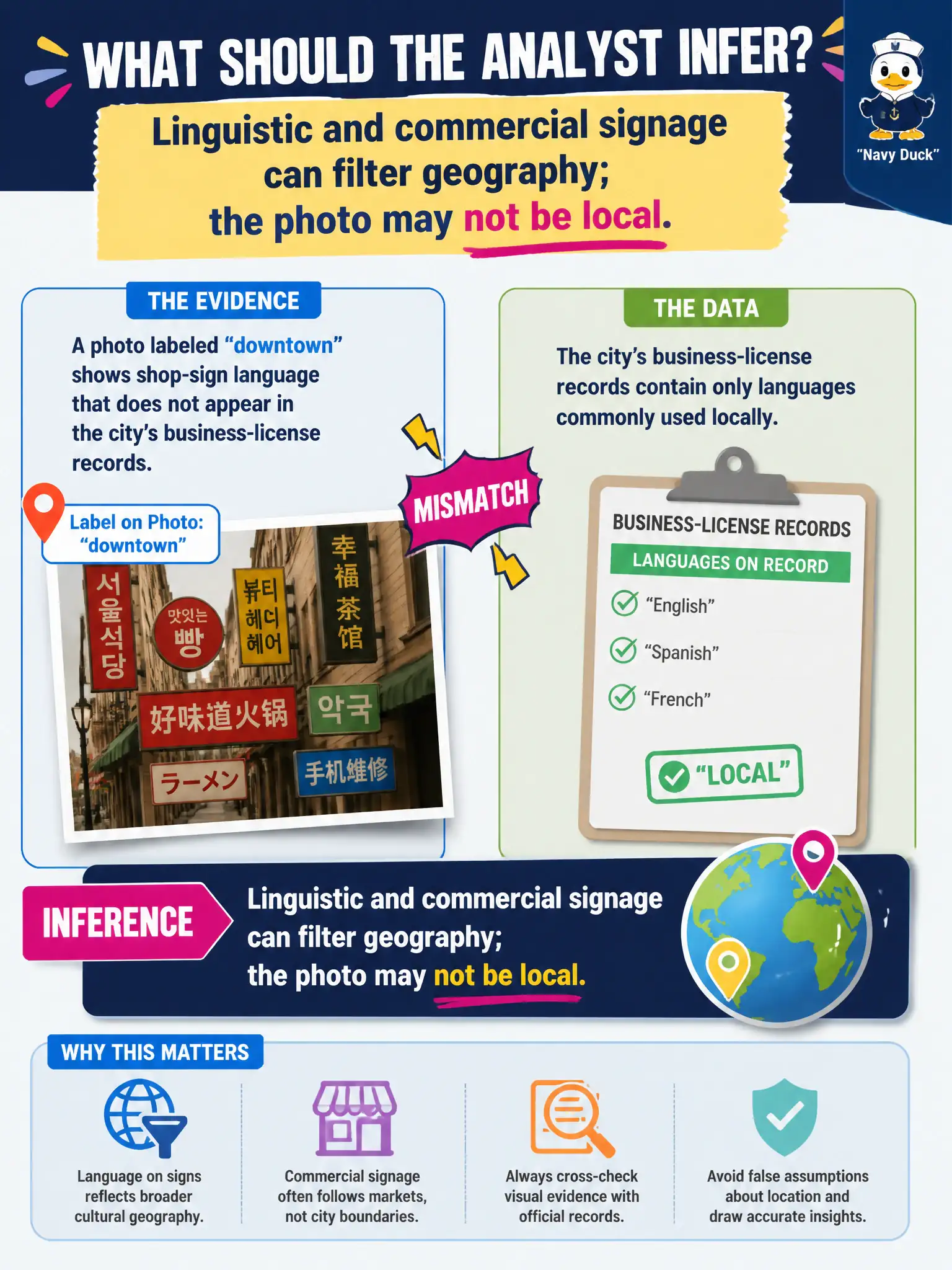
A photo labeled “downtown” shows shop-sign language that does not appear in the city’s business-license records. What should the analyst infer?
Select an answer to reveal the explanation.
Short Explanation
If every licensed storefront downtown uses one language set and this sign uses another, you may not be downtown at all. Signs are geography filters. Translation is not a mailing address.
Full Explanation
Linguistic and commercial signage in a photograph can filter geography: shop-sign language, script, and business naming conventions often fail to match a claimed “downtown” when the scene is elsewhere. Analysts should treat foreign or unexpected signage as a location filter against business-license records, street imagery, and local language norms, concluding the photo may not be local until proven otherwise. Inferring that the shop must be unlicensed and issuing a citation from the photo alone skips verification and confuses geo filtering with code enforcement sufficiency. Claiming language on signs has no location value because fonts are global ignores that language communities are spatially patterned even when typefaces travel. Treating an AI translation of a sign as a street address invents precision the translation does not provide. Exam caveat: PORP uses commercial and linguistic signage as geographic filters, not as automatic violation findings or geocoders. Operational check: transcribe sign text, compare language and trade names to local license rolls and Street View-class layers, reverse-search the facade, and withhold a local pin—and any citation—until independent civic sources place the scene.