
Public-works hydrant colors follow a known city code. A photo’s hydrant-cap color does not match that block’s GIS record. How should the analyst treat the mismatch?
Select an answer to reveal the explanation.
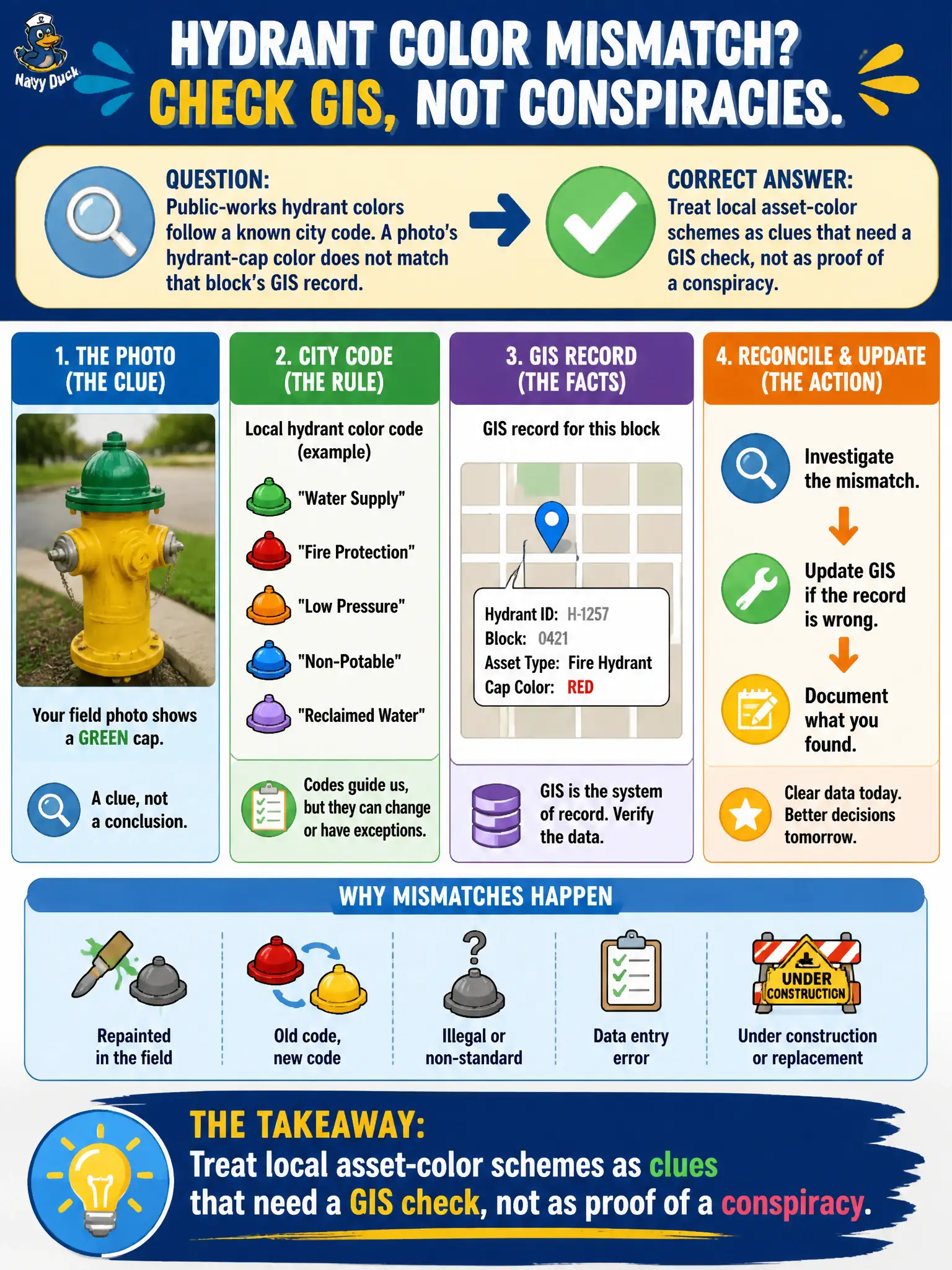
Short Explanation
Hydrant colors are a local codebook, not a crime novel. If the cap does not match that block’s GIS, keep looking—wrong block, faded paint, or a stale map layer. Do not jump from a color mismatch to a conspiracy.
Full Explanation
Many cities encode hydrant-cap or barrel colors to convey flow class or district standards, and those colors can appear in public photos as asset clues. When a photo’s hydrant-cap color does not match that block’s GIS record, the professional response is to treat the local asset-color scheme as a lead that needs a GIS and field check—not as proof of a secret crime cover-up. Color mismatch can mean a wrong block, a repaint lag in GIS, faded paint, camera white-balance error, or an outdated code chart; conspiracy is the least warranted first inference. Ignoring hydrant colors because “civic assets never appear in photos” discards a common public clue. Publishing a fraud alert naming the block before checking GIS converts a mapping inconsistency into an unfounded public accusation. Exam caveat: PORP treats municipal asset-color schemes as corroborative geo clues that still require authoritative map confirmation, not as standalone proof of malfeasance. Operational check: note the observed color, query the hydrant feature in GIS, compare against the published municipal color key, flag data lag if the asset was recently serviced, and request a field verify before any enforcement narrative that depends on the mismatch.