
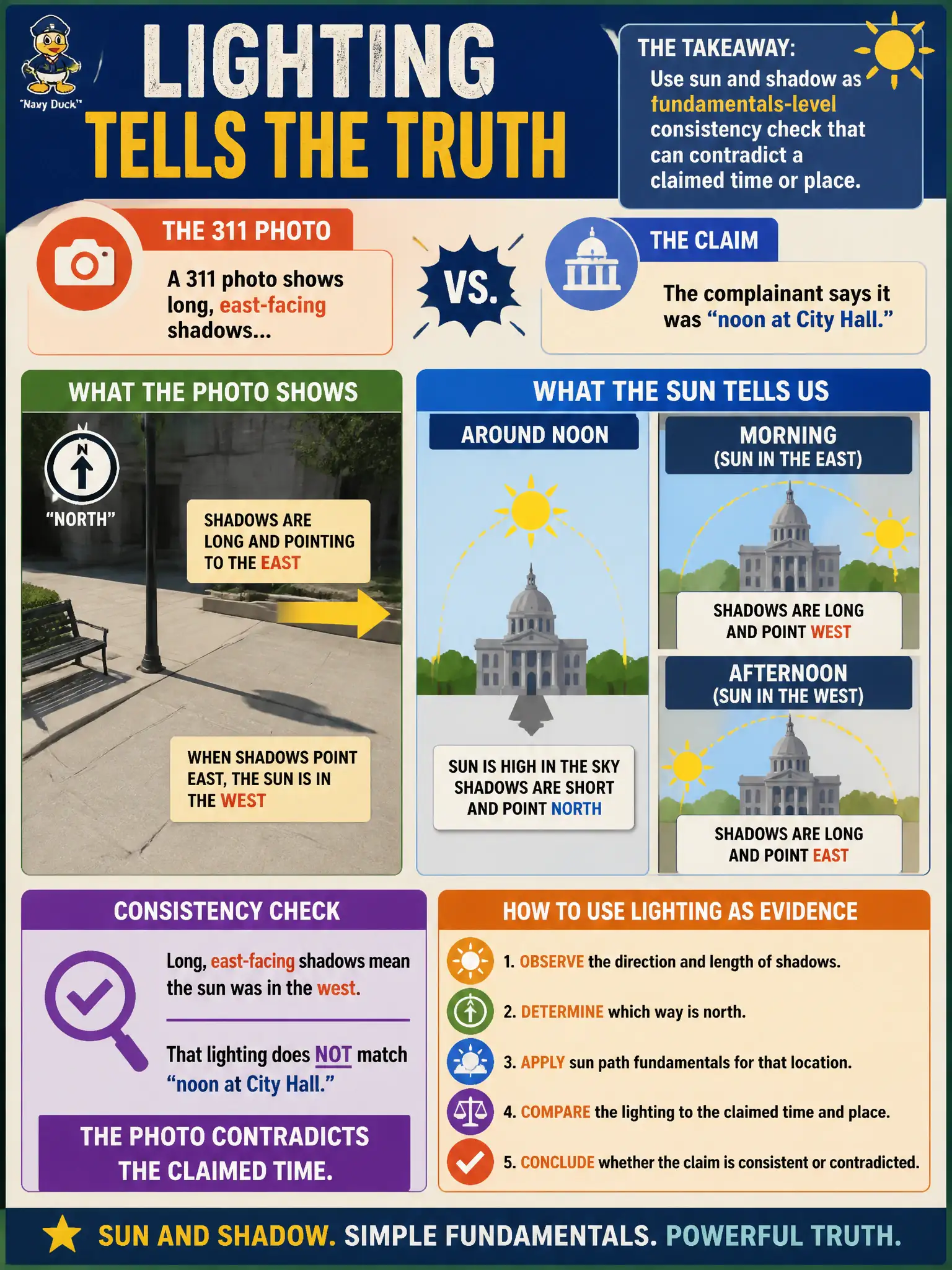
A 311 photo shows long, east-facing shadows while the complainant says it was “noon at City Hall.” How should the analyst use that lighting?
Select an answer to reveal the explanation.
Short Explanation
Noon sun sits high; long sideways shadows mean the clock or the place is off. Treat lighting as a sniff test, not a courtroom sundial diploma. If the story and the shadows fight, flag the mismatch.
Full Explanation
Sun angle and shadow direction provide a fundamentals-level consistency check on claimed time and, in some cases, orientation relative to known facades. Long east-facing shadows conflict with a “noon at City Hall” narrative in most mid-latitude settings and should flag the complainant’s caption for challenge rather than automatic acceptance in a 311 workflow. The method supports contradiction detection and triage; it does not by itself produce a court-ready photogrammetry certification or a certified timestamp. Ignoring lighting because 311 photos are presumed always taken at the stated time abandons a free, public-physics consistency test. Digitally inverting or rotating the image so shadows “point west” to match the claim is fabrication, not analysis, and corrupts the evidentiary record. Analysts should keep lighting checks proportionate: useful for spotting impossible claims, not for overclaiming precision. Exam caveat: PORP uses solar and shadow cues as sanity checks against civic complainant narratives, not as standalone forensic timestamping products. Operational check: note shadow length and direction relative to a known City Hall facade orientation, compare roughly to solar ephemeris for the claimed date, mark the claim inconsistent if shadows cannot fit noon, seek corroborating device timestamps or additional photos, and avoid publishing a precise time from shadows alone.