
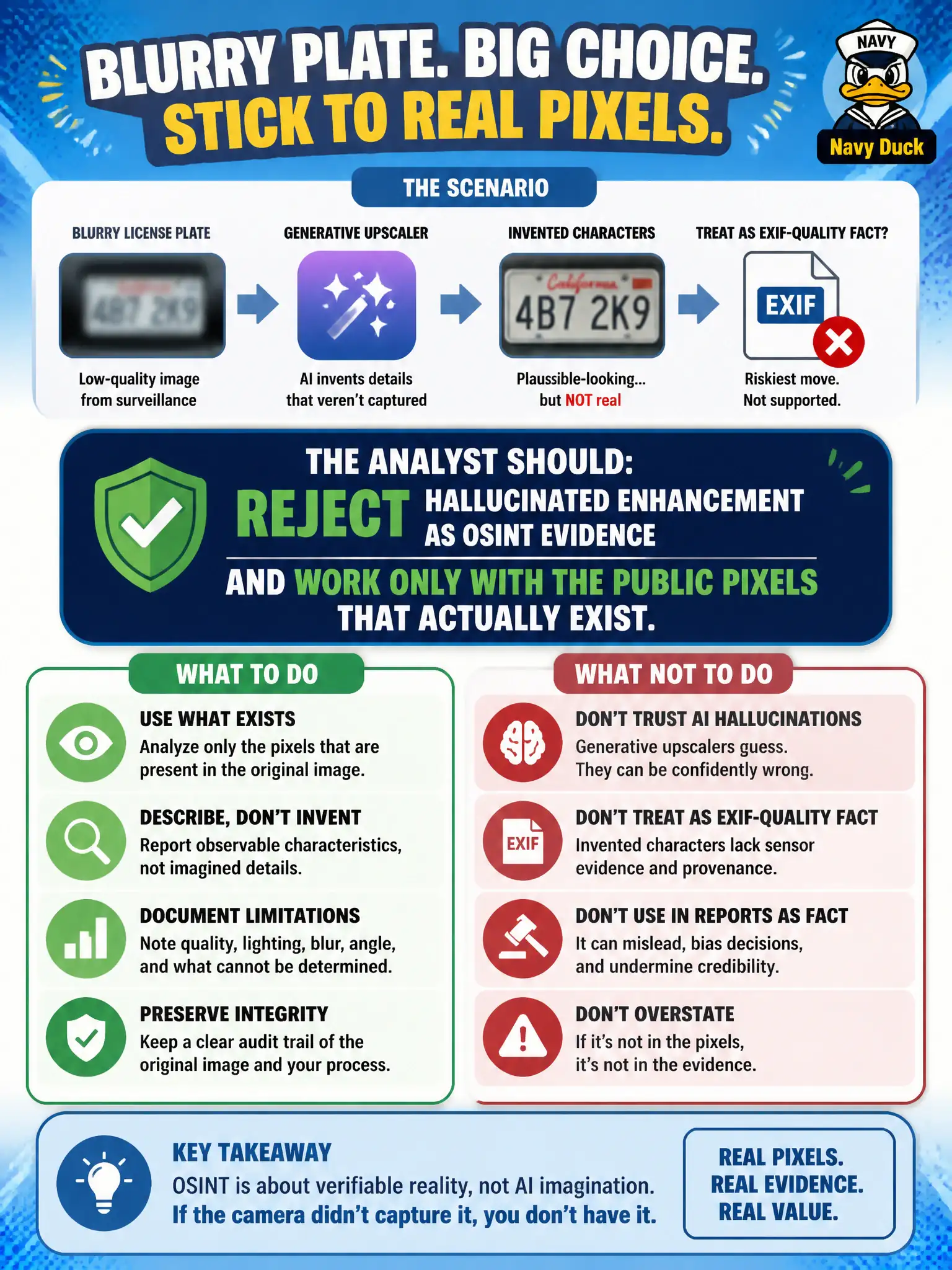
Code enforcement wants to run a blurry license plate through a generative upscaler and treat the invented characters as EXIF-quality fact. What should the analyst do?
Select an answer to reveal the explanation.
Short Explanation
An AI upscaler is not a microscope—it is a guess-the-missing-letters machine. If the plate was mush, the new characters were invented, not recovered. Work with the public pixels you have, and do not dress guesses up as EXIF.
Full Explanation
Generative upscalers and “AI enhance” tools invent plausible high-frequency detail that the original sensor never recorded. For code enforcement, hallucinated license-plate characters are not EXIF-quality fact and must not enter the OSINT evidence set or citation narrative. Analysts should reject enhanced plates as evidence and work only with public pixels that actually exist—partial plates, vehicle color and body style, bumper stickers, and landmark context—without inventing missing digits. Accepting an upscaled plate because a model reports high confidence confuses proprietary scoring with forensic truth; confidence meters are not chain-of-custody. Overlaying invented characters onto the original and storing both as a single fused fact contaminates the record and can mislead supervisors or prosecutors. Converting the photo to a lossless format before upscaling does not create optical information that was never captured. Civic enforcement credibility depends on staying inside observable evidence. Exam caveat: PORP requires candidates to refuse generative enhancement as a substitute for readable public pixels and to keep enhancement experiments out of evidentiary claims. Operational check: preserve the original file and hash, document any enhancement attempt as non-evidentiary if performed at all, report only characters legible on the source image, and advance the case with landmarks, other photos, or authorized plate readers rather than invented text.