
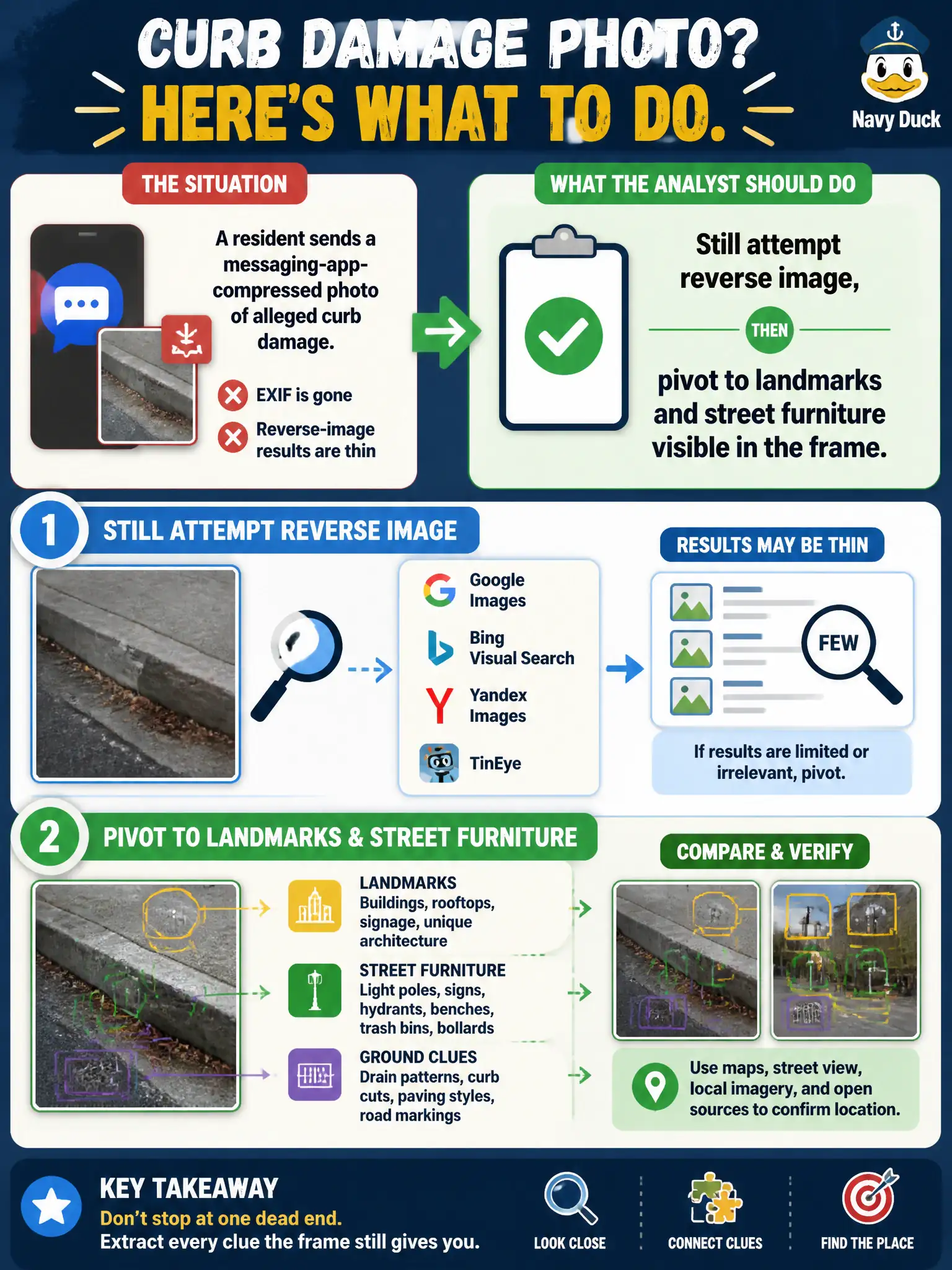
A resident sends a messaging-app-compressed photo of alleged curb damage. EXIF is gone and reverse-image results are thin. What should the analyst do?
Select an answer to reveal the explanation.
Short Explanation
Messaging apps squeeze photos like a suitcase—metadata often falls out, but the snapshot is still a snapshot. Try reverse image anyway, then read the scene: poles, signs, paint, storefronts. The picture can still talk when the EXIF file is silent.
Full Explanation
Messaging apps commonly recompress photos, strip EXIF, and thin reverse-image indexes, yet the remaining pixels often still show curb geometry, ramps, storm drains, storefronts, utility poles, and other public landmarks usable for civic geolocation. For a resident complaint about alleged curb damage, the analyst should still attempt reverse image on the compressed attachment, then systematically pivot to street furniture and map comparison rather than closing the case because metadata is gone. Declaring compressed photos worthless abandons OSINT methods that do not depend on EXIF and that routinely succeed on 311-style imagery. Geocoding the sender’s message headers or account locale as the curb’s location confuses network or messaging metadata with the place depicted; headers do not prove where the camera pointed and can mis-dispatch crews to the wrong block. Demanding that the resident reinstall original camera firmware to “restore EXIF” is operationally unrealistic, outside civic OSINT scope, and unnecessary when visual pivots remain. Thin reverse-image results are a cue to deepen landmark analysis, not a cue to stop. Exam caveat: PORP emphasizes resilience when social compression removes metadata—visual civic assets remain first-class evidence—and rejects substituting sender geolocation for scene geolocation. Operational check: hash and archive the received file, run reverse image, annotate every readable landmark, compare to GIS and street imagery, ask only for a clearer public photo if the pin is still weak, and document residual uncertainty before issuing a work order.