
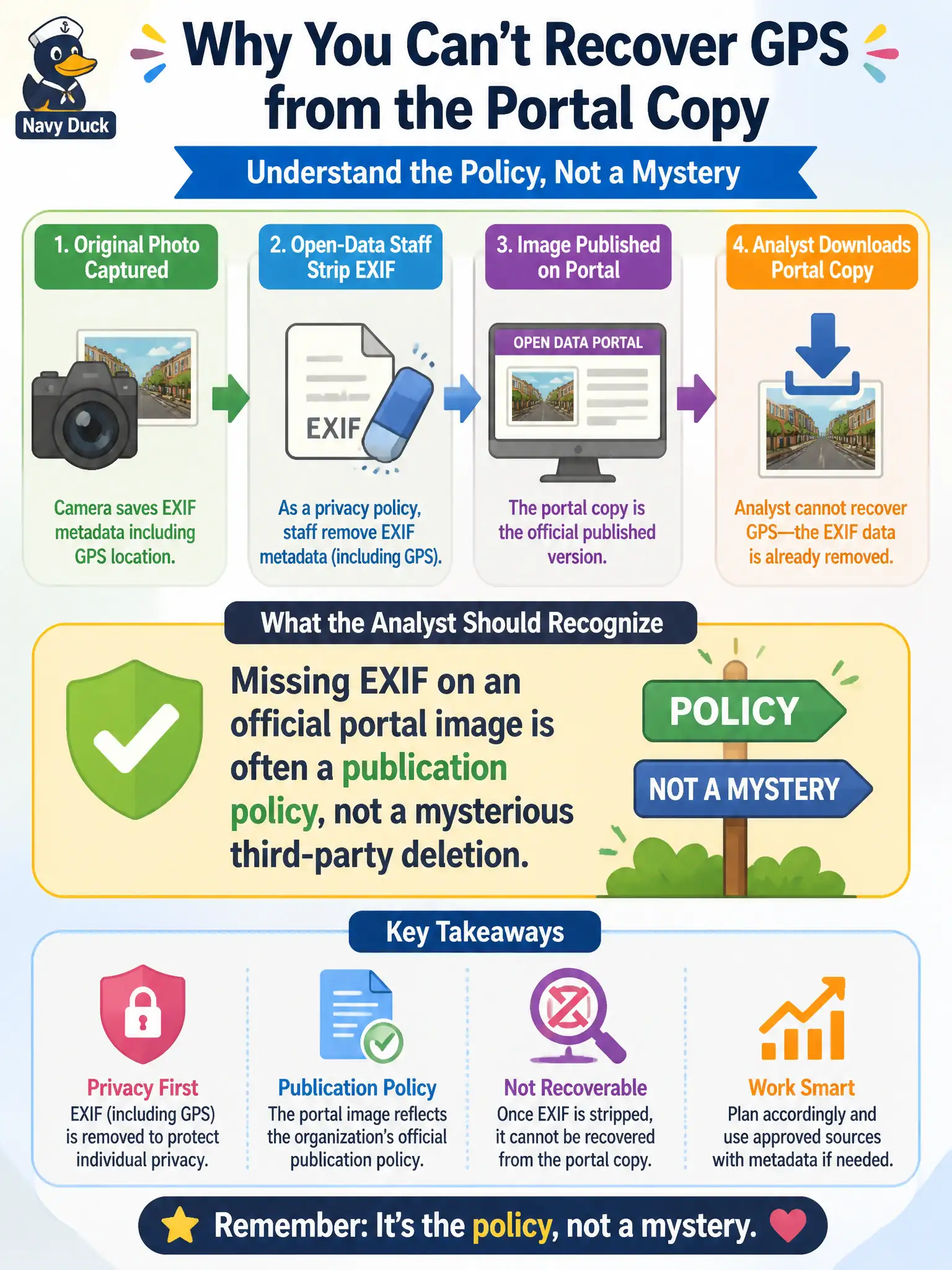
Open-data staff strip EXIF from published street photos as a privacy policy. An analyst later cannot recover GPS from the portal copy. What should the analyst recognize?
Select an answer to reveal the explanation.
Short Explanation
City portals often wipe photo metadata the way they blur license plates—on purpose. If GPS is gone from the published copy, that is usually the privacy pipeline, not a ghost in the machine. Look for another public source if the raw file is not yours to have.
Full Explanation
Civic open-data and portal publication policies often strip EXIF, including GPS, before street photos go public. Missing metadata on an official portal copy is therefore frequently a deliberate privacy control, not evidence that a third party stole tags or that the image is fake. Analysts who later cannot recover GPS from the portal file should recognize publication hygiene as the likely cause and shift to visual geolocation—landmarks, asset IDs, and reverse image—rather than assuming criminal deletion. Claiming civic photos always retain GPS contradicts common municipal privacy practice. Filing a computer-crime report for “metadata theft” from a stripped portal copy misreads policy as intrusion. Believing an AI upscaler can reconstruct original GPS from pixels confuses generative hallucination with forensic recovery; coordinates are not encoded in JPEG DCT coefficients waiting to be reinvented. Exam caveat: PORP expects candidates to distinguish intentional civic EXIF stripping from unexplained absence and to continue analysis with public visual methods. Operational check: confirm the portal’s published media policy, note that the working copy is EXIF-stripped, geolocate from scene content and agency maps, and document that GPS absence is consistent with publication practice rather than alleging tampering without other evidence.