
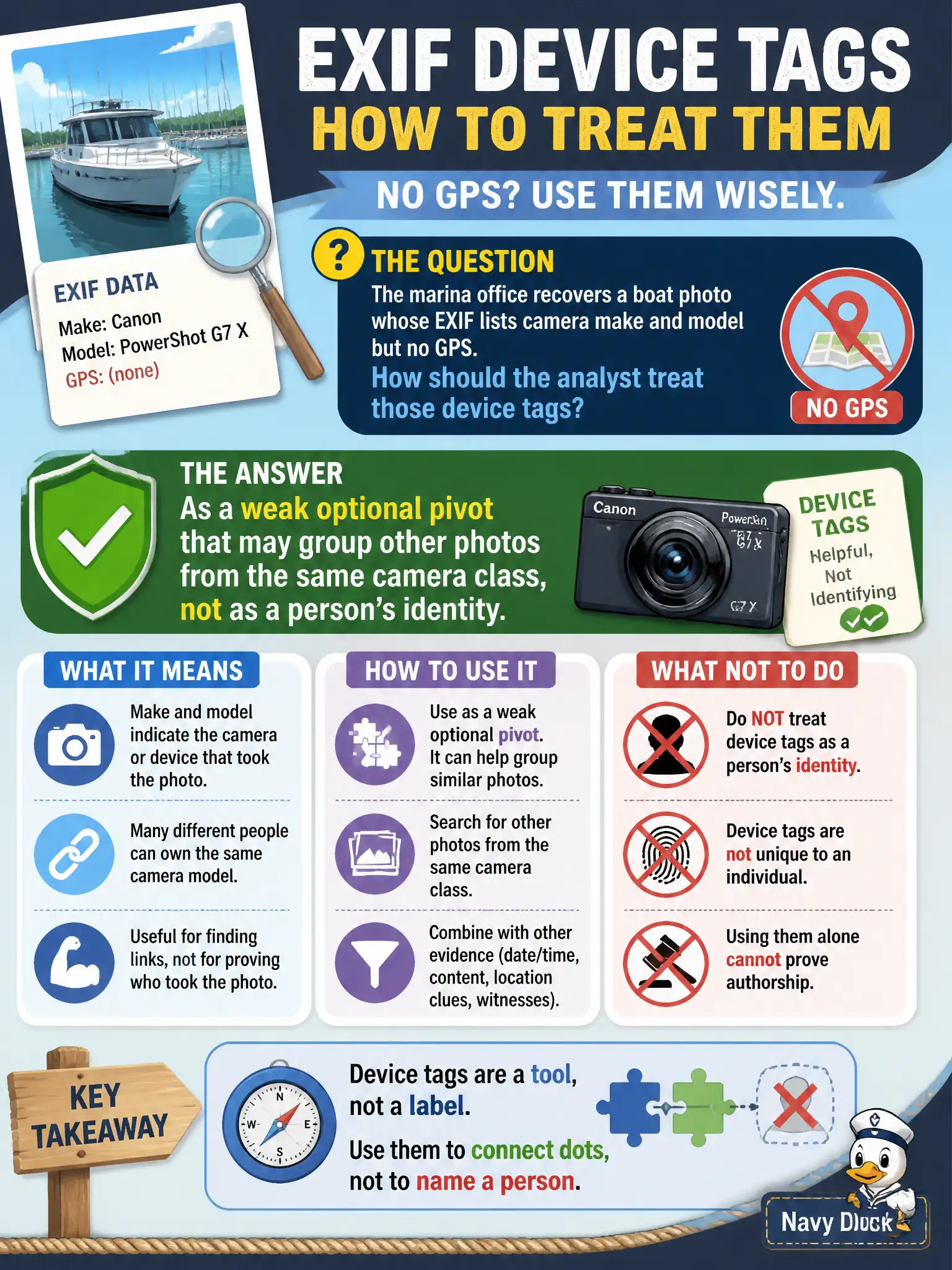
The marina office recovers a boat photo whose EXIF lists camera make and model but no GPS. How should the analyst treat those device tags?
Select an answer to reveal the explanation.
Short Explanation
Camera make is like knowing someone drives a silver sedan—it is a clue, not a name tag. EXIF device fields can weakly group other files from the same gear. They do not identify a person and they do not replace looking at the picture.
Full Explanation
EXIF camera make and model describe the device class that wrote the file, not a legal identity. In marina or harbor due diligence, those tags can weakly group other public photos that share the same camera signature, which may support a timeline or equipment-consistency check when combined with visual content. They do not name a boat owner, prove staff custody, or place the vessel at a slip. Treating make and model as a unique owner identifier overclaims what consumer EXIF carries: thousands of cameras share the same strings. Inferring marina location solely because staff might use that brand confuses device marketing with geospatial fact. Discarding the image until GPS appears throws away usable visual OSINT—hull marks, pier geometry, and background landmarks—when metadata is incomplete, which is common after social compression. Exam caveat: PORP treats device tags as optional weak pivots subordinate to visual and documentary corroboration; absence of GPS is normal and is not automatic grounds to abandon the photo. Operational check: extract make/model if present, search for other public files with the same signature only as a secondary lead, prioritize reverse image and scene features for the marina question, and never report camera brand as proof of ownership in the civic file.