
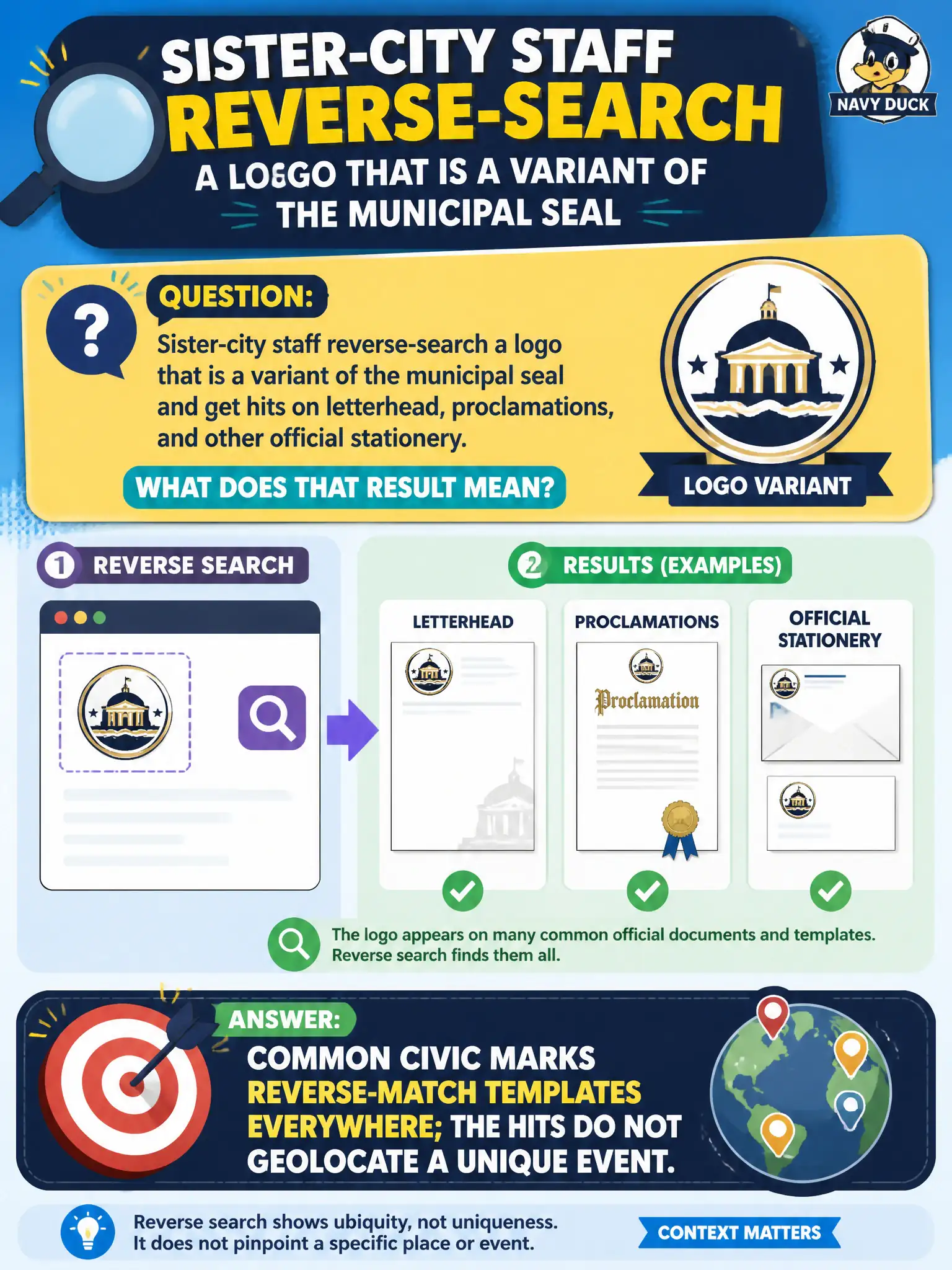
Sister-city staff reverse-search a logo that is a variant of the municipal seal and get hits on letterhead, proclamations, and other official stationery. What does that result mean?
Select an answer to reveal the explanation.
Short Explanation
Searching a city seal is like searching a stop-sign shape—you will find the template, not the intersection. Common civic marks live on thousands of documents. Those matches do not pin an incident to a doorway.
Full Explanation
Municipal seals, letterhead marks, and seal variants are template graphics that reverse-image engines match wherever stationery, proclamations, and official PDFs reuse the artwork. Sister-city or civic branding staff who reverse-search such a logo will typically land many legitimate hits that share the mark without sharing a street address or incident. Those hits prove the graphic is a common civic mark; they do not geolocate a unique event or prove the photograph was taken inside City Hall. Reading each stationery hit as a separate incident confuses document-template reuse with event multiplicity. Treating the seal as indoor location proof conflates branding with architecture. Claiming reverse image cannot run on graphics that include text is false: engines routinely match logos with text, but the analytic meaning of a common seal match is weak for place. Exam caveat: PORP emphasizes that highly common civic graphics reverse-match everywhere and must not be used as unique geo pivots; distinctive scene content still matters. Operational check: classify seal-like matches as template noise, pivot to unique landmarks or scene content in the same image, and document that letterhead hits were reviewed and dismissed as non-locating before any sister-city location claim.