
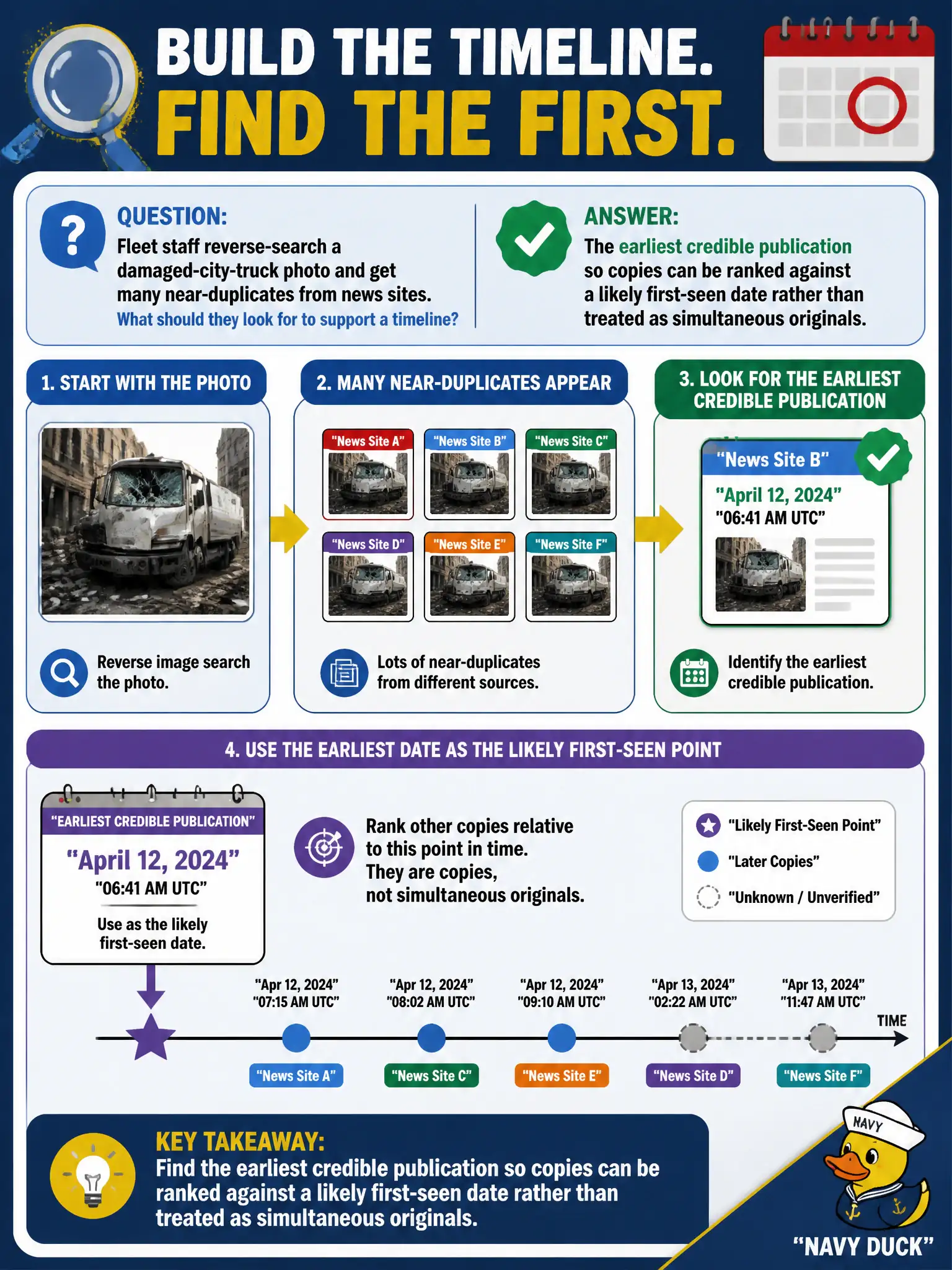
Fleet staff reverse-search a damaged-city-truck photo and get many near-duplicates from news sites. What should they look for to support a timeline?
Select an answer to reveal the explanation.
Short Explanation
News sites photocopy each other. The useful question is who published first, not who got the most likes or the mushiest pixels. Earliest credible appearance is how you sketch a civic timeline from copies.
Full Explanation
When reverse search returns many near-duplicates of a damaged-city-truck photo, look for the earliest credible publication so copies can be ranked against a likely first-seen date rather than treated as simultaneous originals. The copy with the most social likes is not thereby the original. Limiting attention to screenshots from the last hour misses earlier syndication. Choosing the blurriest copy because blur means it is closest to the crash is a myth. Exam caveat: earliest visible publication is a lower bound on public appearance, not always the true camera original. Operational check: tabulate matching URLs with publication timestamps, identify the earliest credible source, and cite that timeline basis in the fleet note. Keep the civic purpose, method limits, and exhibit labels aligned so reviewers can see what was public-source work versus other authorities. Document residual uncertainty explicitly rather than implying completeness. Prefer reversible public methods and preserve exhibits that a second analyst can reopen without guessing. When sources conflict, record both locators and state the confidence level in plain language. Retain retrieval times beside every locator so volatility does not erase the observation window.