
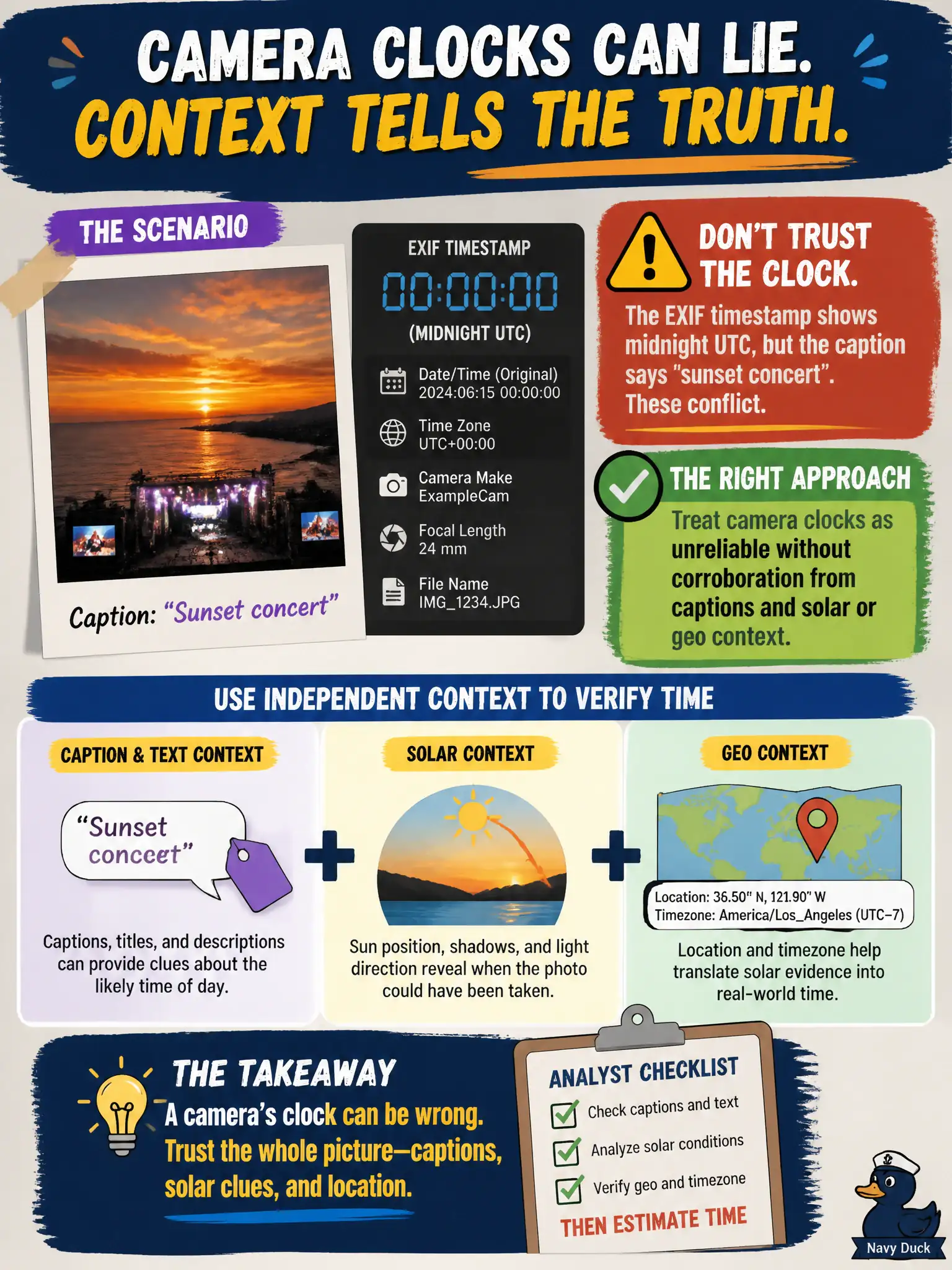
A tourism photo's EXIF timestamp is midnight UTC while the caption says sunset concert. How should the analyst treat the camera clock?
Select an answer to reveal the explanation.
Short Explanation
Camera clocks are the friend who is always 'on time' in the wrong time zone. Midnight UTC versus a sunset caption is a mismatch, not a cancelled concert. Check sun, place, and other photos before believing the stamp.
Full Explanation
Treat camera clocks as unreliable without corroboration from captions and solar or geo context. A tourism photo stamped midnight UTC while the caption describes a sunset concert illustrates how device time zones and incorrect clocks mislead. Trusting EXIF time over any caption because cameras cannot be wrong is false. Converting midnight UTC into proof the concert was cancelled is an invalid inference. Ignoring geography because timestamps settle location reverses the corroboration order. Exam caveat: normalize time zones explicitly when comparing EXIF to event schedules. Operational check: compare EXIF time, caption claims, and expected solar conditions at the stated place; if they conflict, label time as unresolved and seek independent schedules or other photos. Keep the civic purpose, method limits, and exhibit labels aligned so reviewers can see what was public-source work versus other authorities. Document residual uncertainty explicitly rather than implying completeness. Prefer reversible public methods and preserve exhibits that a second analyst can reopen without guessing. When sources conflict, record both locators and state the confidence level in plain language. Retain retrieval times beside every locator so volatility does not erase the observation window.