
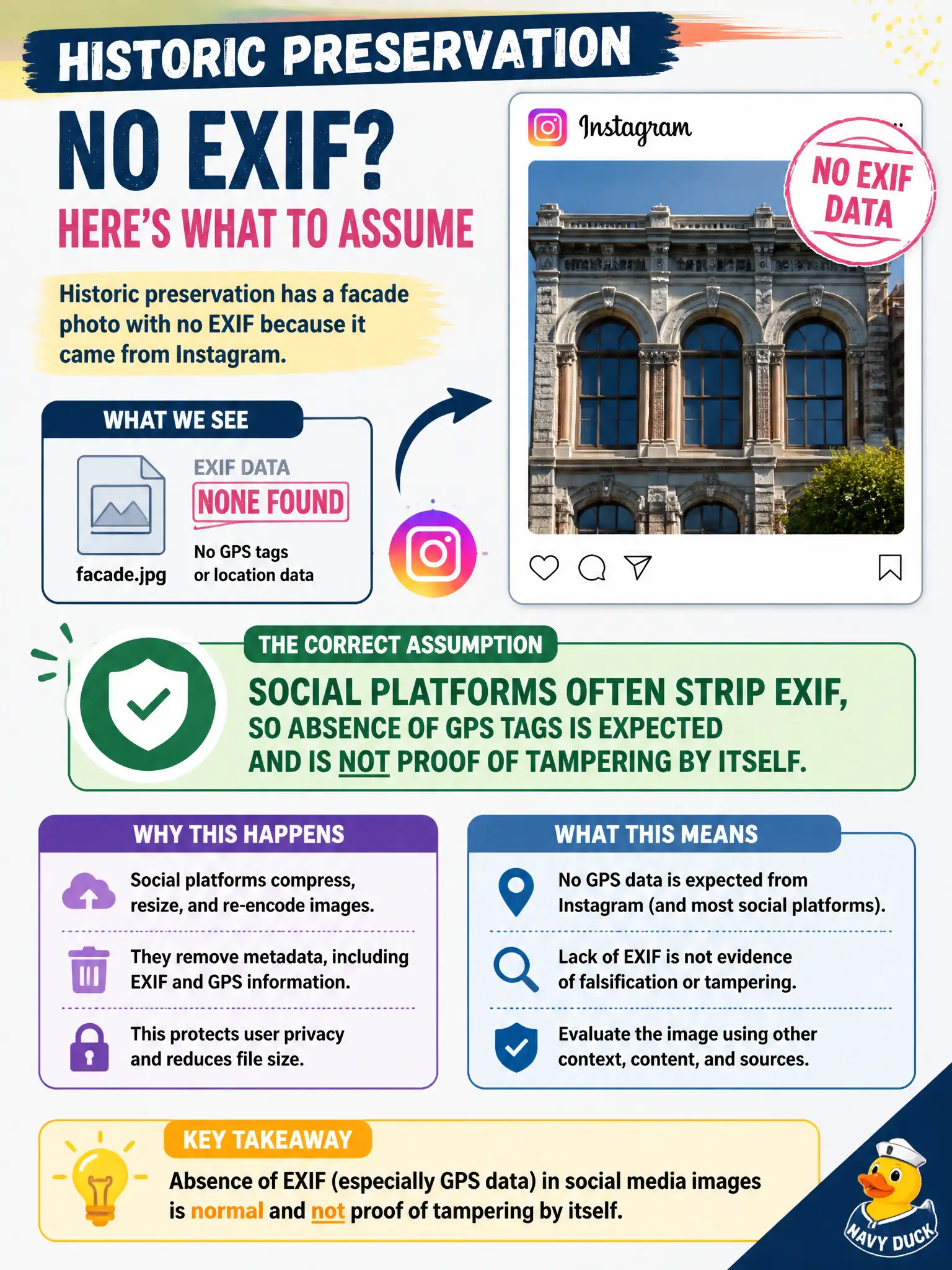
Historic preservation has a facade photo with no EXIF because it came from Instagram. What should the analyst assume?
Select an answer to reveal the explanation.
Short Explanation
Instagram is a luggage scanner for photos—it dumps the EXIF before the file comes out the other side. No GPS tags from that platform is normal, not a smoking gun of tampering. You still have the pixels; use reverse image and scenery, not missing metadata as a confession.
Full Explanation
Social platforms often strip EXIF, including GPS, so absence of those tags on an Instagram facade photo is expected and is not proof of tampering by itself. Historic-preservation analysts should not treat missing GPS as evidence of photographer misconduct. Instagram does not always preserve full camera EXIF for civic users. The photo is not unusable for OSINT without EXIF—content, reverse image, and context still matter. Exam caveat: when original camera files are later obtained, their EXIF can be compared, but platform downloads remain EXIF-poor by design. Operational check: note the platform source and EXIF-stripped expectation in the file log, then proceed with reverse image and visual analysis rather than a tampering allegation based only on missing tags. Keep the civic purpose, method limits, and exhibit labels aligned so reviewers can see what was public-source work versus other authorities. Document residual uncertainty explicitly rather than implying completeness. Prefer reversible public methods and preserve exhibits that a second analyst can reopen without guessing. When sources conflict, record both locators and state the confidence level in plain language. Retain retrieval times beside every locator so volatility does not erase the observation window.