
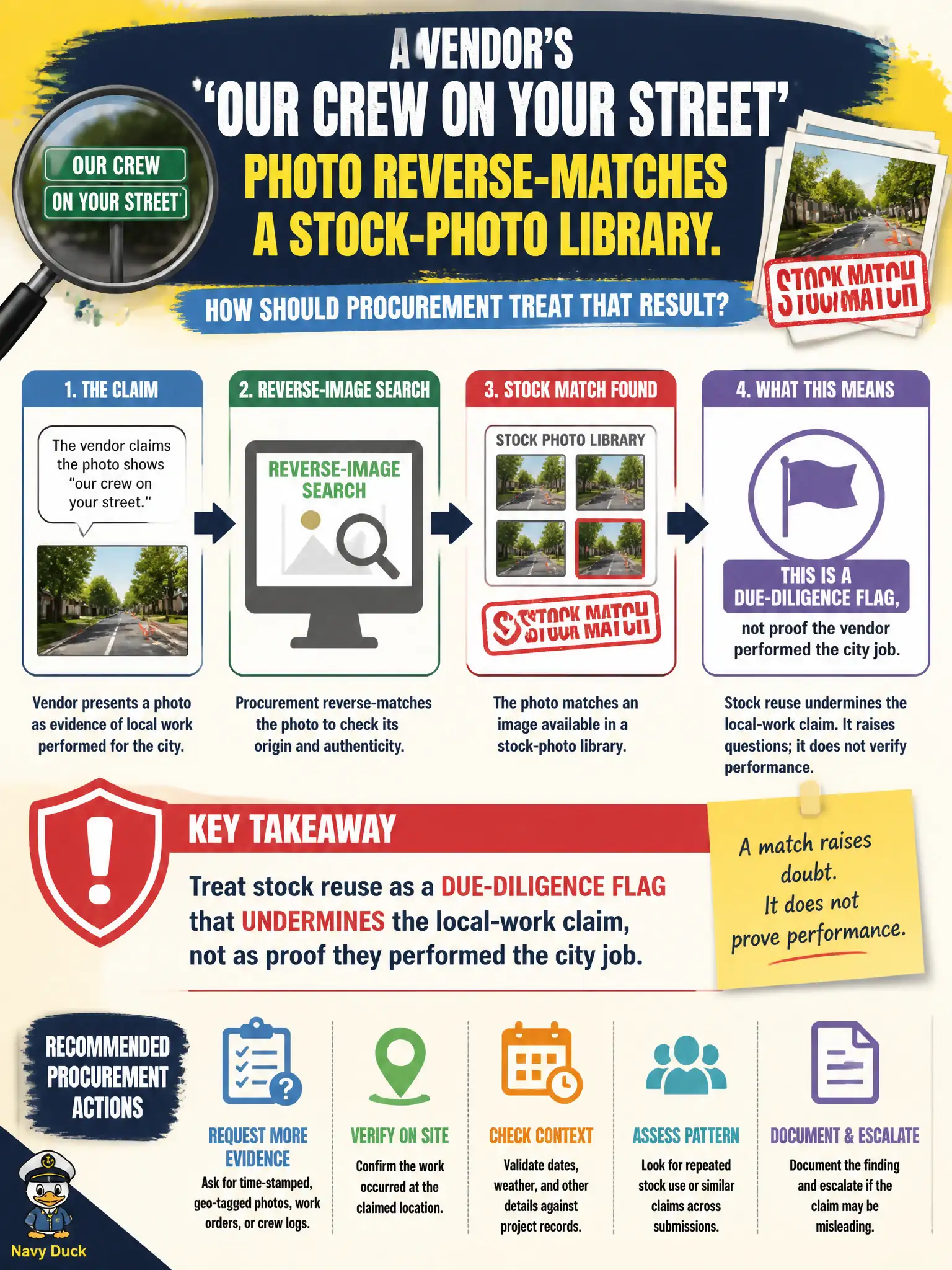
A vendor's 'our crew on your street' photo reverse-matches a stock-photo library. How should procurement treat that result?
Select an answer to reveal the explanation.
Short Explanation
If the 'crew on your street' picture also sells as generic stock, that is a red flag, not a timesheet. Reverse image just showed the photo is not evidence of local work. It does not prove they never worked—it proves this picture does not prove they did.
Full Explanation
A reverse-image hit on a stock-photo library is a due-diligence flag that undermines a vendor's local-work claim; it is not proof the crew performed the city job overnight. Treating the stock match as proof of local performance inverts the meaning of generic marketing art. Ignoring reverse image because marketing photos are never in-scope for OSINT discards a useful procurement check. Demanding the vendor's camera so staff can recover deleted originals escalates beyond public-source methods and is usually unnecessary for the flag. Exam caveat: stock reuse suggests unverified visuals; it does not by itself prove broader fraud without more facts. Operational check: preserve the stock-library match URL beside the vendor page capture and describe the claim that the image was supposed to support in the procurement note. Keep the civic purpose, method limits, and exhibit labels aligned so reviewers can see what was public-source work versus other authorities. Document residual uncertainty explicitly rather than implying completeness. Prefer reversible public methods and preserve exhibits that a second analyst can reopen without guessing. When sources conflict, record both locators and state the confidence level in plain language.