
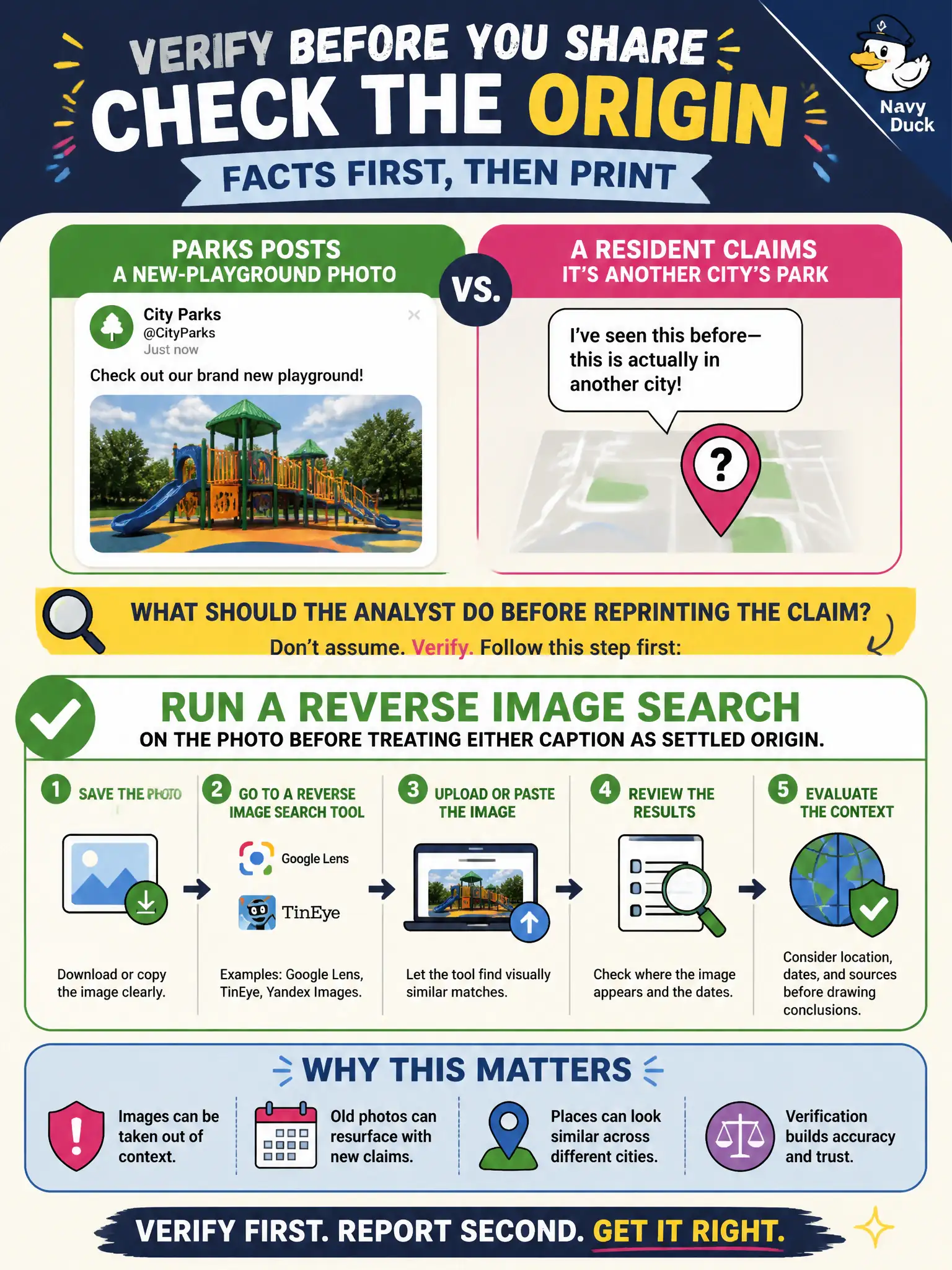
Parks posts a new-playground photo that a resident claims is actually another city's park. What should the analyst do before reprinting the claim?
Select an answer to reveal the explanation.
Short Explanation
When two captions fight over one photo, reverse image search is the tie-breaker you run first. It finds earlier posts and lookalikes without inventing pixels or slapping on a logo. Publish after you know where the picture has lived.
Full Explanation
Run a reverse image search on the contested playground photo before treating either caption as settled origin. Parks publication does not automatically prove locality when a resident claims the image is another city's park. Cropping a city logo onto the photo to prove it is local fabricates evidence. Asking a vendor to enhance pixels until a street sign appears is speculative manipulation, not a first-line OSINT method. Ignoring the dispute because Parks already published the image skips verification. Exam caveat: reverse-image matches can themselves be wrong or syndicated—use them as leads alongside maps and known landmarks. Operational check: reverse-search the image, record matching URLs and dates, and corroborate with independent scene details before reprinting an origin claim. Keep the civic purpose, method limits, and exhibit labels aligned so reviewers can see what was public-source work versus other authorities. Document residual uncertainty explicitly rather than implying completeness. Prefer reversible public methods and preserve exhibits that a second analyst can reopen without guessing. When sources conflict, record both locators and state the confidence level in plain language.