
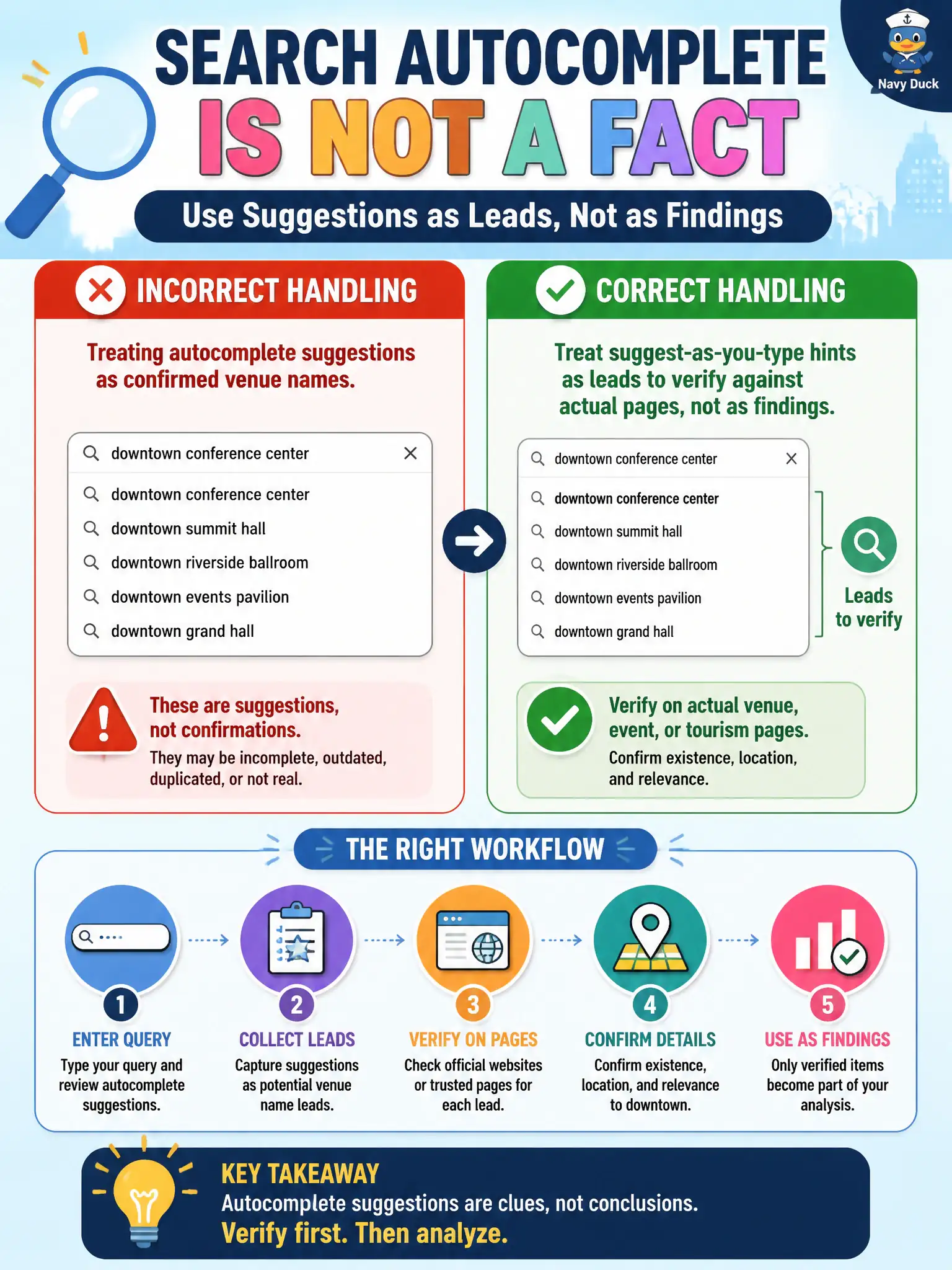
A convention-bureau analyst treats search-autocomplete suggestions as confirmed downtown venue names. What is the correct handling?
Select an answer to reveal the explanation.
Short Explanation
Autocomplete is a whisper, not a citation. It is the engine guessing what other people typed, not a stamped venue roster. Use the hint, open a real page, and keep the suggestion out of the findings column.
Full Explanation
Treat suggest-as-you-type hints as leads to verify against actual pages, not as findings. Autocomplete ranks common queries; it is not a sourced civic fact about downtown venues. Pasting autocomplete strings into the report as sourced facts with no URL invents evidence. Treating autocomplete as a court-admissible municipal record overstates its status. Disabling the search box so suggestions cannot contaminate research is unnecessary if analysts simply refuse to cite suggestions without page verification. Exam caveat: suggestions can still be useful brainstorming inputs when immediately checked. Operational check: for each autocomplete lead, open and capture a real page URL that confirms or refutes the venue name before it enters the convention-bureau report. Keep the civic purpose, method limits, and exhibit labels aligned so reviewers can see what was public-source work versus other authorities. Document residual uncertainty explicitly rather than implying completeness. Prefer reversible public methods and preserve exhibits that a second analyst can reopen without guessing. When sources conflict, record both locators and state the confidence level in plain language. Retain retrieval times beside every locator so volatility does not erase the observation window.