
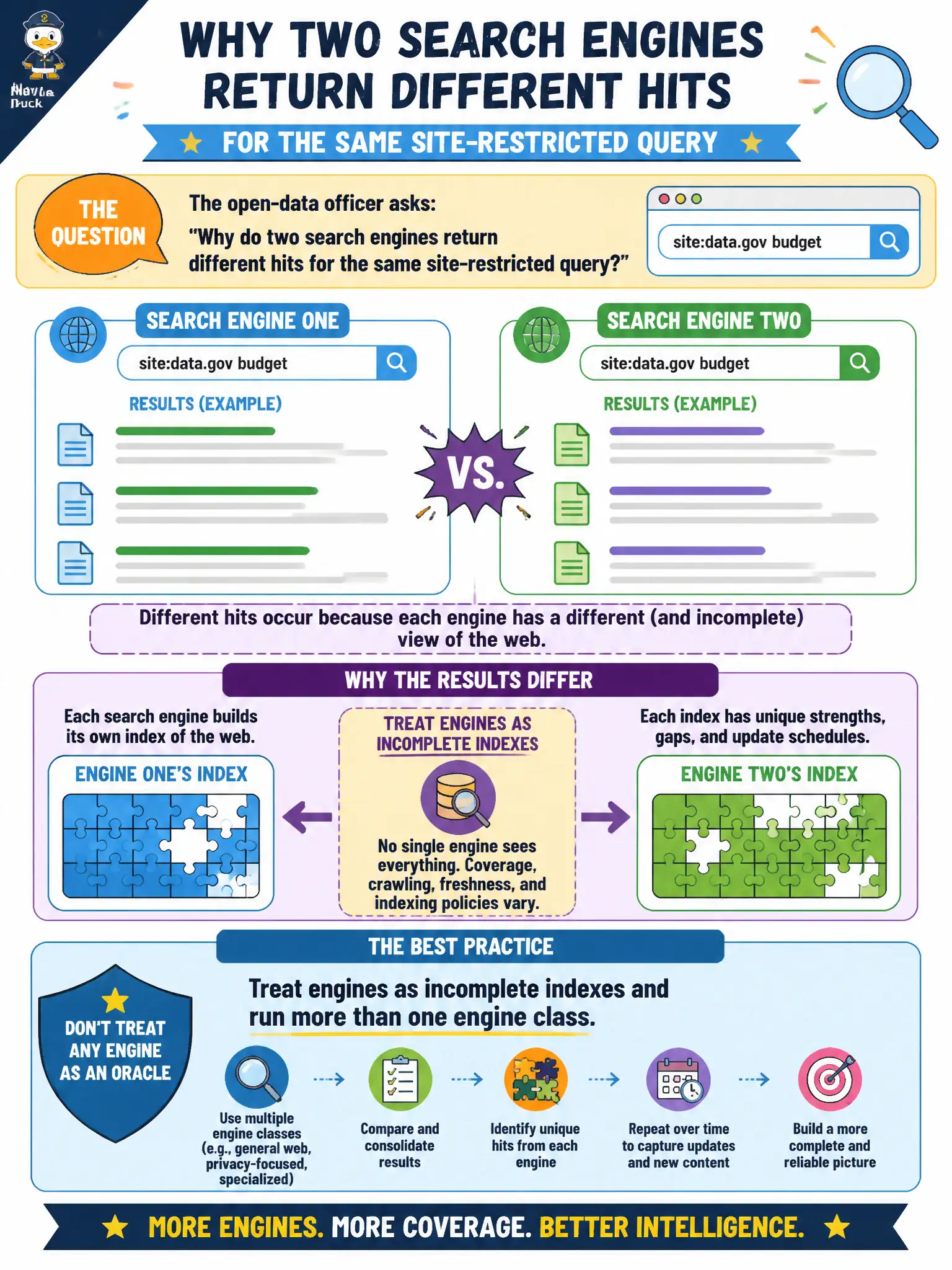
The open-data officer asks why two search engines return different hits for the same site-restricted query. How should the analyst explain it?
Select an answer to reveal the explanation.
Short Explanation
Search engines are different librarians with different card catalogs—not a single omniscient archive. If one misses a city PDF, another may have crawled it. Run more than one class; do not crown an oracle.
Full Explanation
Treat search engines as incomplete indexes and run more than one engine class rather than treating any engine as an oracle when the same site-restricted query returns different hits. One engine is not always lying simply because result counts differ—crawl coverage and ranking differ. Municipal domains are not limited to a single engine's index at a time. Different results do not mean the site restriction operator is disallowed. Exam caveat: identical operators can still miss pages that were never crawled; complementary browsing and archive checks remain useful. Operational check: reproduce the civic site-restricted query in at least two engine classes, merge unique URLs, and note which engine produced each keeper. Keep the civic purpose, method limits, and exhibit labels aligned so reviewers can see what was public-source work versus other authorities. Document residual uncertainty explicitly rather than implying completeness. Prefer reversible public methods and preserve exhibits that a second analyst can reopen without guessing. When sources conflict, record both locators and state the confidence level in plain language. Retain retrieval times beside every locator so volatility does not erase the observation window.