
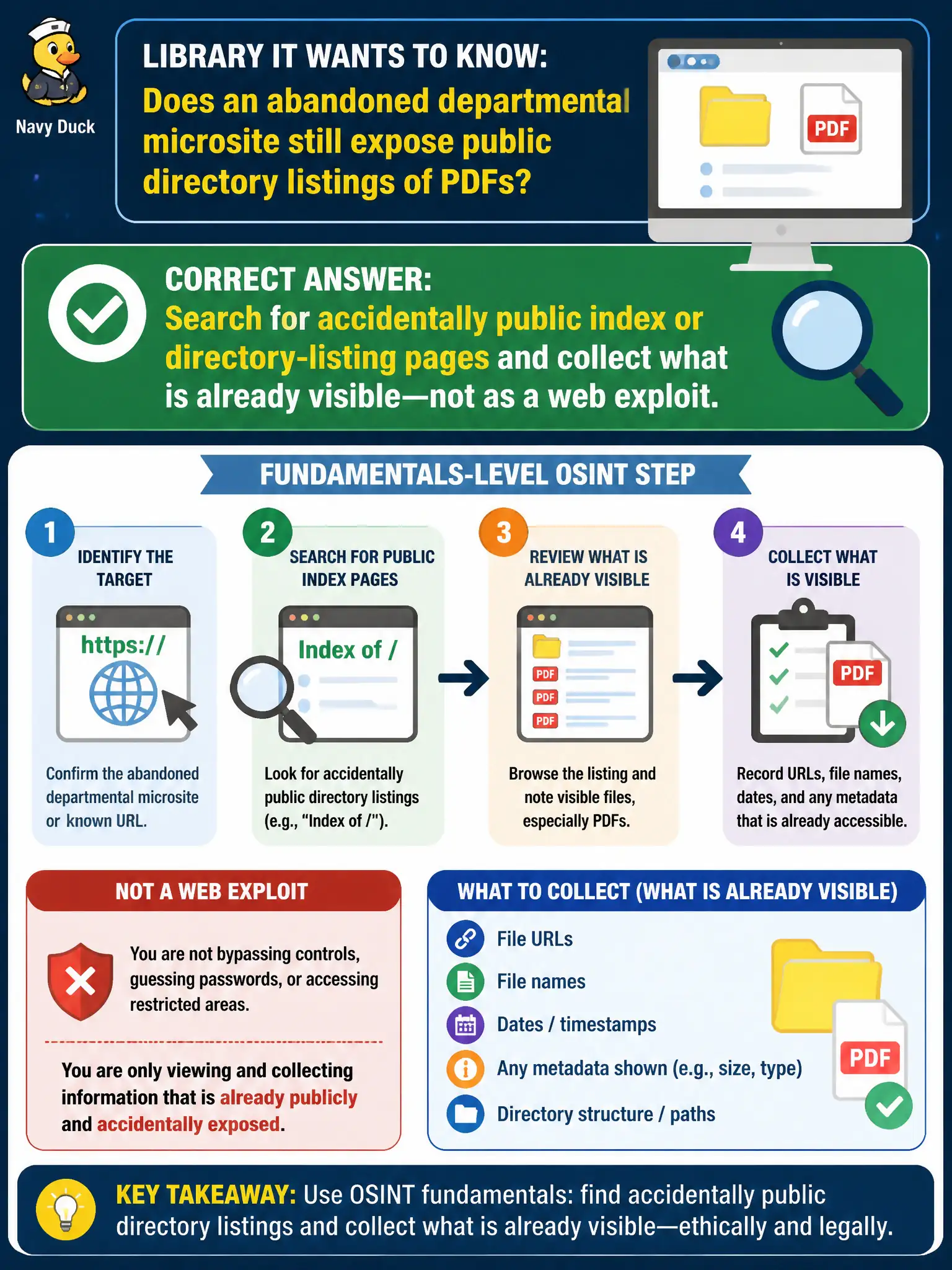
Library IT wants to know whether an abandoned departmental microsite still exposes public directory listings of PDFs. Which fundamentals-level OSINT step is appropriate?
Select an answer to reveal the explanation.
Short Explanation
Sometimes a forgotten microsite still shows a file listing the way a storage room shows unlabeled boxes. Finding that already-public index with search is OSINT. Breaking in to create a listing, or guessing FTP passwords, is a different exam.
Full Explanation
Fundamentals-level OSINT for an abandoned library departmental microsite means searching for accidentally public index or directory-listing pages and collecting what is already visible—not exploiting the site. Exploiting a file-upload flaw to plant a new directory page is offense, not collection. Guessing leftover FTP passwords is unauthorized access. Assuming every abandoned site has been fully decommissioned and skipping search misses common exposure patterns. Exam caveat: if listings reveal sensitive data, follow incident-reporting paths even while limiting the OSINT file to what was publicly visible. Operational check: query for index-of-style listings and open directory URLs related to the microsite host, capture what loads without authentication, and stop at the public boundary. Keep the civic purpose, method limits, and exhibit labels aligned so reviewers can see what was public-source work versus other authorities. Document residual uncertainty explicitly rather than implying completeness. Prefer reversible public methods and preserve exhibits that a second analyst can reopen without guessing. When sources conflict, record both locators and state the confidence level in plain language.