
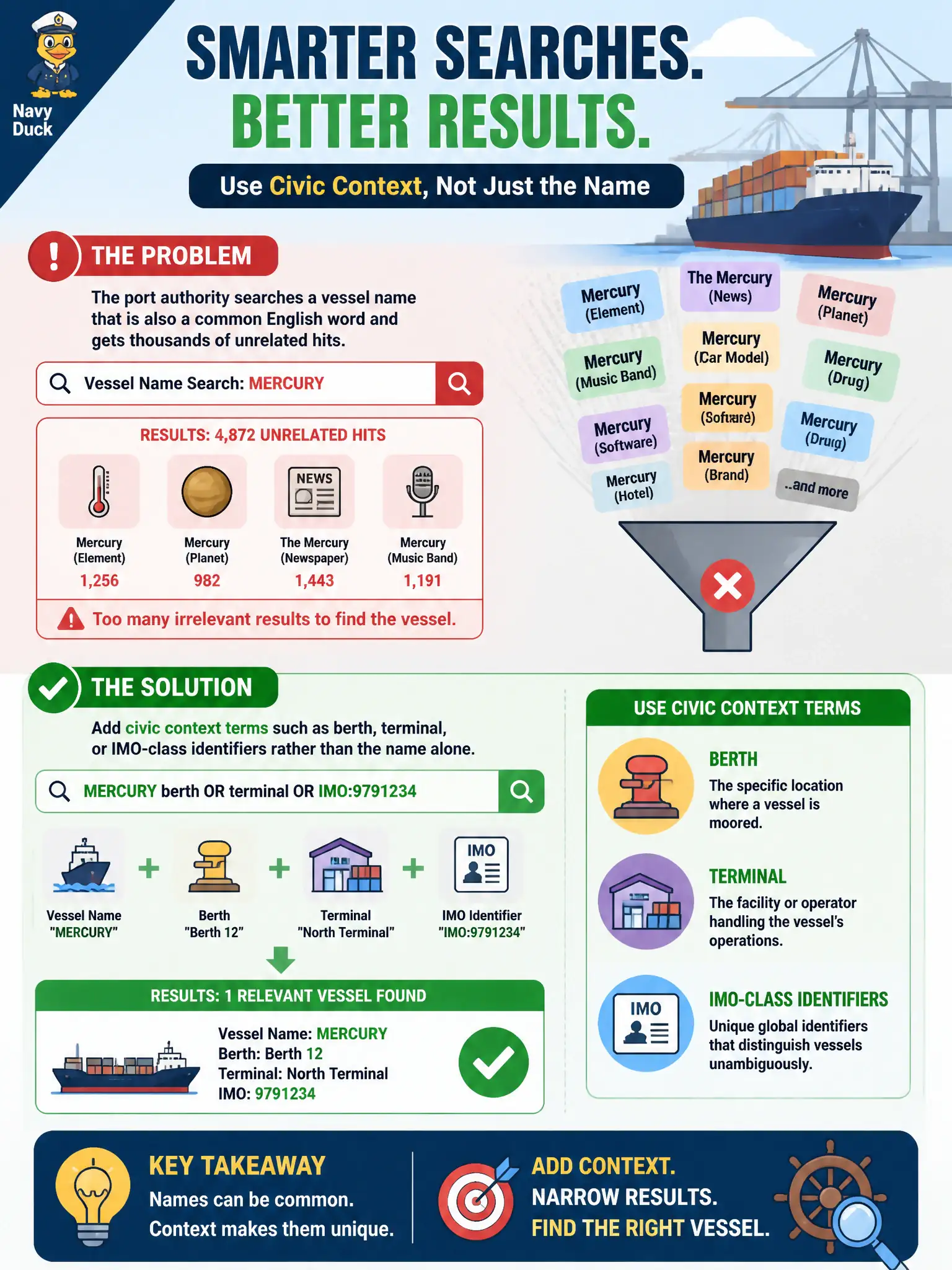
The port authority searches a vessel name that is also a common English word and gets thousands of unrelated hits. What should the analyst add?
Select an answer to reveal the explanation.
Short Explanation
A ship named after a common word is like searching 'harmony' and getting playlists. You need harbor context—berth, terminal, an IMO-class identifier—so the engine looks at the dock, not the dictionary. Shorter queries make the mess worse.
Full Explanation
When a vessel name is also a common English word, add civic context terms such as berth, terminal, or IMO-class identifiers rather than searching the name alone. Accepting the top dictionary result for the single common word fails disambiguation. Querying a dark-web marketplace for the vessel name leaves PORP public-source scope and is usually irrelevant to port operations. Truncating the vessel name to two letters broadens noise instead of narrowing it. Exam caveat: too many constraining terms can hide sparse but valid hits—iterate from name+one context term upward. Operational check: rebuild the query with at least one port-operations discriminator, compare precision to the bare-name set, and keep the locators that survive the narrowed search. Keep the civic purpose, method limits, and exhibit labels aligned so reviewers can see what was public-source work versus other authorities. Document residual uncertainty explicitly rather than implying completeness. Prefer reversible public methods and preserve exhibits that a second analyst can reopen without guessing. When sources conflict, record both locators and state the confidence level in plain language. Retain retrieval times beside every locator so volatility does not erase the observation window.