
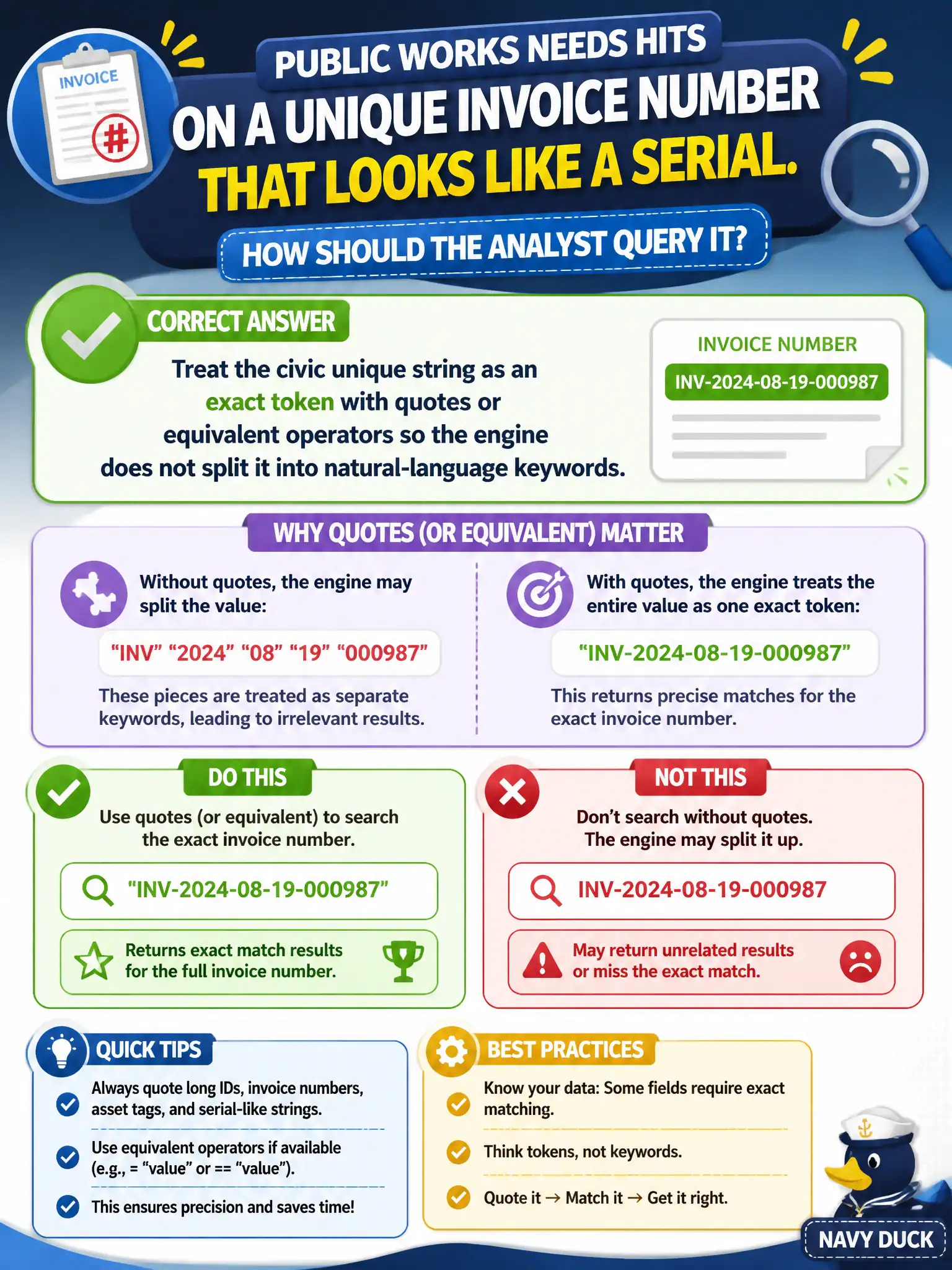
Public works needs hits on a unique invoice number that looks like a serial. How should the analyst query it?
Select an answer to reveal the explanation.
Short Explanation
Invoice numbers are serials, not sentences. If you let the engine 'helpfully' chop them up, you get noise instead of the one filing that matches. Quote the token—or use the operator class that keeps it whole.
Full Explanation
Treat a unique civic invoice number that looks like a serial as an exact token with quotes or equivalent operators so the engine does not split it into natural-language keywords. Dropping the number to search only the vendor's English name loses the strongest discriminator public works has. Asking the engine to find similar invoices without supplying the identifier invites fuzzy irrelevance. Reversing the digits to see whether a different invoice appears is a nonsense transform that can fabricate false leads. Exam caveat: try hyphenation and spacing variants of the same token if the first exact query fails. Operational check: run the exact quoted invoice string first, then controlled format variants, and record which form produced the hit used in the report. Keep the civic purpose, method limits, and exhibit labels aligned so reviewers can see what was public-source work versus other authorities. Document residual uncertainty explicitly rather than implying completeness. Prefer reversible public methods and preserve exhibits that a second analyst can reopen without guessing. When sources conflict, record both locators and state the confidence level in plain language. Retain retrieval times beside every locator so volatility does not erase the observation window.