
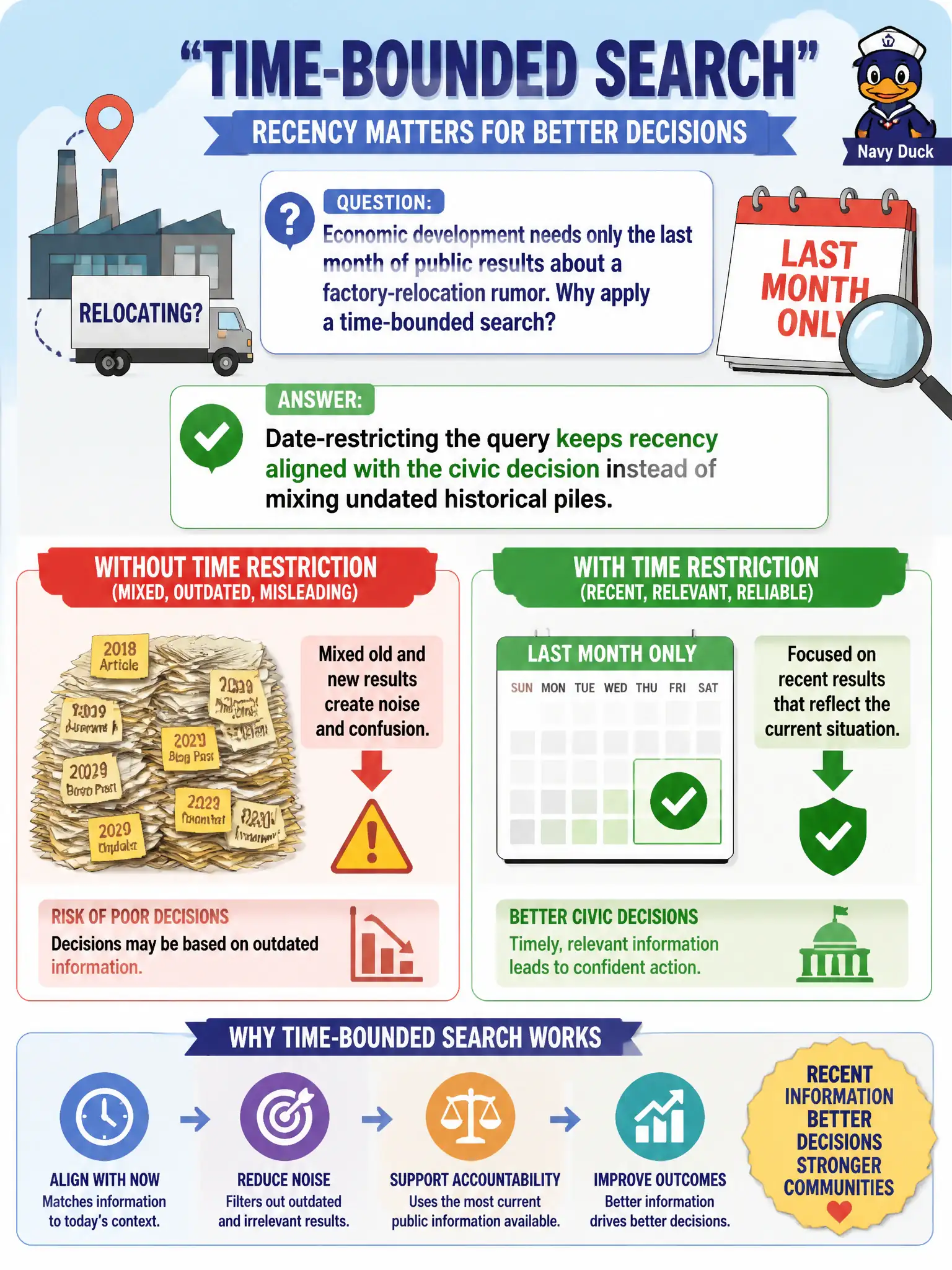
Economic development needs only the last month of public results about a factory-relocation rumor. Why apply a time-bounded search?
Select an answer to reveal the explanation.
Short Explanation
Old factory gossip sits in search results like leftover flyers on a kiosk. A date window is how you look at this month's stack, not every rumor since the mill closed. Recency still needs sources—filters are not a truth serum.
Full Explanation
Date-restricting the query keeps recency aligned with the civic decision when economic development needs only the last month of public results about a factory-relocation rumor, instead of mixing undated historical piles. Date filters do not prove the rumor is true merely because any hit appears. Search engines do not only index the last month unless a filter is used—that claim reverses how indexes work. Time filters do not replace the need to record source URLs. Exam caveat: highly relevant older documents may still matter as background; segregate them rather than pretending they fall inside the month window. Operational check: apply the time bound, save the filtered result set with retrieval date, and explicitly label any older material kept for context as outside the decision window. Keep the civic purpose, method limits, and exhibit labels aligned so reviewers can see what was public-source work versus other authorities. Document residual uncertainty explicitly rather than implying completeness. Prefer reversible public methods and preserve exhibits that a second analyst can reopen without guessing. When sources conflict, record both locators and state the confidence level in plain language.