
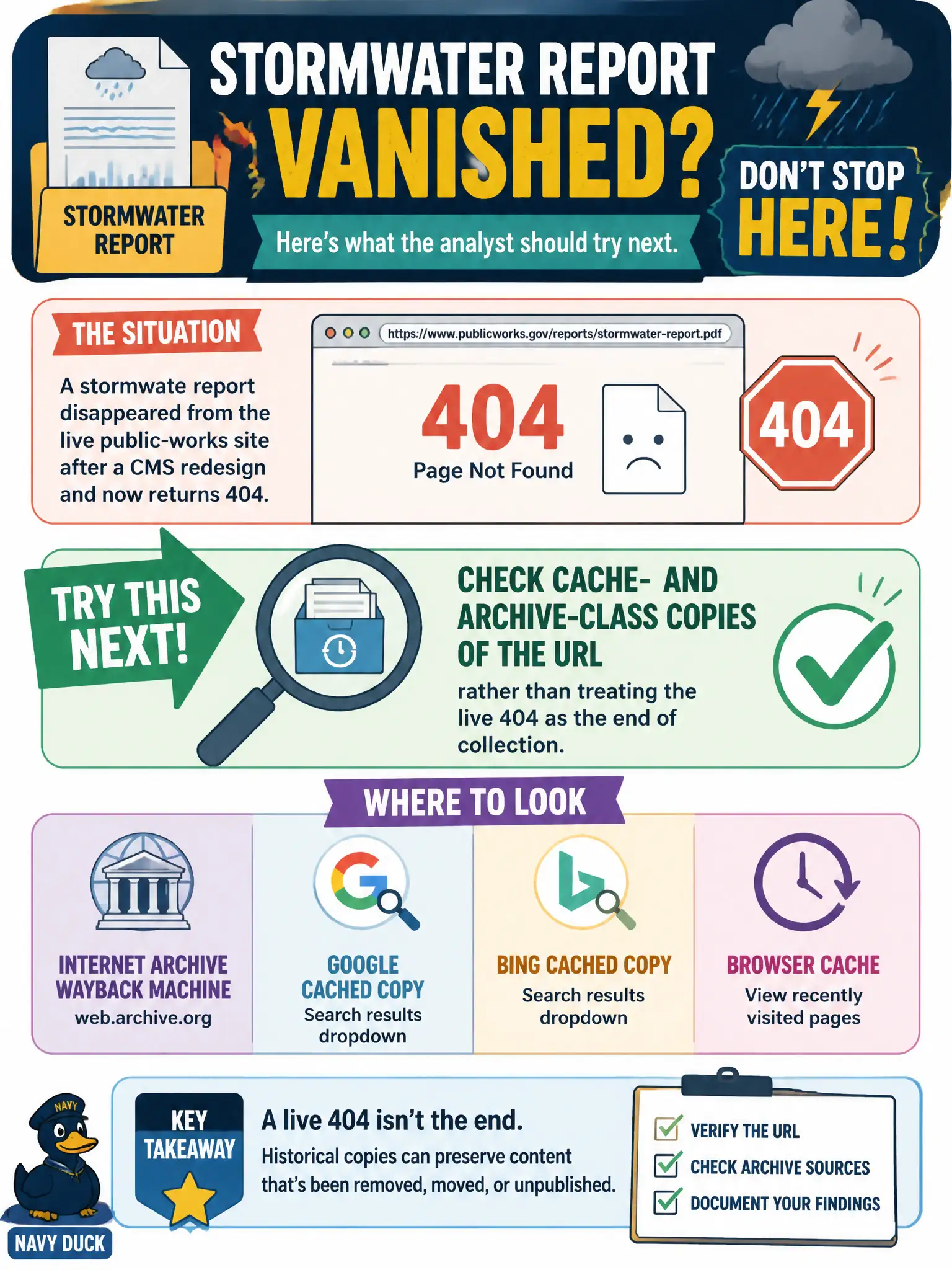
A stormwater report vanished from the live public-works site after a CMS redesign and now returns 404. What should the analyst try next?
Select an answer to reveal the explanation.
Short Explanation
A 404 is a locked front door, not a demolished house. Cache and archive copies often still hold the stormwater report the live CMS dropped. Guessing passwords or inventing a summary is how you fail the collection, not how you recover it.
Full Explanation
When a stormwater report vanishes from the live public-works site after a CMS redesign and returns 404, check cache- and archive-class copies of the URL rather than treating the live miss as the end of collection. Declaring the report never existed because the live URL fails confuses link rot with non-publication. Attempting administrative CMS logins to restore the unpublished file leaves public-source methods for privileged access. Replacing the missing report with an unsourced generated summary invents content. Exam caveat: archived copies can differ from the final live version—note the archive timestamp and any differences. Operational check: query at least one cache/archive source for the known URL, preserve the archived exhibit, and cite both the original locator and the archive capture time. Keep the civic purpose, method limits, and exhibit labels aligned so reviewers can see what was public-source work versus other authorities. Document residual uncertainty explicitly rather than implying completeness. Prefer reversible public methods and preserve exhibits that a second analyst can reopen without guessing. When sources conflict, record both locators and state the confidence level in plain language.