
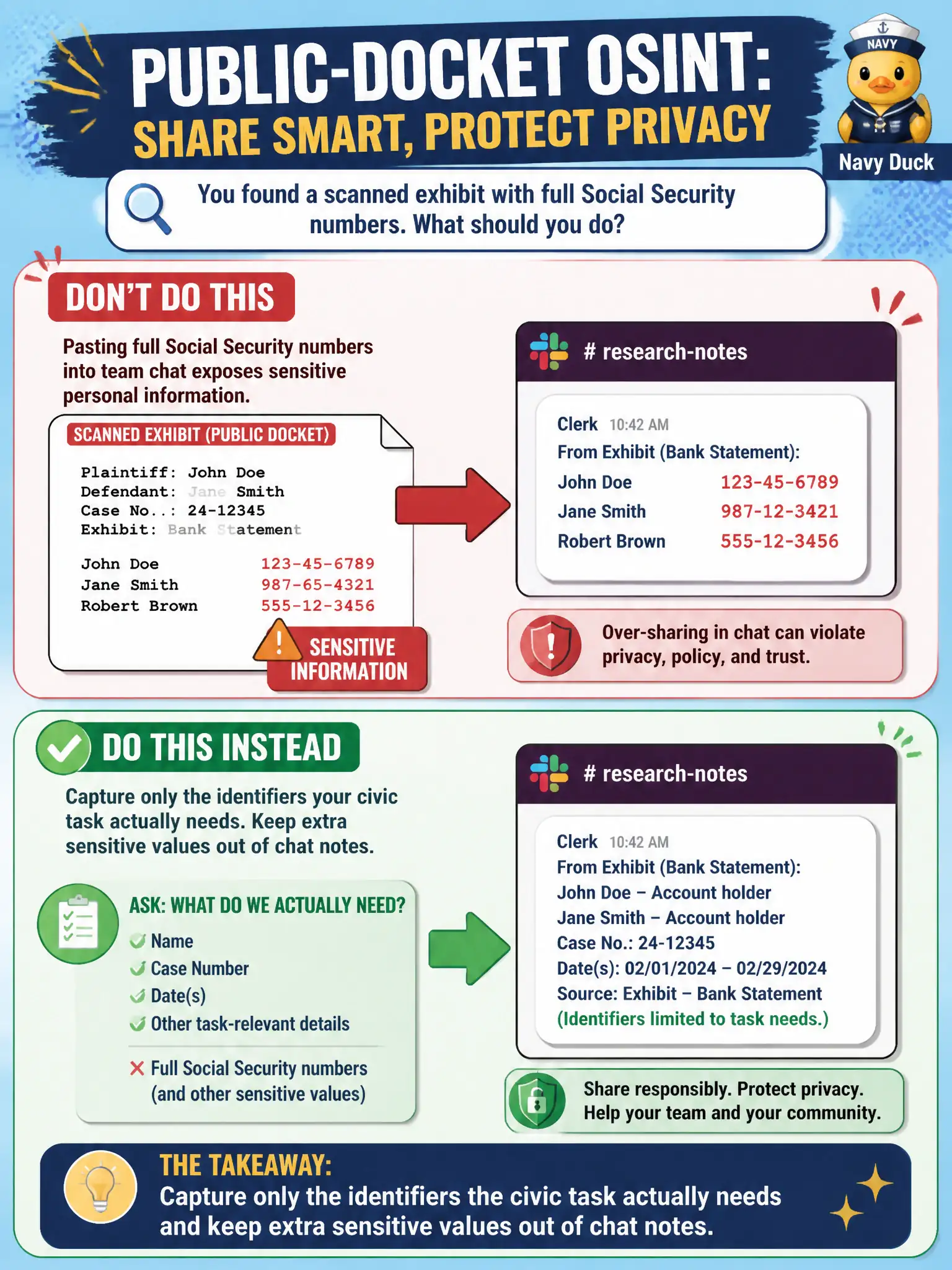
A municipal court clerk doing public-docket OSINT finds a scanned exhibit that includes full Social Security numbers and pastes those numbers into a team Slack channel used for research notes. What should the clerk do instead?
Select an answer to reveal the explanation.
Short Explanation
Just because a scan sits on a public docket does not mean Slack needs every extra identifier on it. Think of notes like a grocery list: write down what the recipe needs, not every label in the aisle. Civic OSINT captures what the task requires and leaves surplus sensitive data out of chat.
Full Explanation
Civic OSINT notes should capture only the identifiers the task actually needs and keep extra sensitive values—such as full Social Security numbers from a scanned public-docket exhibit—out of team Slack. Paste-dumping every identifier into chat expands the breach surface and often violates retention and privacy rules even when the underlying docket scan was public. Posting the full exhibit to a public city social feed for crowd-checking is reckless redistribution. Storing the complete SSN list in a personal cloud folder unconnected to the case notebook creates shadow copies outside official controls. Exam caveat: public availability of a court scan does not authorize unconstrained republication of sensitive identifiers into informal channels. Operational check: redact or omit SSNs from research chat; if a specific identifier is required, place it in the protected case system with need-to-know access and note only a partial reference in Slack. Keep the civic purpose, method limits, and exhibit labels aligned so reviewers can see what was public-source work versus other authorities. Document residual uncertainty explicitly rather than implying completeness. Prefer reversible public methods and preserve exhibits that a second analyst can reopen without guessing.