
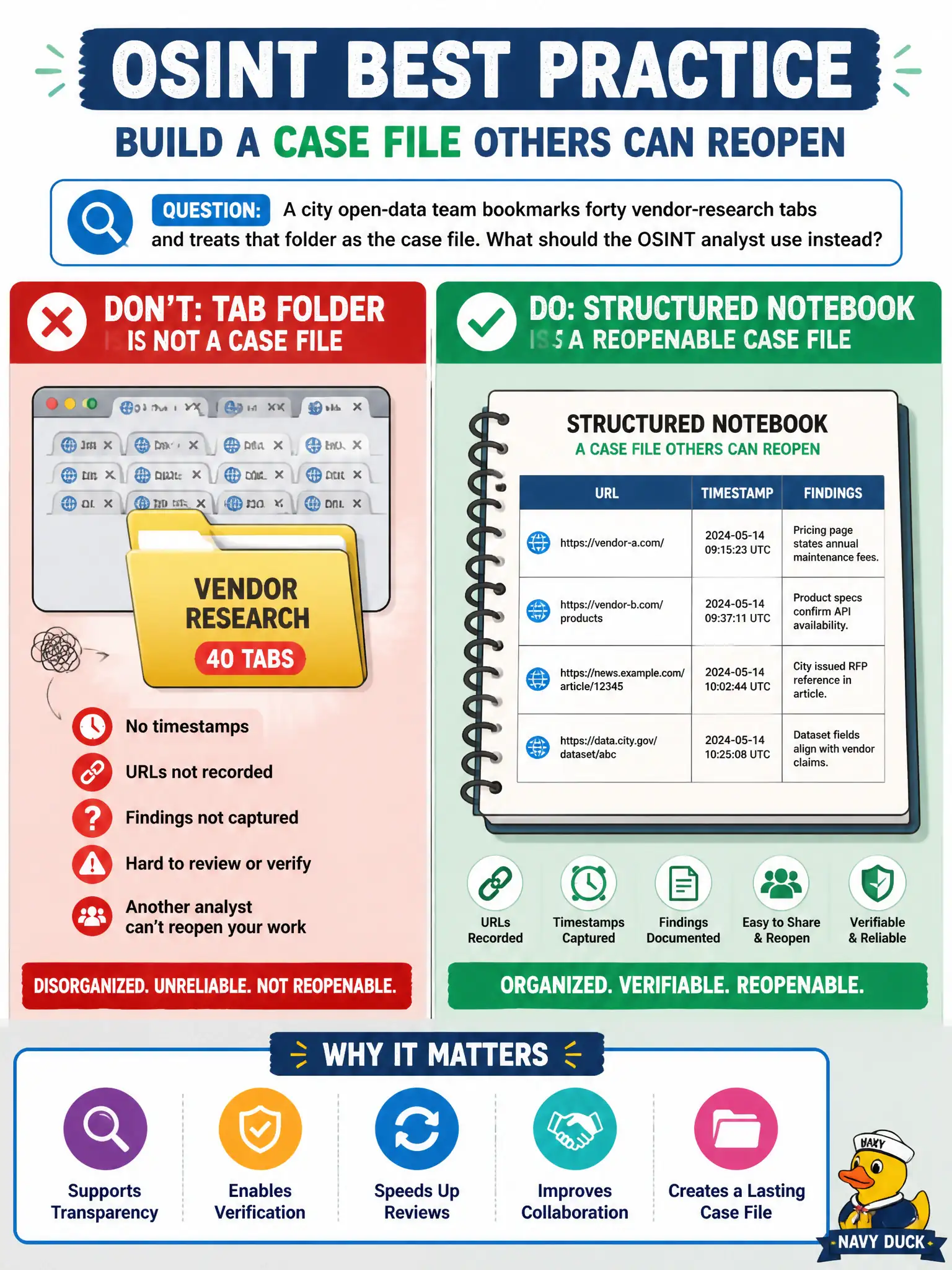
A city open-data team bookmarks forty vendor-research tabs and treats that folder as the case file. What should the OSINT analyst use instead?
Select an answer to reveal the explanation.
Short Explanation
Bookmarks are sticky notes on a fridge, not a case file. Close the laptop and those forty tabs are just titles with no what-you-saw or when-you-saw-it. A notebook that captures the URL, the time, and the finding is what survives into a report.
Full Explanation
A structured notebook with URLs, timestamps, and findings another analyst could reopen is the case file—not a bookmark folder of forty vendor-research tabs. Bookmarks are convenience pointers; they lack analytical claims, retrieval times, and durable context when tabs die or titles change. Growing the tab set until the live browser session itself is the official record collapses when the session closes. Emailing a bookmark export to the city manager and skipping written notes offloads an incomplete artifact. Capturing one unlabeled screenshot of the tab strip and then closing everything preserves almost nothing usable. Exam caveat: bookmarks can index the notebook, but they cannot replace sourced findings for open-data vendor research. Operational check: for each kept bookmark, ensure a matching notebook entry already exists with URL, time, and finding text before treating the topic as documented. Keep the civic purpose, method limits, and exhibit labels aligned so reviewers can see what was public-source work versus other authorities. Document residual uncertainty explicitly rather than implying completeness. Prefer reversible public methods and preserve exhibits that a second analyst can reopen without guessing.