
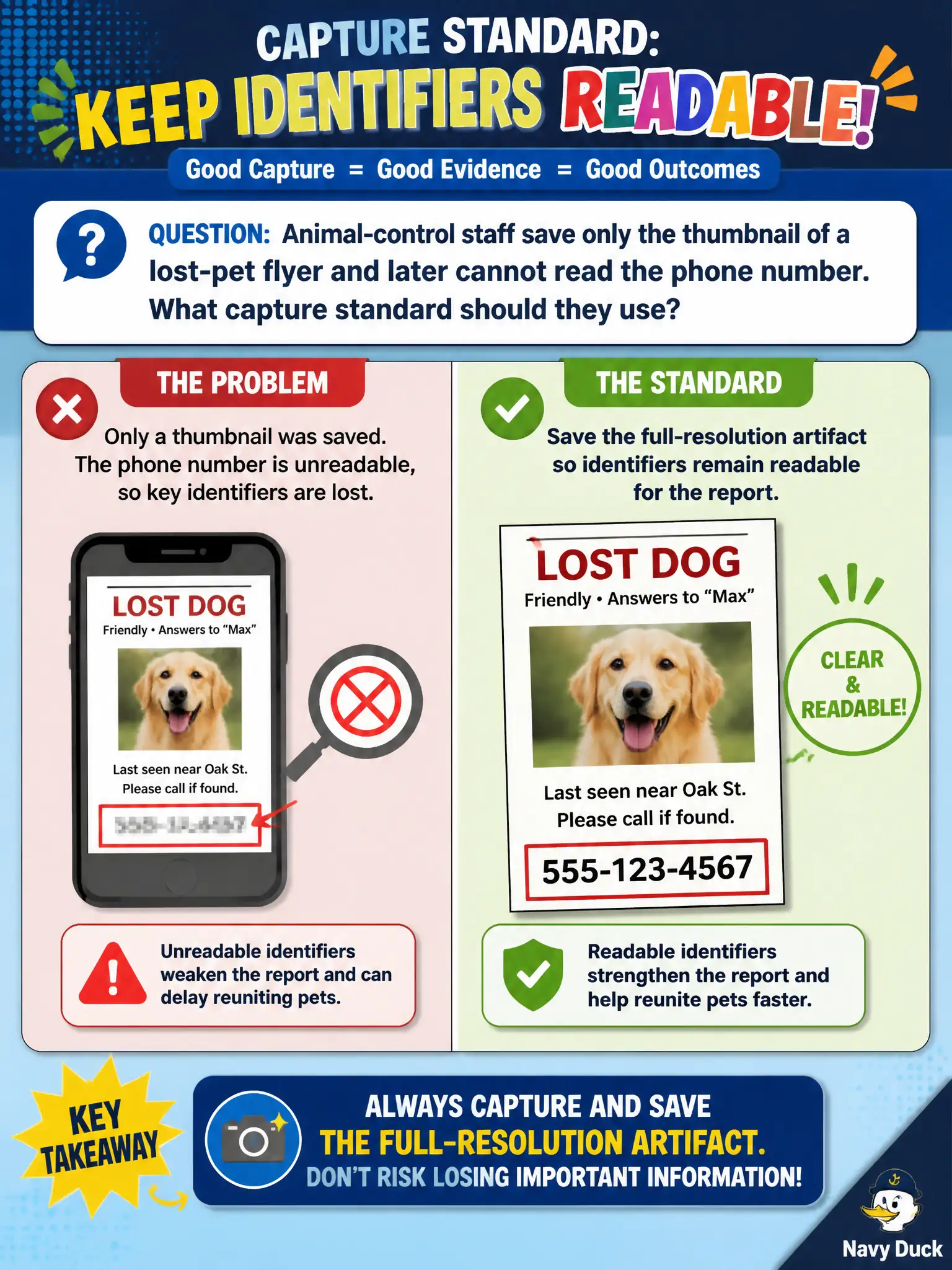
Animal-control staff save only the thumbnail of a lost-pet flyer and later cannot read the phone number. What capture standard should they use?
Select an answer to reveal the explanation.
Short Explanation
A postage-stamp photo of a street sign will not give you the address. Thumbnails drop the very identifiers the flyer exists to carry. Capture the full artifact so the number is still readable later.
Full Explanation
Capture standards for civic OSINT require saving the full-resolution artifact so identifiers such as phone numbers on a lost-pet flyer remain readable for the report. Thumbnails alone often blur or crop critical text and force animal-control staff into guesswork later. Keeping thumbnails only to save disk space is a false economy when the flyer is the evidence. Sketching the flyer from memory after closing the tab introduces transcription error. Saving a cropped icon of the pet photo while discarding the text removes the very contact data the case needs. Exam caveat: derivatives for briefing slides are fine if the archival capture retains full resolution and the locator. Operational check: zoom the saved file until the phone number and any case ID are legible; if not, recapture at full resolution before closing the source. Keep the civic purpose, method limits, and exhibit labels aligned so reviewers can see what was public-source work versus other authorities. Document residual uncertainty explicitly rather than implying completeness. Prefer reversible public methods and preserve exhibits that a second analyst can reopen without guessing. When sources conflict, record both locators and state the confidence level in plain language.