
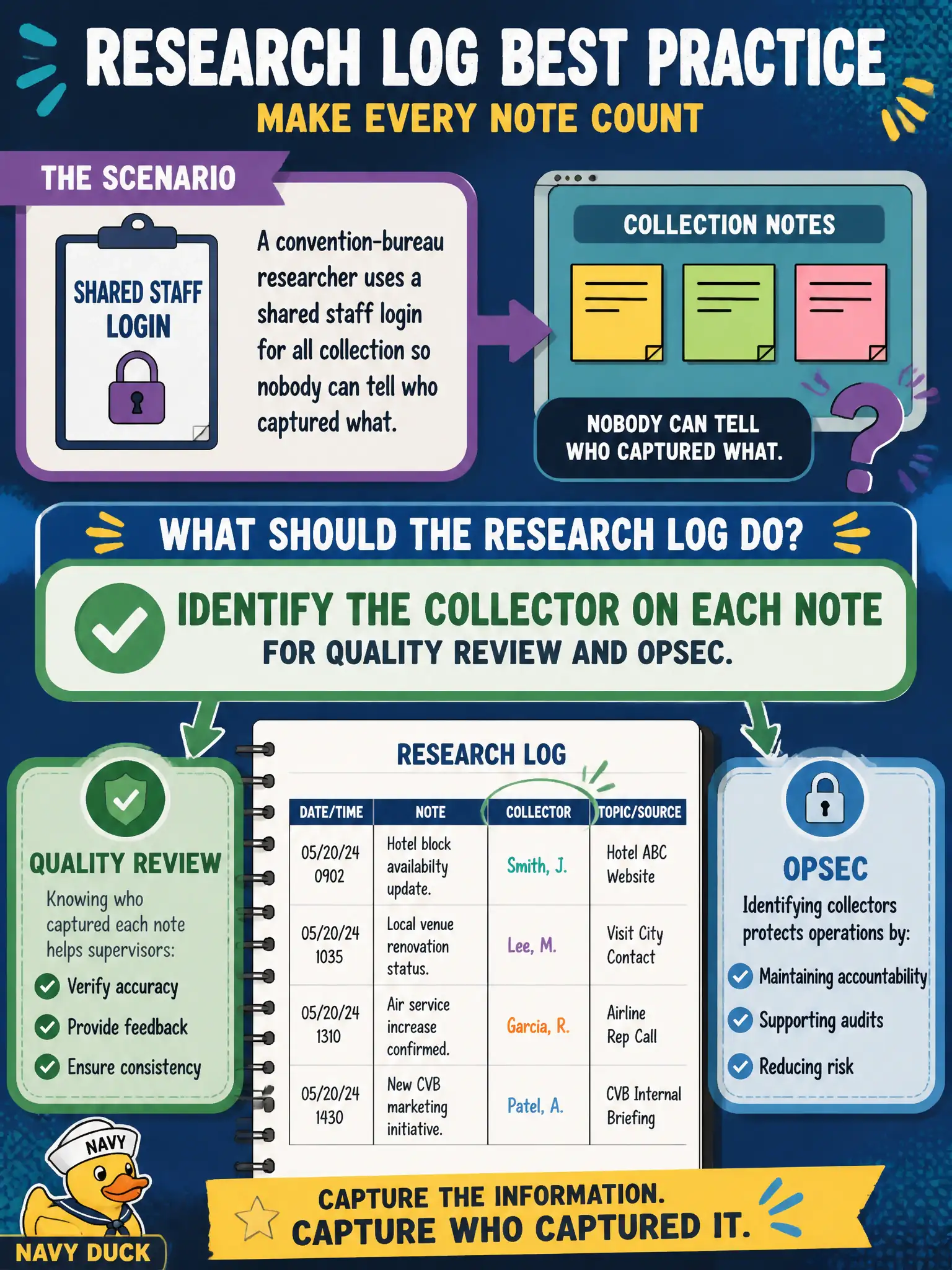
A convention-bureau researcher uses a shared staff login for all collection so nobody can tell who captured what. What should the research log do?
Select an answer to reveal the explanation.
Short Explanation
A shared kitchen key cannot tell you who left the stove on. Shared logins hide who captured a page and who mixed identities. Put a name on each note so review and OPSEC have someone to follow.
Full Explanation
The research log should identify the collector on each note so quality review and OPSEC accountability remain possible. A shared staff login for all convention-bureau collection that hides who captured what prevents coaching, error tracing, and detection of risky browsing choices. Staying anonymous so no individual is associated with a source is the opposite of professional control. Continuing only the shared login and skipping collector names preserves the defect. Attributing every capture to the bureau as if it were a single person creates a fiction that collapses under review. Exam caveat: team accounts may exist for publishing, but collection notes still need a human collector field even when a shared tool is used. Operational check: require collector name or unique analyst ID, date-time, and locator on every note line before the log is accepted as complete. Keep the civic purpose, method limits, and exhibit labels aligned so reviewers can see what was public-source work versus other authorities. Document residual uncertainty explicitly rather than implying completeness. Prefer reversible public methods and preserve exhibits that a second analyst can reopen without guessing. When sources conflict, record both locators and state the confidence level in plain language.