
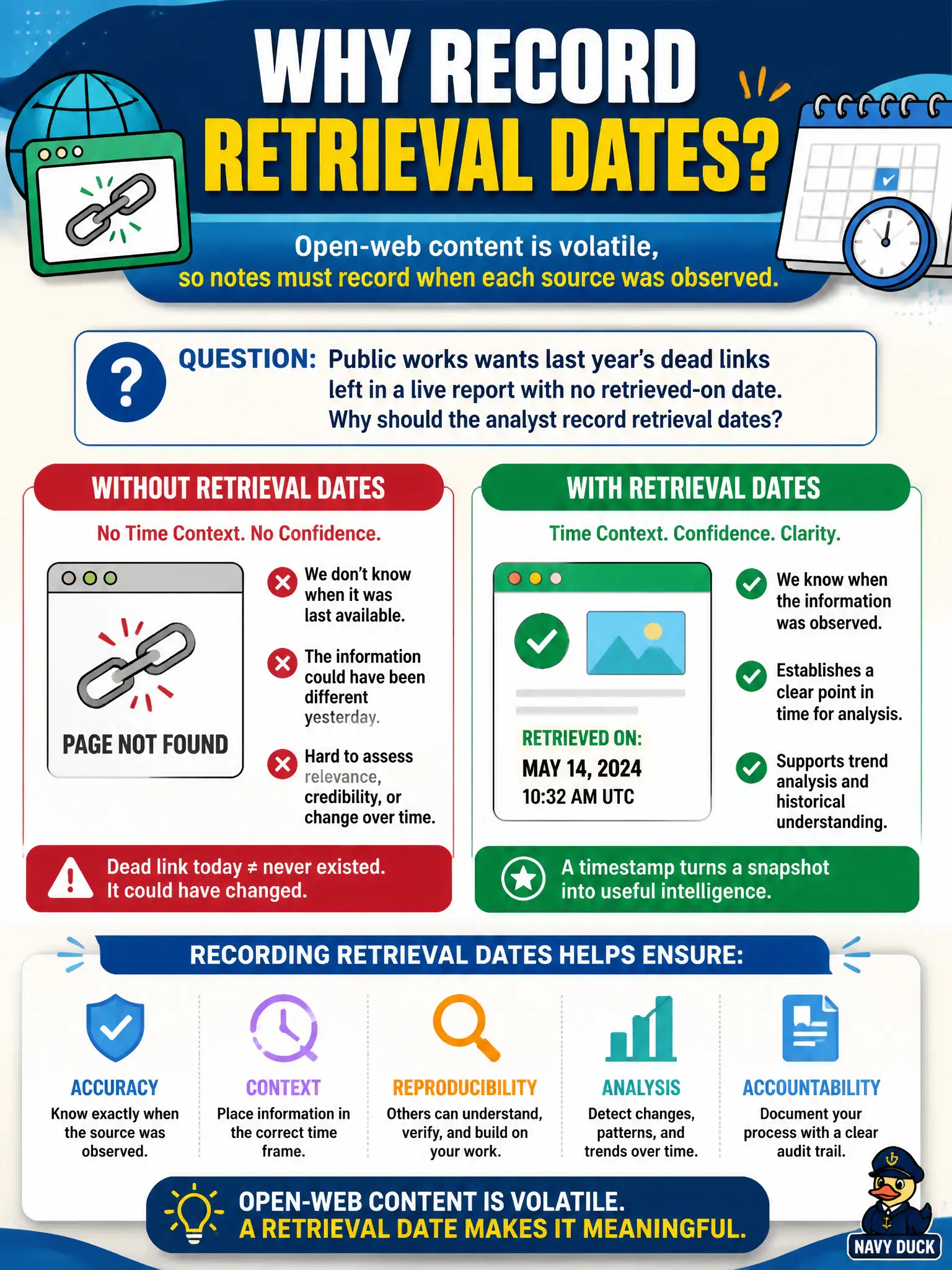
Public works wants last year's dead links left in a live report with no retrieved-on date. Why should the analyst record retrieval dates?
Select an answer to reveal the explanation.
Short Explanation
A chalkboard special changes overnight; the web does too. A link that works in March can be gone in April. The retrieved-on date is how the report proves what the page said when it was actually seen.
Full Explanation
Open-web content is volatile: pages move, edit, or disappear, so notes must record when each source was observed. Leaving last year's dead links in a live public-works report with no retrieved-on date denies reviewers the observation window that makes the citation meaningful. Treating retrieval dates as optional academic decoration understates their operational role in civic reporting. Claiming dead links prove the original page never existed confuses link rot with nonexistence. Omitting dates so the report looks timeless undermines credibility when URLs fail. Exam caveat: archived copies and screenshots complement dates; they do not replace recording when the live observation occurred. Operational check: every live-web citation in the report should show a retrieved-on date, and volatile pages should have a preserved exhibit captured near that date. Keep the civic purpose, method limits, and exhibit labels aligned so reviewers can see what was public-source work versus other authorities. Document residual uncertainty explicitly rather than implying completeness. Prefer reversible public methods and preserve exhibits that a second analyst can reopen without guessing. When sources conflict, record both locators and state the confidence level in plain language.